 Why Pluginera Exists
It Started With a Trip to the Mall
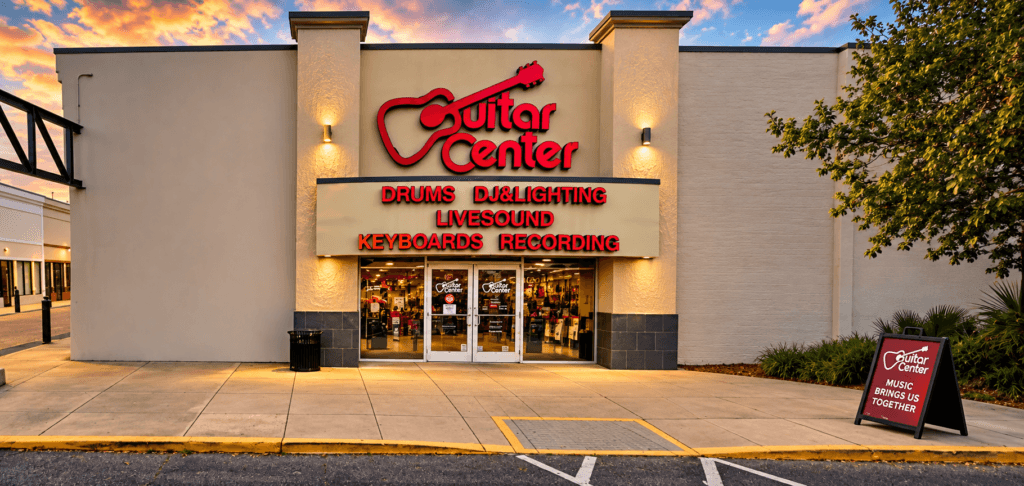
About a week before I started making beats in September 2005, I didn’t even know Guitar Center existed.
Seriously.
I was heading to Tallahassee Mall with my friend Corey when I noticed a store called Guitar Center.
I remember looking at the sign and thinking something like, “Guitar Center? What’s this?”
Based on the name, I assumed they sold guitars.
That was good enough for me.
I’ve always loved music, so even though I wasn’t a guitar player, the idea of walking around and looking at instruments sounded interesting. We went inside.
I had no idea that seemingly insignificant decision would help change the direction of my life.
Today, I look back at moments like that and see God’s hand in them. Sometimes the things that seem like beautiful accidents in the moment turn out to be important parts of a much bigger story.
That trip to Guitar Center was one of those moments for me.
“What Do I Need to Make Beats?”
You have to remember that this was 2005.
Google existed, of course, but we weren’t yet living in today’s world where the first instinct when you’re interested in something is to pull out your phone, search Google, watch 15 YouTube videos, read Reddit threads and become a semi-expert before buying anything.
YouTube itself was just getting started around that time.
I certainly didn’t have an endless library of producer tutorials teaching me exactly what equipment I needed.
What I had was curiosity.
And now I knew there was this incredible store filled with music equipment.
So about a week after discovering Guitar Center, I went back.
At the time, I was in college, working full-time and newly married. My wife and I had about $10,000 available from a combination of wedding gifts and school money.
And I walked into Guitar Center with virtually zero knowledge about music production.
That’s where I met a salesman named Bill.
I asked him a very simple question:
“What do I need to make beats?”
And Bill got me ALL the way together. 😂
I walked out of Guitar Center with a Roland Fantom X8, an iMac G5, Pro Tools with the newly released Mbox 2, M-Audio studio monitors, Beyerdynamic DT 770 headphones, Reason, and even a DJ mixer and turntable.
Remember:
I had never made a beat before.
I basically went from zero to having a complete production studio in one afternoon.
Bill and I would eventually become great friends, too.
Hopefully it wasn’t just because of the commission he made that day. 😂
I Was Fortunate Enough to Start With Great Equipment
There’s an important distinction I want to make about my story.
I didn’t become passionate about software production because I couldn’t afford hardware.
Quite the opposite.
I was incredibly fortunate to start with equipment that many aspiring producers would have dreamed of owning.
The Fantom X8 was an incredible workstation.
I had a Mac.
I had Pro Tools.
I had an audio interface.
I had monitors.
I had great headphones.
I had more than enough equipment to make music.
There was only one small problem.
I still didn’t know how to make music.
And that’s when I started learning one of the most important lessons of my entire production journey:
Having expensive equipment and knowing what to do with it are two completely different things.
Then I Opened Reason
Of everything I purchased that day, there was one piece of software I kept coming back to.
Reason.
Something about it clicked with me.
The virtual rack.
The instruments.
The effects.
The drum machines.
The routing.
The cables.
The experimentation.
The ability to open this program on my computer and feel like I had an entire studio sitting in front of me fascinated me.
I could load an instrument, create something, route it somewhere unexpected, add an effect, manipulate it and keep experimenting.
There was always another possibility.
And I fell in love with it.
Meanwhile, sitting in front of my computer was this beautiful Roland Fantom X8 workstation that I’d spent thousands of dollars on.
And you know what I frequently used it for?
Practicing piano and controlling Reason.
Yes.
I essentially turned a flagship Roland workstation into one of the world’s most expensive MIDI controllers. 😂
That’s When the Idea Took Hold
The more I used Reason, the more I began thinking:
Wait a minute.
I can do all of this inside the computer.
That realization changed the way I thought about making music.
It wasn’t that I suddenly disliked hardware.
I didn’t.
In fact, I still love hardware today.
I love MPCs. I love workstations. I love synthesizers.
And to this day, one of my favorite things to do is walk into Guitar Center, hang around, play the keyboards and just take everything in.
There’s something magical about a music store to me.
But now I can sit in front of an expensive workstation, appreciate everything it can do, and still know something that the completely clueless version of me didn’t understand in September 2005:
My beloved Reason is just as capable of helping me create something incredible.
And depending on what I’m trying to accomplish creatively, sometimes I prefer it.
More Gear Doesn’t Automatically Mean Better Music
That’s one of the biggest lessons those early years taught me.
Another synthesizer won’t automatically give you better melodies.
Another compressor won’t teach you compression.
Another drum machine won’t automatically make your drums knock.
And owning a $4,000 workstation doesn’t automatically make you a better producer than someone sitting in their bedroom with a laptop.
Tools absolutely matter.
I love tools.
This is Pluginera, after all. We can talk about plugins all day. 😂
But knowledge matters more.
Creativity matters more.
Taste matters more.
Practice matters more.
Learning your tools matters more.
And perhaps most importantly, learning how to turn an idea in your head into something another person can feel matters more.
That’s music production.
Why I Believe So Strongly in Software Production
My love for software production isn’t theoretical.
I’ve lived this for more than 20 years.
I’ve owned the hardware.
I’ve used different DAWs.
I’ve watched music-production technology evolve dramatically.
And through all of it, I’ve remained fascinated by the idea that an enormous creative universe can exist inside a computer.
Think about what that means for someone starting today.
A young producer doesn’t necessarily need $10,000.
They don’t need a flagship workstation.
They don’t need a room filled with synthesizers.
They don’t need racks of outboard equipment.
They don’t need every plugin they see their favorite producer using.
Someone might be reading this right now with an inexpensive laptop, FL Studio, a small MIDI controller and a pair of headphones.
They may be watching successful producers surrounded by expensive equipment and thinking:
“I’ll be able to make serious music when I can afford all of that.”
I want Pluginera to be one of the places that tells them:
You don’t have to wait.
Software Changed the Price of Admission
That’s one of the things I find beautiful about modern music production.
A computer can be your recording studio.
A DAW can be your sequencer, mixer, recorder and creative workspace.
A virtual instrument can give you access to sounds that once required expensive hardware.
Plugins can put synthesizers, compressors, reverbs, delays, samplers, drum machines and entire mixing environments inside a laptop.
And there are incredible free and affordable tools available today.
Does that mean expensive software is bad?
Of course not.
Does it mean hardware doesn’t matter?
Absolutely not.
It means there are more doors into music creation than ever before.
And I want Pluginera to help people find the one that works for them.
That’s Why Pluginera Exists
Pluginera started as a place for me to write about music-production software.
But the more I’ve worked on it, the clearer its purpose has become.
I don’t want Pluginera to simply tell you that a plugin has four oscillators, 200 presets, oversampling and a resizable interface.
You can read the specification sheet for that.
I want to help answer questions like:
Is this plugin actually useful?
Who is it for?
How do you use it?
Can I make Hip Hop with it?
Can I make R&B with it?
How can I use it to make my music sound better?
Is the expensive option actually worth the money?
Is there something more affordable that gets me where I need to go?
And sometimes the answer might be:
You don’t need another plugin at all.
Use what you already have.
Because I’d rather help someone make better music than convince them they need to buy something.
I believe if Pluginera consistently does the first one, everything else will take care of itself.
The Software the Pros Use—and the Software You Should Know About
There’s another part of Pluginera that’s important to me.
I intentionally spend a lot of time covering software from companies like Roland, Korg, IK Multimedia and other developers whose instruments and sounds have genuine relevance to the music producers I know and the music I love.
These aren’t random products I’ve selected because they happen to have an affiliate program.
They’re the kinds of tools and sounds that producers actually gravitate toward.
But I also want Pluginera to help producers discover companies and plugins they might otherwise overlook.
Sometimes the established tool is exactly what you need.
Sometimes a smaller developer creates something brilliant that deserves attention.
We’re going to explore both.
The question will always be:
Can this help us make better music?
And Yes, I’m Still Using Reason
After more than 20 years, Reason remains incredibly special to me.
I’ve used plenty of other software.
I’ve owned plenty of hardware.
I’ve explored countless plugins.
And yet I can still open Reason today and discover something new.
That’s remarkable.
Sometimes I genuinely feel like after more than two decades of using it, I still haven’t scratched the surface of what it’s capable of.
Its creative possibilities feel almost endless to me.
Reason isn’t simply a DAW I’ve used for a long time.
It has been one of the primary instruments through which I’ve learned to express myself musically.
And I’m still learning it.
I’m still experimenting.
I’m still making beats.
I’m still trying to get better.
More than 20 years later, I’m still excited about what might happen when I open that rack.
That’s special.
Looking Back at That $10,000 Afternoon
Sometimes I think about the version of myself who walked into Guitar Center that afternoon in September 2005.
College student.
Working full-time.
Newly married.
Zero beats made.
About $10,000 available.
And absolutely no idea what I was doing.
😂
Part of me wishes I could walk into the store behind him.
I’d watch him find Bill.
I’d listen as he asked:
“What do I need to make beats?”
And knowing everything I know now, I’d probably have a very different answer.
But here’s the thing:
I wouldn’t change what happened.
That journey taught me something.
It introduced me to Reason.
It started a lifelong fascination with music-production software.
It gave me experiences that eventually shaped the philosophy behind the website you’re reading right now.
And it all happened because one week earlier, while heading to the mall with my buddy Corey, I noticed a store I’d never heard of and thought:
“Guitar Center? What’s that?”
Maybe it was coincidence.
I don’t believe it was.
Looking back now, I see moments like that as part of God’s plan for my life—small decisions, unexpected encounters and beautiful accidents whose importance you don’t always understand while they’re happening.
I’m certainly glad I walked through that door.
Because more than 20 years later, I’m still making music.
And now I get to help somebody else walk through theirs.
So, What Do You Actually Need to Make Beats?
If you’re here because you’re thinking about making music but you’re worried you don’t have enough…
Maybe you don’t own expensive monitors.
Maybe you don’t have a Fantom.
Maybe you don’t have an MPC.
Maybe you’ve only got a laptop.
Maybe you’ve got FL Studio, Ableton, Logic, Reason or another DAW.
Maybe your MIDI controller was $100.
Maybe you’re making beats in headphones.
And maybe you’re wondering:
“Is this enough to really start?”
Twenty-one years ago, I walked into Guitar Center and spent thousands of dollars trying to answer that question.
So let me save you the trip.
Nope. You’re ready. Let’s make something.