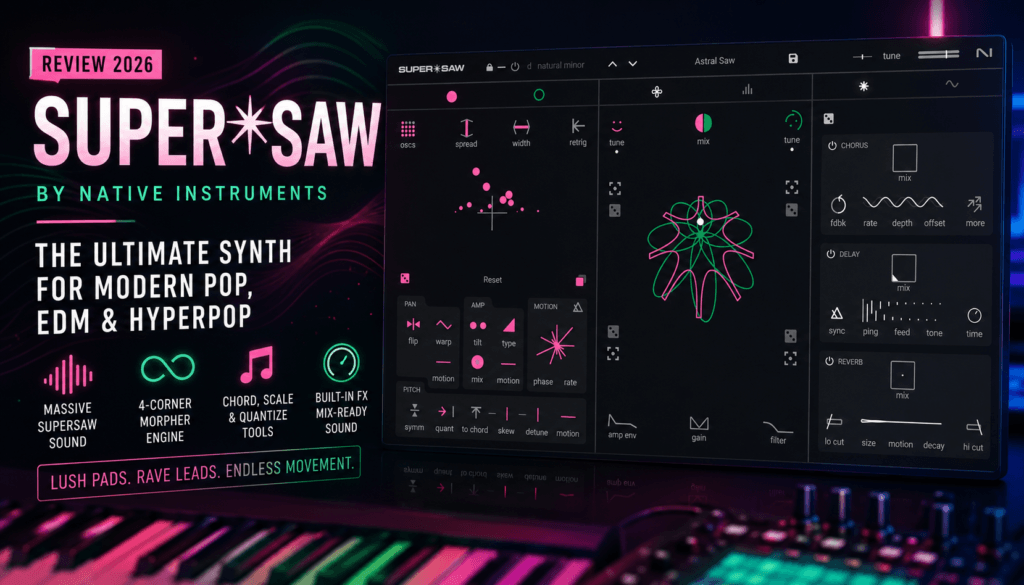
 Native Instruments Super*Saw Review (2026): A Fresh Take on the Classic Supersaw
Introduction
Supersaw sounds have been a cornerstone of electronic music for decades, powering everything from soaring trance anthems to modern pop hooks and cinematic soundscapes. While countless synthesizers can create supersaw-style patches, Native Instruments Super*Saw takes a different approach. Rather than treating supersaws as just another preset, this instrument is built entirely around stacked sawtooth synthesis, giving producers an expressive and immediate way to create lush, evolving sounds.
Co-created with acclaimed producer A. G. Cook, whose credits include Charli XCX, Caroline Polachek, Jónsi, and Oklou, Super*Saw blends simplicity with creative depth. Instead of spending time layering multiple oscillators across different synths, you can generate massive harmonics, animated textures, and expressive transitions from a single interface.
In this review, we’ll explore its features, workflow, sound quality, and whether it’s worth adding to your production toolkit. Shout out to Roland for giving us the first Supersaw Synths!
Key Features
The heart of Super*Saw is its dual 8-voice stacked saw oscillator engine. This architecture creates the wide stereo image and dense harmonic content that producers typically build through multiple layered synth instances.
One of the plugin’s standout innovations is the 4-corner Morpher. Instead of manually automating dozens of parameters, the Morpher lets you move between four distinct sound states using a simple X/Y controller. This makes evolving pads, dramatic transitions, and expressive lead performances incredibly intuitive.
Additional highlights include:
- Dual 8-voice supersaw oscillators
- Four-corner X/Y Morpher
- Chord, scale, and quantize modes
- Per-voice glide and stereo offset controls
- Chorus, delay, and reverb
- Integrated low-pass, band-pass, and high-pass filters
- Mono and polyphonic operation
- Native support for VST3, AU, and AAX
For producers who value speed, these features eliminate much of the setup normally required to create rich supersaw textures.
Sound Quality & Workflow
Where Super*Saw truly shines is its workflow.
Traditional supersaw programming often involves detuning oscillators, stacking voices, adjusting stereo spread, adding effects, and carefully balancing multiple layers. Super*Saw condenses that process into a streamlined instrument designed for immediate results.
The Morpher encourages experimentation in a way that’s difficult to achieve with conventional synthesizers. Moving between sound states feels musical rather than technical, allowing ideas to evolve naturally while performing or recording automation.
Sonically, the instrument delivers exactly what you’d expect from its name. The oscillators sound wide, polished, and harmonically rich without becoming harsh. Pads feel immersive, lead sounds cut through a mix, and chord stacks maintain impressive clarity even with dense arrangements.
While its roots are clearly in modern pop and hyperpop, Super*Saw is equally capable of producing:
- Emotional R&B pads
- Future bass chords
- EDM leads
- Trance melodies
- Ambient textures
- Cinematic soundscapes
- Trap intros and atmospheric layers
The built-in effects also deserve praise. The chorus adds instant width, the delay creates movement without overwhelming the source, and the reverb provides polished ambience that often requires little additional processing.
Pros & Cons
Pros
- Excellent supersaw sound quality
- Intuitive Morpher encourages creativity
- Fast workflow with minimal setup
- Built-in effects sound polished
- Beginner-friendly while remaining expressive
- Inspiring for songwriting and sound design
Cons
- Focused primarily on supersaw-style synthesis
- Less flexible than fully modular synthesizers
- Producers who already own several supersaw synths may find some overlap
Who Is It For?
Super*Saw is best suited for producers who want inspiring sounds without spending excessive time programming patches.
It fits particularly well in genres like:
- Pop
- Hyperpop
- EDM
- Future Bass
- Trance
- R&B
- Cinematic production
Beat makers can also benefit from its lush intros, atmospheric transitions, layered chords, and wide background textures that help tracks sound larger and more professional.
If your productions rely heavily on evolving harmonies and expressive synth layers, Super*Saw offers a streamlined workflow that keeps creativity at the forefront.
Specifications
| Feature | Details |
|---|---|
| Developer | Native Instruments |
| Synth Engine | Dual 8-Voice Supersaw Oscillators |
| Morphing | 4-Corner X/Y Morpher |
| Effects | Chorus, Delay, Reverb |
| Filters | LPF, BPF, HPF |
| Modes | Mono & Poly |
| Formats | VST3, AU, AAX |
| Platforms | Windows & macOS |
| Apple Silicon | Supported |
Final Verdict
Native Instruments Super*Saw isn’t trying to replace every synthesizer in your collection—and that’s precisely its strength. Instead of offering endless menus and deep programming options, it focuses on one iconic sound and executes it exceptionally well.
The combination of dense supersaw oscillators, expressive morphing, and built-in musical tools makes it a joy to use whether you’re sketching ideas or polishing a finished production. Beginners will appreciate its accessibility, while experienced producers will enjoy how quickly it delivers polished, mix-ready sounds.
If you’re producing modern pop, hyperpop, EDM, cinematic music, or even melodic hip-hop and R&B, Super*Saw is an inspiring addition to your plugin library. It encourages experimentation without slowing down your workflow, making it easy to move from an idea to a finished sound in minutes.
Rating: 4.7/5 ⭐
Bottom Line: If you want a dedicated supersaw instrument that prioritizes creativity, speed, and musical expression over endless complexity, Native Instruments Super*Saw is well worth considering for your next production.