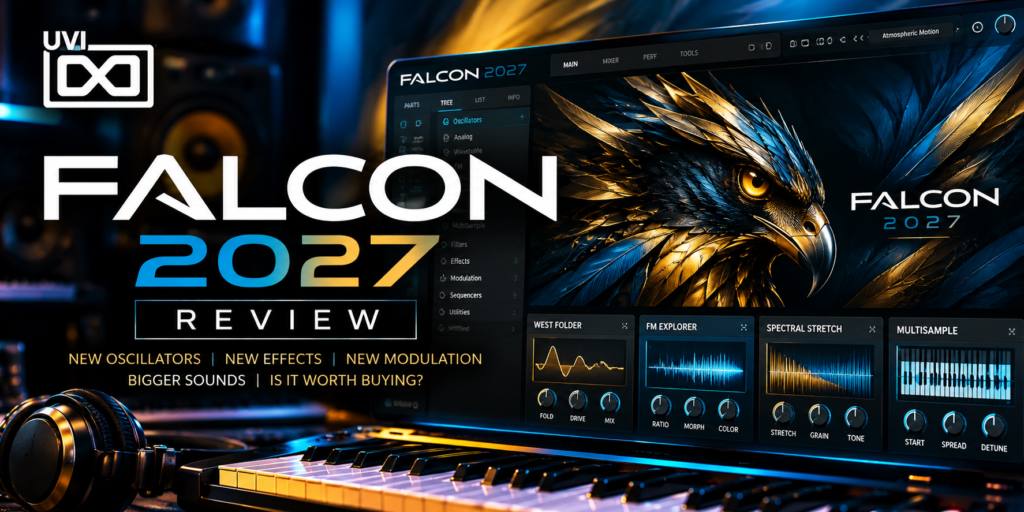
 UVI Falcon has long been recognized as one of the most powerful software instruments available to music producers and sound designers. With the release of Falcon 2027, UVI continues expanding what its flagship hybrid synthesizer can accomplish.
But with so many excellent virtual instruments already available, is UVI Falcon 2027 worth buying?
The latest version introduces four new oscillators, ten additional effects, a new modulation source, and improvements designed to make its extensive sound design capabilities easier to navigate.
For producers working in Hip-Hop, R&B, Trap Soul, cinematic music, or electronic genres, these additions create interesting possibilities.
In this UVI Falcon 2027 review, we’ll examine the new features, explore its strengths and limitations, and help you determine whether it deserves a place in your music production setup.
Editor’s note: This is a feature-based review and buying guide informed by published product specifications and release information, rather than an independent hands-on audio test.
What Is UVI Falcon 2027?
UVI Falcon 2027 is a hybrid software instrument that combines multiple synthesis techniques, sampling capabilities, modulation, and audio effects within a single environment.
Unlike synthesizers designed around one primary synthesis method, Falcon allows producers to combine different sound-generation techniques to create complex instruments.
For example, you could layer a wavetable synthesizer with a sampled piano, add granular textures, and modulate the results using envelopes and other modulation sources.
This flexibility makes Falcon suitable for both traditional music production and advanced sound design.
Its core capabilities include:
- Multiple synthesis and sampling engines
- Layered instrument construction
- Advanced modulation and sound shaping
- Extensive effects processing
- MIDI scripting and event processing
- A large library of factory sounds
- Expandable sound libraries
Falcon is more than a conventional preset-based synthesizer. It is an environment for building, manipulating, and performing sounds.
However, that flexibility also introduces a learning curve.
What’s New in UVI Falcon 2027?
Falcon 2027 introduces several major additions to its synthesis engine and overall workflow.
The headline improvements include four new oscillators, ten effects, a new Data Envelope modulator, additional factory presets, and interface enhancements.
Let’s examine the most important changes.
1. Four New Oscillators
One of the biggest improvements in Falcon 2027 is the addition of four new oscillators.
These expand the instrument’s existing synthesis and sampling capabilities.
West Folder
West Folder introduces West Coast-inspired synthesis techniques.
Rather than relying exclusively on traditional subtractive synthesis, this oscillator emphasizes waveform manipulation and harmonic complexity.
Its wavefolding capabilities can produce rich tones that range from subtle harmonic coloration to aggressive, evolving textures.
For Hip-Hop and R&B producers, this could be useful for creating distinctive synth basses, leads, and experimental melodic elements.
It also provides opportunities for sound designers who enjoy building patches from scratch.
FM Explorer
Frequency modulation synthesis is known for producing everything from metallic bells to expressive electric piano sounds and complex digital textures.
However, traditional FM programming can feel intimidating.
FM Explorer introduces a more approachable way to experiment with FM synthesis.
Its three-operator architecture and morphing capabilities allow producers to explore different harmonic relationships without constantly rebuilding complex routing configurations.
This is particularly interesting for producers who enjoy the classic digital sounds associated with late-1980s and 1990s R&B.
FM-style electric pianos, bells, and expressive plucked sounds can work beautifully in modern productions.
Spectral Stretch
Spectral Stretch is one of Falcon 2027’s most interesting additions for producers who enjoy manipulating audio.
It uses spectral processing to stretch and transform sampled material while offering control over playback characteristics.
This opens creative possibilities for turning ordinary recordings into evolving textures.
Imagine taking a short vocal phrase, stretching it into a sustained atmospheric layer, and placing it behind an R&B chord progression.
Or transforming a short piano sample into an evolving ambient texture.
For producers interested in experimental sampling and cinematic sound design, Spectral Stretch could become a particularly valuable tool.
MultiSample
MultiSample expands Falcon’s capabilities for working with multisampled instruments.
It supports mapping samples across different keyboard and velocity regions, allowing producers to construct more expressive sample-based instruments.
This is useful for building custom pianos, keyboards, percussion instruments, and other sampled sounds.
Producers who maintain extensive sample libraries may appreciate having more control over how those samples are organized and performed.
2. Ten New Effects
Falcon 2027 also introduces ten additional effects.
The new processors include:
- Lowpass Gate
- Wavefolder
- FET Compressor
- Feedforward Compressor
- Steiner Filter
- Passive EQ
- Analog BBD Delay
- Analog BBD Chorus
- Spectrogram Analyzer
- Loudness Meter
These additions provide both creative sound manipulation and practical audio-processing options.
Analog BBD Delay and Chorus
Bucket-brigade-style delay and chorus effects are associated with warm, characterful modulation.
For producers working in R&B, Synthwave, and Trap Soul, these effects may be particularly appealing.
A subtle chorus can add movement to electric piano sounds, pads, and synthesizer leads.
Meanwhile, a characterful delay can introduce rhythmic movement or create atmospheric repeats.
FET and Feedforward Compression
The addition of new compression options provides greater control over dynamics within Falcon’s sound design environment.
FET-style compression is commonly associated with fast, assertive dynamic control, although the specific character depends on the implementation.
These processors can be useful when shaping layered instruments, controlling transients, or creating more consistent dynamics.
Wavefolder and Steiner Filter
The Wavefolder and Steiner Filter provide additional tonal shaping possibilities.
Wavefolding introduces new harmonic content by reshaping a waveform.
The Steiner-style filter offers another option for sculpting frequency content and creating expressive movement.
Together, these effects give sound designers more ways to create distinctive patches without leaving Falcon.
3. The New Data Envelope Modulator
Another important addition is the Data Envelope.
This modulator allows characteristics extracted from audio to influence other parameters.
For example, information derived from a sample can become a modulation source.
This creates opportunities for more complex movement and interaction between sound sources.
Instead of relying entirely on conventional LFOs or manually programmed envelopes, producers can experiment with modulation that responds to characteristics of audio material.
For advanced sound designers, this adds another layer of creative control.
Beginners may not immediately need this feature, but it illustrates Falcon’s focus on flexible sound construction.
4. Improved Workflow and Interface
Powerful software isn’t necessarily productive software.
A synthesizer can offer hundreds of features, but those features become less useful when the interface makes them difficult to access.
Falcon 2027 addresses this with several workflow improvements.
These include:
- A new Module TreeView browser
- An updated oscillator picker with category filters
- Redesigned editing interfaces
- Improved visual editing controls
- Additional navigation refinements
These changes aim to make Falcon’s extensive architecture easier to manage.
For producers who frequently build layered instruments, improved navigation can reduce the time spent moving between different sections of a patch.
However, Falcon remains a sophisticated instrument.
Even with these improvements, beginners should expect to spend time learning its architecture.
5. New Factory Presets
Falcon 2027 introduces 140 new handcrafted presets, according to UVI’s release announcement.
These sounds showcase the new synthesis engines and processing capabilities.
Factory presets are particularly valuable for producers who prefer making music rather than programming every instrument from scratch.
A useful preset library can also serve as an educational resource.
By examining how sounds are constructed, producers can gradually learn synthesis techniques and apply them to their own patches.
This makes Falcon useful both as a playable instrument and as a platform for learning sound design.
Is UVI Falcon 2027 Good for Hip-Hop and R&B?
Falcon’s flexibility makes it an interesting option for Hip-Hop and R&B production.
Although it isn’t limited to any particular genre, several of its synthesis and sampling capabilities align well with modern production techniques.
Atmospheric Pads
Layered synthesizers and modulation can create evolving pads that add depth behind chord progressions.
These sounds can work particularly well in Trap Soul and atmospheric R&B.
Electric Pianos and Digital Keys
FM synthesis can produce expressive keyboard tones, including bells, digital electric pianos, and plucked sounds.
These textures can complement traditional piano and Rhodes-style sounds.
Synth Bass
Falcon’s synthesis engines offer numerous ways to construct bass sounds.
Producers can experiment with different waveforms, filters, modulation, and effects to create basses suited to their arrangements.
Vocal Textures
Spectral Stretch and Falcon’s sampling capabilities make it possible to explore unusual vocal-based textures.
For example, producers could transform short vocal samples into atmospheric layers or experimental melodic elements.
As always, make sure you have the appropriate rights to any samples you use.
Cinematic Elements
Falcon’s layering and modulation capabilities can also be useful for creating dramatic transitions, evolving soundscapes, and cinematic textures.
These sounds can add personality to intros, breakdowns, and other sections of a production.
UVI Falcon 2027 vs Serum
Serum is known for its wavetable-focused workflow and visual approach to synthesis.
Falcon takes a broader approach by combining numerous synthesis and sampling methods within a single environment.
| Feature | UVI Falcon 2027 | Serum 2 |
|---|---|---|
| Main focus | Hybrid synthesis and sampling | Streamlined, multi-engine synthesis |
| Deep sample mapping | Major strength | More limited |
| Wavetable synthesis | Yes | Yes |
| FM capabilities | Yes | Yes |
| Granular and spectral tools | Extensive | Multiple sample-based modes |
| Learning curve | Steeper | Generally more approachable |
| Best suited for | Deep sound design and custom instruments | Fast electronic sound creation and synthesis |
Neither instrument is automatically better.
Serum may be more appealing to producers who prioritize a focused synthesis workflow.
Falcon may be more attractive to producers who want to combine several synthesis methods and advanced sampling capabilities.
If you already own Serum, Falcon isn’t necessarily a replacement.
Instead, it may provide additional sound design options that complement your existing instruments.
UVI Falcon 2027 vs Omnisphere
Spectrasonics Omnisphere is another powerful software instrument frequently considered by producers seeking a versatile sound library.
Both instruments offer extensive sound design capabilities, but their workflows differ.
Omnisphere emphasizes a large curated sound library alongside its synthesis engine.
Falcon places considerable emphasis on flexible instrument construction, sampling, and detailed modulation.
Producers who want to browse sounds quickly may prefer Omnisphere’s preset-oriented experience.
Those who enjoy building custom instruments and experimenting with different synthesis techniques may find Falcon particularly appealing.
The better choice depends on how you prefer to create music.
Is UVI Falcon 2027 Beginner-Friendly?
Falcon can be used by beginners, but its advanced architecture requires patience.
If your primary goal is to browse presets and immediately start recording melodies, you may not need all its capabilities.
However, beginners interested in learning synthesis can gradually explore its features.
A sensible approach would be to:
- Begin with factory presets.
- Learn how Falcon organizes instruments and layers.
- Experiment with filters and effects.
- Explore one synthesis engine at a time.
- Practice creating simple sounds.
- Gradually introduce modulation and advanced sampling.
There’s no need to master every feature immediately.
In fact, attempting to learn everything at once may make Falcon feel unnecessarily complicated.
Start with the tools that support your music and expand your knowledge as needed.
UVI Falcon 2027 Pros and Cons
Pros
- Extensive synthesis and sampling capabilities
- Four additional oscillators
- Ten new effects
- Flexible modulation architecture
- Large and expandable sound library
- Useful tools for creating custom instruments
- Improved interface and navigation
- Free 2027 update for registered Falcon owners
Cons
- Steeper learning curve than many simpler synthesizers
- Complex interface may overwhelm beginners
- Extensive features can be unnecessary for preset-focused producers
- Deep sound design can require significant time
- Producers with large plugin collections may already have overlapping capabilities
How Much Does UVI Falcon 2027 Cost?
Falcon 2027 launched with a promotional price of $149, reduced from its regular $299 price.
The introductory offer listed at Plugin Boutique is scheduled to run through October 31, 2026.
Existing registered Falcon owners can receive the update without purchasing another license.
New Falcon licenses also include a $100 or €100 voucher toward eligible UVI soundware purchases.
Pricing and promotions can change, so check the retailer’s current listing before purchasing.
Check UVI Falcon 2027 at Plugin Boutique
Check the price for UVI Falcon at Pluginboutique here
Is UVI Falcon 2027 Worth Buying?
Falcon 2027 presents a compelling option for producers who want a versatile instrument capable of handling many different sound design tasks.
Its combination of synthesis engines, sampling tools, modulation, and effects provides considerable creative flexibility.
The new oscillators and effects further expand those capabilities.
However, whether Falcon is worth purchasing depends largely on your workflow.
Falcon 2027 May Be Worth Buying If:
- You enjoy creating original sounds.
- You want advanced sampling and synthesis in one instrument.
- You produce across several musical genres.
- You want to build custom layered instruments.
- You are willing to invest time learning a sophisticated synthesizer.
You May Want to Skip It If:
- You primarily use factory presets.
- You already have instruments that cover your needs.
- You prefer simpler interfaces.
- You rarely experiment with synthesis.
- You are trying to reduce unnecessary plugin purchases.
An extensive feature list doesn’t automatically make an instrument essential.
The best plugins are the ones that help you create better music and finish more projects.
Final Verdict: UVI Falcon 2027
UVI Falcon 2027 continues the development of an already ambitious hybrid software instrument.
The addition of West Folder, FM Explorer, Spectral Stretch, and MultiSample expands its sound-generation possibilities.
Meanwhile, ten new effects, the Data Envelope, and interface refinements give users additional tools for shaping and organizing their sounds.
For serious sound designers, Falcon offers an unusually broad creative environment.
For Hip-Hop, R&B, and Trap Soul producers, its greatest appeal may be the ability to build unique pads, keys, basses, and atmospheric textures.
But not every producer needs this level of complexity.
If your existing instruments already help you create the sounds you want, Falcon may be an optional addition rather than a necessity.
Our verdict: UVI Falcon 2027 is worth considering for producers who want deep synthesis and sampling capabilities, especially at its introductory price. Preset-focused beginners should evaluate whether they’ll use its advanced features before investing.
Ultimately, the value of Falcon isn’t simply how many oscillators or effects it includes.
It’s what you can create with them.
Explore UVI Falcon 2027 at Plugin Boutique
Buy UVI Falcon ay Pluginboutique
Affiliate Disclosure: This article may contain affiliate links. If you purchase through these links, Pluginera may earn a commission at no additional cost to you. Our editorial recommendations are based on product capabilities, intended use, and overall value.
Frequently Asked Questions
Is UVI Falcon 2027 a free update?
Yes. Registered Falcon owners can download the 2027 update without purchasing another license.
Can you use Falcon 2027 in Reason?
Falcon supports VST3, making it suitable for use in compatible versions of Reason that support VST3 instruments. Confirm your Reason version and system compatibility before purchasing.
Is Falcon 2027 good for beginners?
Beginners can use Falcon’s presets immediately, but learning its advanced sound design features takes time.
Does Falcon 2027 include presets?
Yes. Falcon includes an extensive factory sound library, and the 2027 release adds 140 new presets.
Is Falcon better than Serum?
Falcon offers broader sampling and instrument-building capabilities, while Serum provides a more focused synthesis workflow. The better option depends on your production needs.
Is Falcon 2027 worth it for R&B producers?
It can be, particularly for producers who want custom keys, evolving pads, digital textures, and experimental sampled sounds. However, it isn’t essential if your current instruments already meet your needs.