 Baby Audio Crystalline Review: Is This Modern Reverb Worth It?
Reverb is one of those effects that can completely transform a mix—but it can also destroy one surprisingly quickly.
Too much reverb can push vocals into the background, muddy melodies, soften drums, and make an otherwise clean production sound washed out. The challenge is creating depth, width, and atmosphere without sacrificing clarity.
That’s exactly the problem Baby Audio Crystalline is designed to tackle.
Rather than attempting to perfectly recreate a real room, hall, or physical space, Crystalline takes the algorithmic approach. It creates artificial spaces that can be shaped far beyond what would be possible in the real world.
The result is a modern reverb capable of everything from subtle vocal ambience to huge atmospheric pads, shimmering R&B textures, gated drums, and experimental effects.
But with so many excellent reverb plugins already available, does Crystalline actually deserve a place in your collection?
In this Baby Audio Crystalline review, we’ll look at its sound, features, workflow, presets, strengths, weaknesses, and the producers who will get the most out of it.
What Is Baby Audio Crystalline?
Crystalline is a modern algorithmic reverb plugin from Baby Audio.
Algorithmic reverbs don’t necessarily attempt to reproduce the acoustics of an actual physical location. Instead, they generate reflections mathematically, allowing developers to create spaces that wouldn’t necessarily exist in the real world.
Crystalline builds on the concept behind classic digital algorithmic reverbs while taking advantage of modern processing power.
That distinction matters.
If you’re looking for an extremely realistic recreation of a recording studio, concert hall, chamber, or scoring stage, convolution reverb may be a better choice.
Crystalline is about something different:
Creating the ideal space for the music.
That approach makes it particularly interesting for modern Hip Hop, R&B, Trap, Pop, electronic music, and other genres where reverb is frequently used as a creative production tool rather than simply a simulation of an acoustic environment.
Baby Audio Crystalline: Quick Verdict
Rating: 9.2/10
Its biggest strength is the combination of excellent sound quality and creative control.
You can quickly create clean vocal spaces, enormous atmospheric reverbs, wide synth textures, shimmering pads, gated snares, reverse effects, and unusual spaces without needing a complicated routing setup.
The BPM synchronization is particularly useful because Crystalline allows the beginning and decay of the reverb to interact rhythmically with your production.
The built-in Ducker, Shimmer, Width, Smoothing, Freeze, Reverse, filtering, modulation, and transient-shaping tools also reduce the number of additional plugins you’ll need after your reverb.
Best For
- Hip Hop producers
- R&B producers
- Trap and Trap Soul producers
- Pop producers
- Electronic producers
- Vocal mixing
- Synths and pads
- Keys and electric pianos
- Melodic samples
- Snare and percussion effects
- Ambient sound design
Pluginera Rating: 9.2/10
Bottom line: If you want a clean, lush, highly customizable reverb designed around modern production rather than strict realism, Crystalline is one of Baby Audio’s strongest effects.
Crystalline’s Interface and Workflow
One thing Baby Audio generally does well is make plugins visually approachable.
Crystalline continues that philosophy.
Despite having a surprisingly deep feature set, the interface doesn’t feel like you’re operating a piece of laboratory equipment.
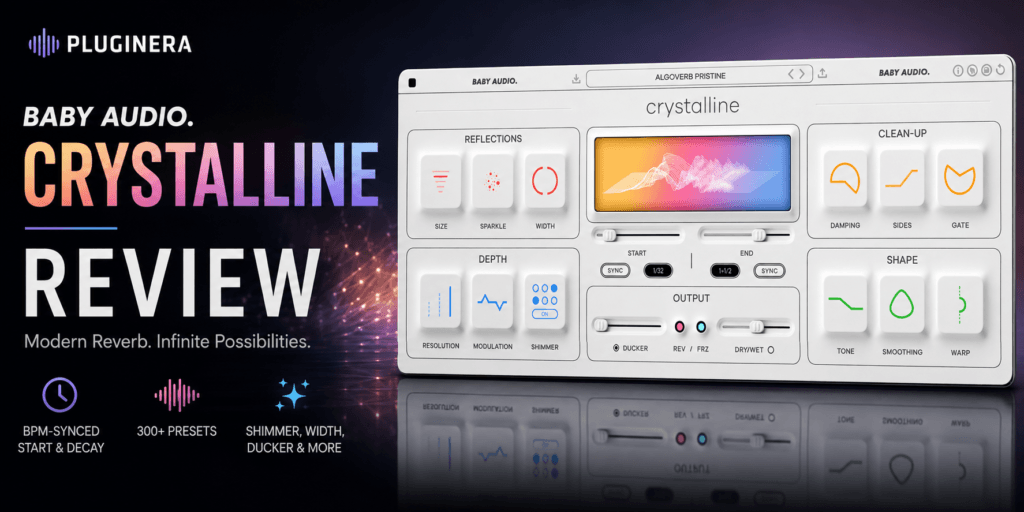
The controls are separated into logical areas covering things like reflections, depth, cleanup, shaping, and output.
That organization encourages you to think about reverb in terms of questions such as:
How large should the space feel?
How long should it last?
How bright should it be?
How wide should it be?
How should it interact with the dry signal?
That’s much more intuitive for many producers than navigating dozens of technical parameters.
The interface is also fully resizable, and you can switch between light and dark appearances.
BPM-Synced Reverb Is One of Crystalline’s Best Features
This is where Crystalline starts separating itself from many conventional reverbs.
Crystalline lets you synchronize the reverb’s timing to your DAW.
Instead of always thinking about decay in seconds or milliseconds, you can make the reverb interact with the tempo of your track.
You can synchronize both its start and decay behavior.
This can be extremely useful for beat-driven music.
Imagine you’re working on a slow R&B record.
Instead of endlessly adjusting decay time until the reverb feels like it fits the groove, you can synchronize the effect to musical timing.
That can help prevent reverb tails from overlapping important musical moments.
And if you prefer traditional control, Crystalline can still operate using milliseconds.
This gives you the best of both workflows.
Size and Length Can Be Controlled Independently
Another clever feature is the separation between the perceived Size of the space and the Length of the reverb.
These parameters aren’t forced to behave like a real acoustic environment.
You could create:
- A huge space with a short tail
- A small space with a surprisingly long tail
- Tight ambience around vocals
- Massive but controlled synth spaces
This is one of those features that sounds relatively minor until you start designing reverbs around a dense production.
You’re no longer asking:
“What room sounds right?”
You’re designing exactly how the space should behave.
Sparkle Adds Air and Presence
Sparkle emphasizes high-frequency information within the reverb algorithm.
This can give reflections a brighter, more polished character.
It can work particularly well on:
Vocals
A little Sparkle can create that glossy, expensive ambience frequently heard around modern Pop and R&B vocals.
Snares
Bright reflections can help snares feel larger without simply turning the entire reverb louder.
Keys
Electric pianos, bells, plucks, and synth keys can gain an airy atmosphere around their upper frequencies.
You’ll want to use it carefully on already-bright material, but it’s an excellent tonal tool.
Width Gives You Serious Stereo Control
Reverb is one of the easiest ways to create stereo depth, and Crystalline gives you direct control over the width of its reflections.
You can move from:
Mono → Stereo → Wide → Extra Wide
That gives you a lot of freedom when positioning sounds.
For example, you might keep a lead vocal relatively centered while allowing its reverb to spread far into the stereo field.
Likewise, a pad can be surrounded by an extremely wide reverb while the core instrument remains more focused.
For modern R&B and Trap Soul production, this is incredibly useful.
Wide atmospheric textures can create the sense of a massive production without requiring dozens of additional layers.
Resolution: Choose Between Efficiency and Maximum Quality
Crystalline allows you to change the complexity of its reverb algorithm.
At higher settings, the algorithm becomes smoother and cleaner.
At lower settings, CPU usage is reduced.
There’s also an Eco Mode, which places the plugin into a more CPU-friendly configuration.
That’s useful because reverb is often something you’ll use multiple times throughout a session.
You may have separate reverbs for:
- Lead vocals
- Background vocals
- Snares
- Keys
- Synths
- Ad-libs
- FX
Being able to reduce processing demand while producing and then increase quality later can make a significant difference in larger sessions.
Modulation Makes Reverb Feel More Alive
Crystalline includes modulation inside its reverb algorithm.
This creates subtle pitch movement within the reflections.
Instead of a completely static reverb tail, the ambience develops a richer, more animated quality.
This can work especially well on:
- Synth pads
- Electric piano
- Guitar
- Background vocals
- Lead vocals
- Atmospheric samples
For R&B production in particular, modulation can turn a relatively basic chord progression into something much more immersive.
Shimmer Creates Huge Atmospheric Textures
The result can produce a glowing, almost halo-like effect around a sound.
Used aggressively, it becomes an obvious creative effect.
Used subtly, it can add beautiful air around:
- Vocal ad-libs
- Background vocals
- Pads
- Bells
- Synth leads
- Electric piano
- Ambient samples
This is one of the areas where Crystalline moves beyond being a basic mixing reverb and becomes a legitimate sound-design tool.
Damping Helps Keep Your Mix Clean
Reverb can create mud very quickly.
Crystalline addresses this with built-in filtering.
The Damping section allows you to reduce unwanted low- and high-frequency information from the reflections.
This means you can remove unnecessary bass from the reverb without inserting another EQ after Crystalline.
For example, on a vocal you might remove much of the low-frequency information from the reverb while leaving the vocal itself untouched.
The vocal stays full.
The ambience stays clean.
That’s exactly what you want.
The Sides Control Is Excellent for Modern Mixes
This is one of my favorite concepts inside Crystalline.
The Sides control can remove stereo information from the low-frequency portion of the reverb while maintaining the mono information.
Why does that matter?
Because huge stereo reverbs can make the bottom end of a mix feel unstable and muddy.
That’s especially problematic in Hip Hop and R&B where the center of the mix may already contain:
- Kick
- 808
- Bass
- Lead vocal
You generally don’t need huge amounts of low-frequency stereo reverb competing with them.
Crystalline lets you create enormous width while maintaining better low-end discipline.
Built-In Ducker: A Huge Win for Vocals
The Ducker may be one of Crystalline’s most practically useful features.
Normally, when mixing vocals with a large reverb, you may want the reverb to become quieter while the singer is actually performing.
Then, when the phrase ends, the reverb can bloom into the available space.
That’s commonly accomplished through sidechain compression.
Crystalline can handle the concept internally.
The dry signal comes through clearly while the reverb moves out of its way.
When the phrase finishes, the ambience becomes more audible.
For modern vocals, that’s incredibly useful.
It allows you to create a vocal that sounds large and spacious without pushing it to the back of the mix.
There’s also a gentler ducking option when you want the effect to behave more naturally rather than producing obvious pumping.
Smoothing Helps Control Harsh Reverb
Bright reverbs can become harsh.
Certain frequencies can accumulate inside the reflections and create unpleasant resonances.
Crystalline includes Smoothing, which applies tonal shaping designed to mellow problematic areas.
This makes it easier to increase the amount of reverb without making the mix sound excessively sharp or artificial.
It’s particularly helpful on:
- Bright vocals
- Snares
- Hi-hats
- Bells
- Plucks
- Synth leads
Combined with Damping and Tone, you have a surprisingly powerful set of tools for fitting the reverb into the mix.
Tone Provides Quick Reverb EQ
Tone works as a tilt-style tonal control.
Instead of opening another EQ whenever the reverb sounds slightly too dark or bright, you can quickly shift its overall character.
Want a darker R&B vocal space?
Move the reverb darker.
Want a brighter Pop vocal?
Push it brighter.
Want a synth to disappear into a darker atmosphere?
You can do that too.
It’s simple, but useful.
Gate Brings Back the Classic Gated Reverb Sound
Crystalline also includes a built-in Gate.
That immediately opens the door to classic gated reverb effects.
Naturally, drums are an obvious candidate.
Try it on:
- Snares
- Claps
- Toms
- Percussion
- Drum loops
You can create enormous initial ambience and then abruptly cut the reverb before it overwhelms the groove.
While gated reverb is strongly associated with classic ’80s production, it can sound surprisingly fresh in modern Hip Hop and R&B when used selectively.
Reverse Turns Crystalline Into a Creative Effect
Enable Reverse, and the reverb’s behavior becomes much more experimental.
This can create rising, swelling textures that work well for transitions and sound design.
Try reverse reverb before:
- Vocal phrases
- Snare hits
- Chord changes
- Drops
- Hooks
- Melodies
Rather than manually printing and reversing reverb every time you want that effect, Crystalline gives you a much faster starting point.
Freeze Is Fantastic for Transitions
Freeze captures the reverb and holds the resulting texture.
That can turn practically any sound into an atmospheric layer.
For example:
Take one electric piano chord.
Send it through a large Crystalline reverb.
Activate Freeze.
Now that chord can become a sustained atmospheric bed underneath an entire section.
You could also automate Freeze during transitions to create evolving textures between the verse and chorus.
This is exactly the kind of feature that makes Crystalline useful during production, not just mixing.
More Than 300 Presets
That’s important because Crystalline has enough controls that beginners could otherwise feel overwhelmed.
Instead, you can start with a preset close to your goal and adjust from there.
For example:
Start with a vocal preset.
Adjust the decay.
Darken the Tone.
Increase Width.
Turn on Ducker.
Adjust the Dry/Wet balance.
Done.
Preset browsing is made even more useful by Wet Lock, which allows you to maintain your preferred dry/wet balance while auditioning different presets.
That’s a small workflow feature that can save a surprising amount of time.
How Does Baby Audio Crystalline Sound?
Crystalline’s character is best described as:
Clean, lush, wide, polished, and modern.
This isn’t necessarily the reverb I’d reach for if I wanted an intentionally dirty vintage room.
Crystalline shines when you want beautiful artificial spaces.
The tails can sound smooth and expansive, particularly at higher resolution settings.
It excels at creating that sense that a sound extends beyond the speakers.
And that’s exactly why I think it makes so much sense for contemporary R&B.
Imagine a sparse production consisting of:
Electric piano.
Minimal drums.
Lead vocal.
Background vocals.
One atmospheric synth.
Crystalline could potentially create several distinct layers of depth around those relatively few instruments.
That’s often more effective than simply adding more sounds.
Crystalline on Vocals
Vocals may be one of the strongest uses for Crystalline.
You have almost everything necessary to build a polished vocal reverb directly inside the plugin.
You can:
Filter the low end.
Control brightness.
Adjust stereo width.
Add modulation.
Smooth harsh frequencies.
Synchronize decay to the track.
Duck the reverb underneath the vocal.
And add Shimmer when you want something more atmospheric.
For R&B, Trap Soul, Pop, and melodic Hip Hop vocals, that’s a powerful combination.
Crystalline on Keys and Electric Piano
This is another standout application.
Rhodes-style electric pianos and soft keyboard patches often benefit tremendously from reverb.
With Crystalline, you can keep the original instrument focused while surrounding it with a large stereo environment.
Add some modulation.
Increase Width.
Darken the Tone.
Use a longer decay.
Suddenly a relatively simple chord progression can feel cinematic.
That’s particularly useful for producers working in the style of atmospheric R&B and Trap Soul.
Crystalline on Synths and Pads
Crystalline and synths are almost made for each other.
The combination of:
- Long decay
- Modulation
- Shimmer
- Width
- Freeze
- Reverse
can turn even a relatively basic synth patch into a massive ambient texture.
You could realistically use Crystalline as part of the actual sound-design process rather than simply treating it as a final mixing effect.
Crystalline on Drums
Crystalline can work well on drums, although restraint becomes more important.
Shorter reverbs can add depth to:
- Snares
- Claps
- Percussion
- Drum loops
The Gate makes it especially useful when you want large drum ambience without long tails filling every gap in the groove.
Sparkle can also help create bright snare reflections.
However, Crystalline’s polished character won’t necessarily be the right choice every time.
If you’re trying to create an extremely gritty, vintage drum room, another reverb may provide that character more naturally.
What I Like About Baby Audio Crystalline
1. Modern Sound
Crystalline sounds polished and spacious.
It’s particularly well suited to contemporary production.
2. BPM Synchronization
Being able to think about reverb timing musically instead of only in milliseconds is extremely useful.
3. Excellent Stereo Control
Width and low-frequency stereo management make it easier to create huge spaces without destroying the center of the mix.
4. Built-In Ducker
This alone makes Crystalline very attractive for vocal mixing.
5. Powerful Sound Design
Shimmer, Reverse, Freeze, modulation, Gate, and extreme Size/Length combinations go well beyond basic ambience.
6. Strong Cleanup Tools
Damping, Tone, Smoothing, Sides, and ducking help prevent the reverb from taking over your mix.
7. Huge Preset Library
More than 300 presets provide plenty of starting points.
8. Easy to Learn
There’s a lot happening under the hood, but the interface remains relatively approachable.
What Could Be Better?
Crystalline isn’t perfect.
It May Be More Reverb Than Some Producers Need
If you simply want three knobs labeled Room, Plate, and Hall, Crystalline may feel excessive.
Its biggest advantage is its flexibility.
If you don’t need that flexibility, a simpler plugin may get you to your destination faster.
It’s Not Primarily About Realism
Crystalline is intentionally algorithmic.
If your priority is placing an orchestral instrument into an extremely convincing real concert hall, you may prefer a convolution or dedicated realistic room reverb.
You Can Overdo It Easily
Crystalline makes huge, beautiful reverbs incredibly tempting.
That’s also dangerous.
Shimmer + extreme Width + long decay + modulation can sound amazing in solo.
Then you turn the entire mix on and realize you’ve created an enormous cloud covering everything.
The solution isn’t avoiding those features.
It’s using them intentionally.
Who Should Buy Baby Audio Crystalline?
Hip Hop Producers
Yes.
Especially if you create melodic or atmospheric Hip Hop.
It’s excellent for samples, melodies, snares, vocal chops, and transitions.
R&B Producers
Absolutely.
This may be one of Crystalline’s strongest applications.
Vocals, Rhodes, synths, pads, guitars, ad-libs, and background vocals can all benefit from its lush character.
Trap Soul Producers
Highly recommended.
Dark reverbs, huge stereo spaces, modulated tails, vocal ducking, and atmospheric textures fit the genre extremely well.
Pop Producers
Yes.
Its polished sound and vocal-friendly controls make it very suitable for modern Pop production.
Electronic Producers
Definitely.
Shimmer, Freeze, Reverse, modulation, and extreme spaces provide plenty of sound-design potential.
Producers Who Want Realistic Acoustic Rooms
Maybe.
Crystalline can certainly create convincing ambience, but strict realism isn’t its primary purpose.
Baby Audio Crystalline vs Stock Reverb Plugins
Do you need Crystalline if your DAW already has a reverb?
Technically, no.
Most modern DAWs include perfectly capable reverbs.
But Crystalline’s advantage isn’t simply “better reverb.”
It’s the workflow surrounding the reverb.
Having:
BPM synchronization + Ducker + Shimmer + Width + Smoothing + modulation + Freeze + Reverse + Gate + filtering
inside one interface can eliminate a substantial amount of routing and additional processing.
That’s where the value becomes apparent.
Is Baby Audio Crystalline Good for Hip Hop & R&B?
Yes—very.
In fact, I’d argue these are among the genres where Crystalline makes the most sense.
Modern Hip Hop and R&B often rely heavily on space.
Not necessarily dense arrangements.
Space.
A vocal can be dry and intimate in the center while its ambience extends outward.
A Rhodes can sit behind the vocal without sounding distant.
A snare can briefly explode into a huge space and disappear.
An ad-lib can float into the background.
A synth can become an atmospheric layer.
Crystalline gives you the tools to create those relationships.
That’s much more valuable than simply having another “hall” preset.
Baby Audio Crystalline Price and Value
Crystalline’s regular listed price is $99, although plugin pricing and promotions can change.
At full price, you’re getting a premium algorithmic reverb with a substantial number of mixing and sound-design features.
When Crystalline is discounted significantly, however, the value proposition becomes considerably stronger.
If you produce music where atmospheric reverbs are an important part of the sound, Crystalline can potentially become one of your primary reverb tools rather than another occasional special-effect plugin.
Pluginera Value Rating: 9.4/10
Baby Audio Crystalline Review: Final Verdict
Baby Audio Crystalline isn’t trying to recreate the room you’re sitting in.
It’s trying to create the room that doesn’t exist yet.
And that’s exactly what makes it interesting.
The core reverb sounds clean, lush, and modern, but the real power comes from everything surrounding the algorithm.
BPM synchronization helps reverb interact with the groove.
Width creates enormous stereo spaces.
Damping and Sides keep the low end under control.
Smoothing helps tame harsh reflections.
Modulation creates movement.
Shimmer adds atmosphere.
Ducking keeps vocals clear.
Gate creates punchy drum spaces.
Reverse and Freeze turn Crystalline into a creative production tool.
For producers working in Hip Hop, R&B, Trap Soul, Pop, and electronic music, that’s a very compelling package.
It’s especially impressive when you’re working with relatively sparse arrangements and want to make them feel larger without adding more instruments.
Crystalline lets you create that size through depth rather than density.
And that’s one of the most useful skills in modern production.
Final Rating: 9.2/10
Sound Quality: 9.3/10
Features: 9.5/10
Ease of Use: 9.0/10
Presets: 9.2/10
Value: 9.4/10
Hip Hop & R&B Usefulness: 9.6/10
Recommended.
If you’re looking for a modern algorithmic reverb that can handle everything from subtle vocal ambience to enormous atmospheric sound design, Baby Audio Crystalline is absolutely worth considering.
Where to Buy Baby Audio Crystalline
Affiliate Disclosure: This article may contain affiliate links. If you purchase through one of our links, Pluginera may earn a commission at no additional cost to you. This helps support the site and allows us to continue creating music production reviews and tutorials.