Surgical EQ vs Colored EQ: Which Plugin Do You Reach For, and When?
Searching for the best EQ plugins for mixing usually returns a ranked list, and the ranking hides the more useful question: what job do you need the EQ to do? An EQ that removes a ringing note from a snare is built differently from one that makes a vocal sound bigger, and using one for both jobs is why mixes end up either sterile or muddy.
This article sorts EQ work into two kinds, surgical and colored, and gives you a rule for choosing between them. If you already own a few EQs, the rule will tell you which one to open first and whether you need another.
Two different jobs: fixing a problem vs shaping a sound
Surgical EQ work fixes something that is wrong. A resonance rings out on an acoustic guitar. A vocal has a harsh spot that gets painful at higher volumes. A bass track has rumble below the range your speakers can reproduce. In each case you can usually point to the problem, and success means the problem disappears without anyone noticing that EQ was used.
Tone-shaping EQ work adds something that is missing, or pushes a sound toward a character. You want a vocal that sounds closer and warmer, a kick with more weight, or a mix bus with a little shine on top. Nothing is broken here. You are making a taste decision, and success means the track sounds better, and often the sound of the EQ itself is part of the appeal.
These two jobs ask for opposite things from a plugin. The corrective job wants precision and neutrality: narrow bands, accurate curves, no added flavor. The tone job wants broad, gentle curves and a character that makes boosts sound pleasant instead of harsh. A tool optimized for one is usually mediocre at the other, which is why the choice matters.
The rest of this article uses the labels “clinical” for the first type and “colored” for the second. Most EQ plugins fall clearly into one group, and a few can do both.
What makes an EQ surgical
A surgical EQ is designed to change the frequency balance and nothing else. Several features make that possible.
Narrow Q values. Q controls how wide a band is. A high Q makes a very narrow band, which lets you cut one ringing frequency without hollowing out the notes around it. A clinical EQ lets you go much narrower than a vintage-style one, and the narrow band stays clean when you cut hard.
A spectrum view. Most clinical EQs draw the live frequency content behind the curve. When a resonance spikes, you see it. This does not replace listening, but it shows you where to look and confirms that a cut hit the right place.
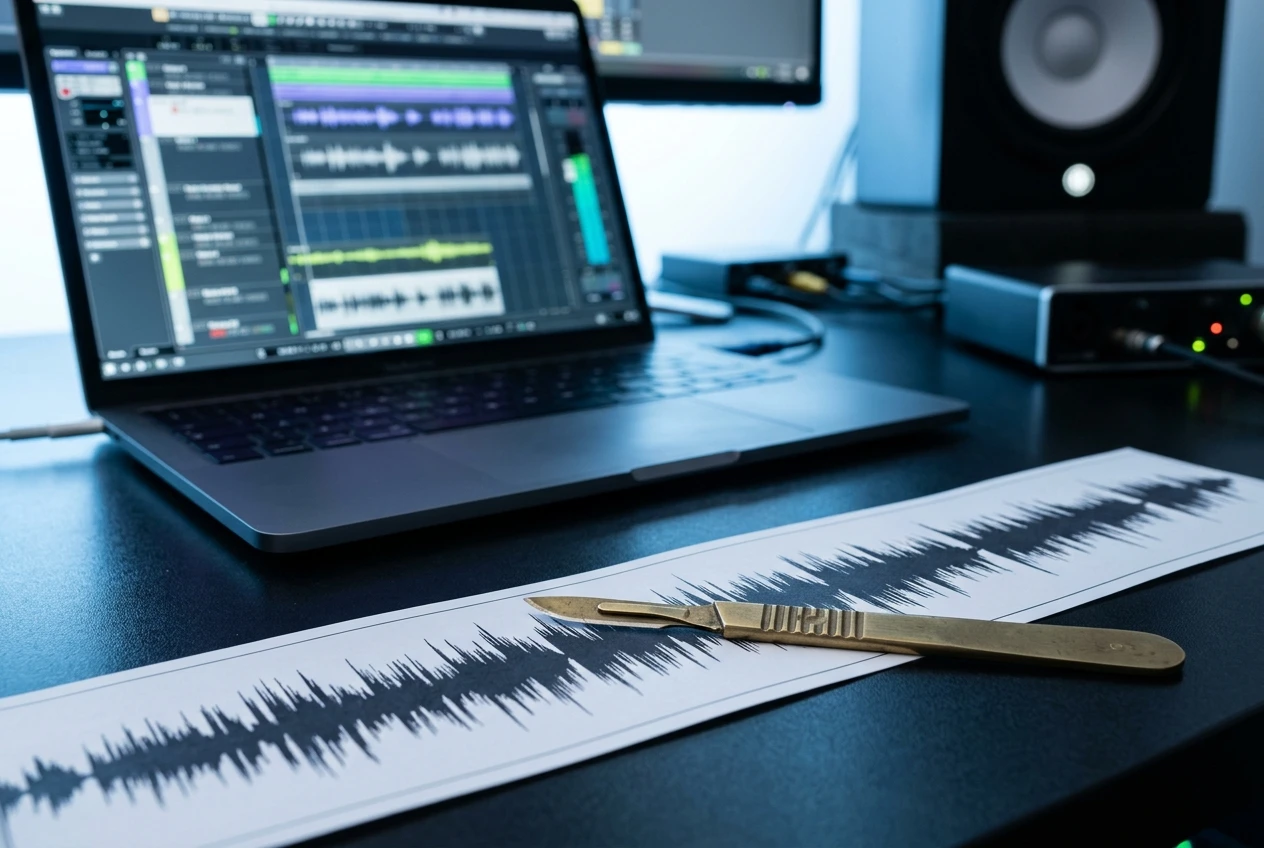
Dynamic bands. A dynamic band only acts when the signal in that band crosses a threshold. A harsh spot on a vocal may only appear on loud, sharp syllables. A static cut would dull the whole performance to fix those moments, while a dynamic cut engages only when the harshness appears. This is closer to compression on one slice of the spectrum than to ordinary EQ, and it is one of the clearest differences between clinical and colored designs. If harshness is your main problem, multiband compression on vocals is a related approach worth comparing.
Linear phase mode. Ordinary EQ (called minimum phase) shifts the timing of frequencies around the bands you move. This is normal and is often what makes EQ sound natural. Linear phase mode removes those shifts, so the cut or boost changes level without changing timing relationships. That matters when you process several tracks that share the same source, like a drum kit recorded with multiple microphones, or when you process parts of a stereo signal where phase matters. If phase and width are on your mind, how to make a mix sound wider without phase problems covers the stereo side.
Linear phase has costs. It adds latency, uses more CPU, and can produce pre-ringing, a faint echo before a transient, especially with steep low-frequency moves. Use it when phase accuracy matters, not by default.
Mid/side and per-band routing. Many clinical EQs let you process the center and the sides separately, or assign individual bands to the left or right channel. This helps with problems that exist in only part of the stereo image.
What makes an EQ colored
A colored EQ changes the sound in ways beyond the frequency curve you set. The color comes from a few sources.
Saturation. Emulations of transformers, tubes and analog circuits add harmonic distortion, usually subtle at moderate levels. Those added harmonics make a sound feel fuller or brighter even before the EQ curve does anything. How much color you get often depends on the input level, so how hard you drive the plugin changes the result.
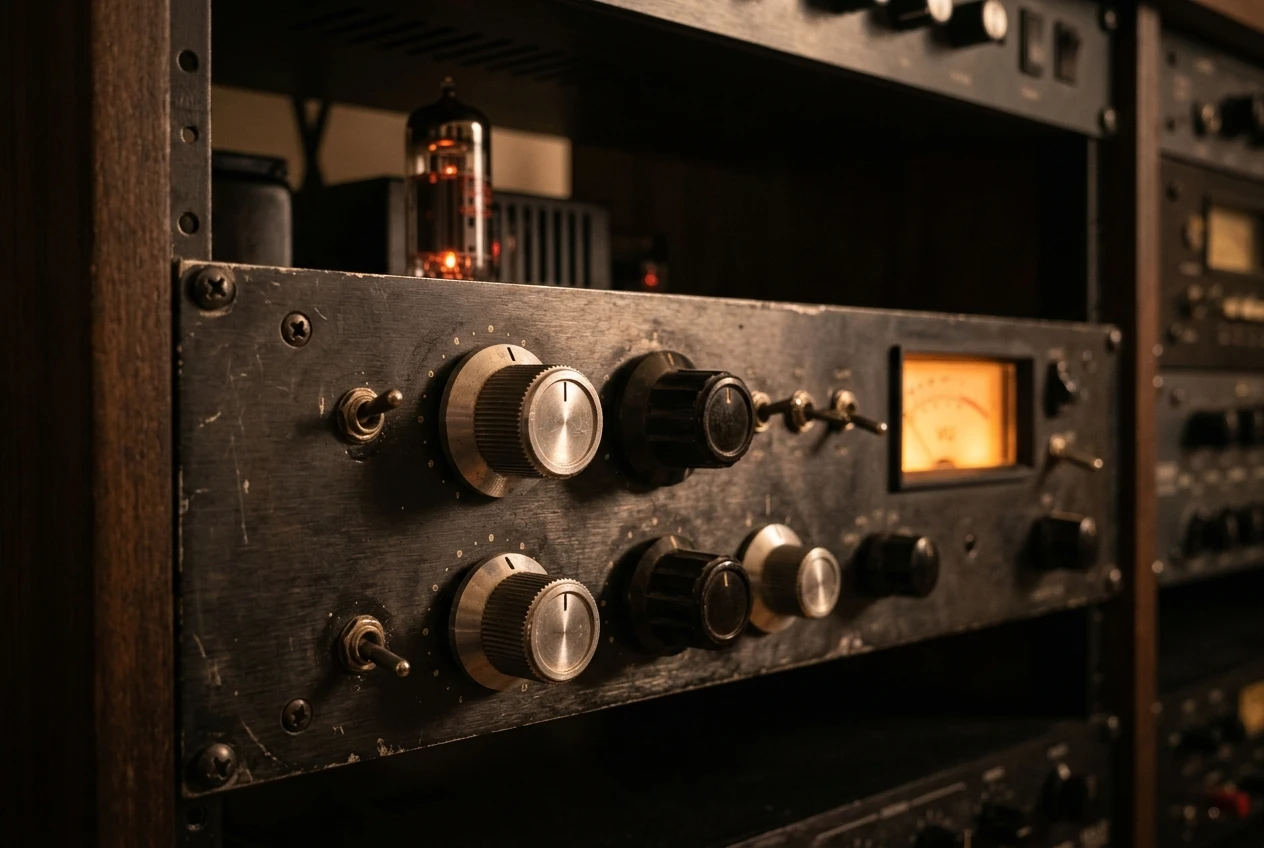
Non-linear curves. On a clean EQ, a 3 dB boost at a given frequency looks exactly like what you drew. On a modeled analog EQ, the shape of the curve can change with the gain setting, and adjacent bands may interact, so boosting two neighboring bands does not simply add up. The curve is broad and smooth, and the results often sound more musical than the numbers would suggest.
Fixed frequencies and stepped controls. Many vintage designs offer a short list of selectable frequencies instead of a continuous sweep. This restricts your options, and the restriction helps. The frequencies were chosen because they work on common sources, and you spend less time hunting.
Quirks. Some designs let you boost and cut at the same frequency at the same time. The two curves do not cancel, because they have different shapes, and the result is a shelf with a dip behind it. This kind of behavior was a side effect of the hardware, and engineers kept using it because the results sounded good. A clean EQ would show that move as a flat line, since it only reports what you asked for.
A colored EQ is a poor choice for narrow surgical cuts. The curves are too broad, the controls are too coarse, and the saturation adds changes you did not want when your goal was to take something away cleanly.
When to cut with a clinical EQ
Use a clinical EQ whenever the job is subtractive and specific. These are the common cases.
Resonances. Rooms, instruments and vocal booths all produce frequencies that ring longer than the rest. To find one, boost a narrow band by several dB, sweep it slowly across the range, and listen for the spot where the sound gets louder, rings or turns unpleasant. Then pull the boost down into a cut at that frequency, and widen or narrow the Q until the problem goes away but the surrounding tone stays intact. Spectrum views make the search faster.

Mud. Buildup in the low-mids, roughly the area between 200 and 400 Hz, makes a mix feel cloudy. Multiple tracks overlap there, and each is fine alone. Use a gentle cut on some of them, and consider which instrument should own that range. This is a starting area to investigate, not a fixed rule, since the exact range depends on the instruments.
Harsh spots. Harshness tends to live in the upper-mids, often in the 2 to 5 kHz region. A narrow cut, or a dynamic band that only reacts on loud passages, removes the sting while keeping the presence of the part. A static broad cut in this region often makes a vocal sound dull and distant.
Low-end cleanup. A high-pass filter on tracks that do not need low frequencies keeps rumble and sub-bass energy out of the mix, which leaves more headroom for the kick and bass. Clinical EQs offer steep filter slopes, so you can remove unneeded low end without affecting the notes just above the cutoff. Filter the tracks one at a time, and check that the part still sounds right in context, because a bass-heavy source can lose body if you cut too high.
A useful habit is to cut with the track soloed for finding the problem, then unsolo it and confirm the cut helps in the mix. Problems found in solo sometimes disappear once other instruments cover them.
When to boost with a colored EQ
Boosting is where a clean EQ often disappoints. A clean boost raises the level at a frequency, and it can sound harsh or artificial because it adds nothing but gain. A colored EQ raises the level and adds harmonics, so the boost sounds as if the sound has more in it.
Air. A broad high-shelf boost above roughly 10 kHz adds a sense of openness on vocals, acoustic guitars and the mix bus. Saturation in a colored EQ adds high-frequency harmonics, so the top end sounds smooth even with a sizable boost. A clean EQ in the same spot can bring out hiss or sibilance.
Weight. Low-shelf boosts on kicks, bass and the bottom of a vocal give a sense of size. The non-linear curves on vintage-style designs keep the boost from turning boomy. Pairing a low boost with a nearby cut on a design that supports both is a well-known way to add weight without adding mud.
Presence. A broad boost in the upper-mids can bring a vocal or guitar forward. A colored EQ tends to do this in a way that sounds forward without sounding sharp, because the curve is wide and the saturation rounds off the edges.
Attitude. Driving the input of a modeled analog EQ adds grit that no amount of clean boosting will produce. This is a creative choice, and it is easy to overdo.
One warning applies to every boost: it makes the track louder, and louder usually sounds better. Match the output level so the processed and bypassed versions are equally loud before you judge. Without level matching, a colored EQ looks like a miracle, since almost any boost wins the comparison.
How to stack both on one track
Using both types on one track works best in a fixed order: surgical first, colored second.
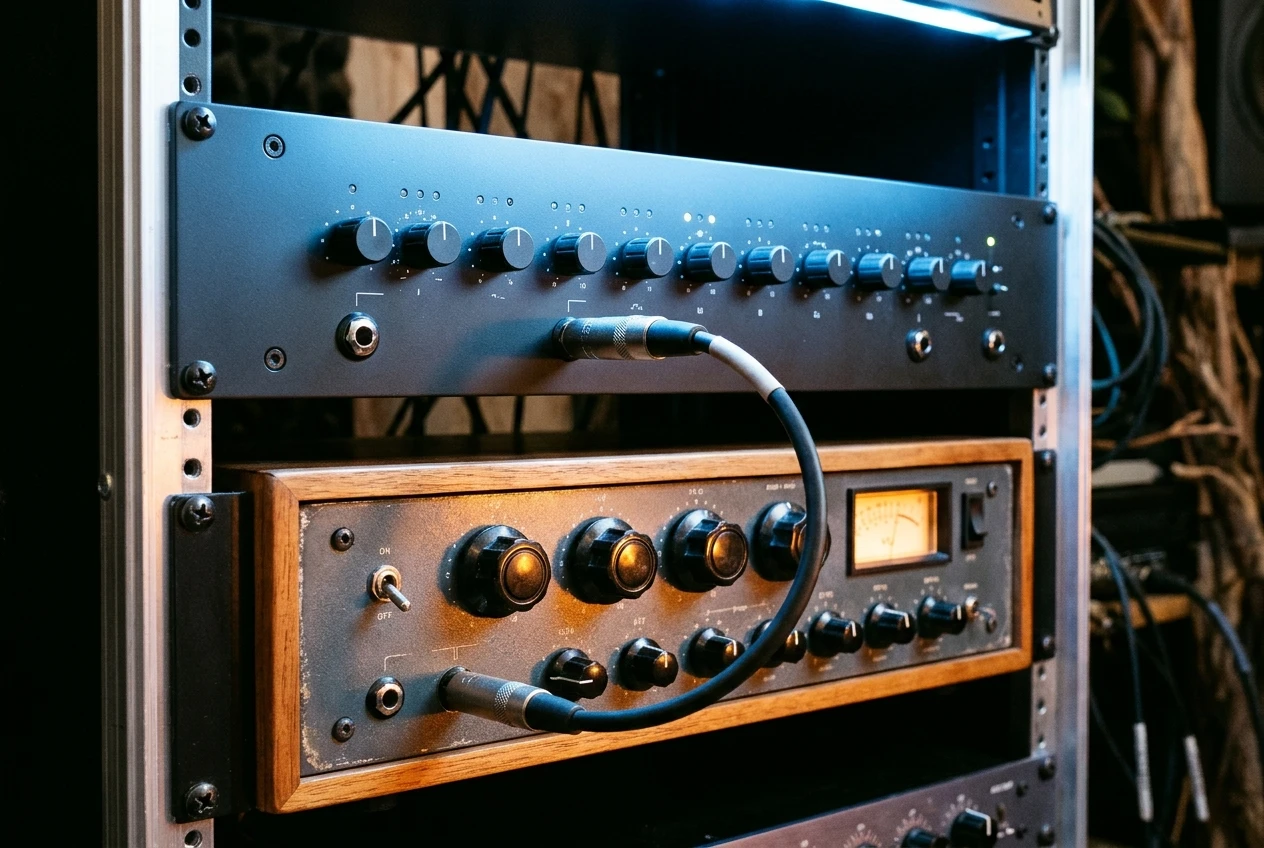
The reason is practical. A colored EQ boosts and adds harmonics, and it amplifies whatever is already in the signal, including a resonance or a harsh spot. If the problem remains in the signal, the colored boost makes it louder and adds distortion on top. If you remove the problem first, the colored stage has clean material to enhance.
A workable process looks like this:
- Start with the clinical EQ. Add a high-pass filter where appropriate, then cut resonances, mud or harshness you can identify. Keep cuts as small as the problem allows.
- Add the colored EQ afterward. Use broad, gentle moves: a shelf for air, a lift for weight, a bump for presence. Small boosts of a few dB are usually enough on a colored design.
- Level match. Adjust the output of the last plugin so the chain sounds equally loud with it bypassed, then compare.
- Check in context. Unsolo the track and judge the change in the full mix.
Sometimes the order should be reversed. If you drive a colored EQ hard for character and the saturation introduces a new harshness, a clinical EQ after it can clean up the result. This is the exception, not the starting point. Begin with the surgical pass first, and move the order only when you hear a reason.
Not every track needs both. A simple, well-recorded part might need only a high-pass filter and a small colored lift. A rough recording might need three surgical cuts and nothing else. Treat the stack as an option and reach for it when a track calls for it.
How to choose what to buy next from the EQs you already own
Before buying another plugin, take inventory. Open your plugin list and label each EQ you own as clinical, colored or unsure. Stock EQs that ship with a DAW are often clean designs, though this varies, so check how each one behaves instead of assuming. Boost a band by a large amount and see whether the sound changes beyond the level and the curve. Drive the input harder and listen for added grit. If nothing but the frequency balance changes, you have a clean design.
Then run your choice through a simple rule:
- If the move is narrow, corrective or should be invisible, use a clinical EQ.
- If the move is a broad boost, or you want to hear character, use a colored EQ.
- If you are unsure, start with the clinical EQ, because fixing problems comes first.
Next, look for the gap. The usual gaps are specific:
- You have no EQ with a spectrum view, so finding resonances takes guesswork.
- You have no dynamic band, so you handle harshness with static cuts that dull the whole performance.
- You have no colored EQ, so every boost sounds sharp and you compensate by boosting less than the track needs.
- You have several colored EQs and no clinical one, so you do cleanup with tools too broad for it.
Whichever gap you find is your shopping list, and it may be empty. If your collection covers both types, spending more on a third or fourth EQ is unlikely to improve your mixes as much as using the ones you have in the right order. Once you have both types, extra purchases tend to be variations on tools you already own, and you gain more from practice than from another install.
When you do shop, the best EQ plugins for mixing are the ones that fill the gap in your chain. Judge candidates by what they do (dynamic bands, a spectrum view, saturation you can hear) and not by what a ranked list says. The same thinking applies to other processing types: the mastering chain for indie artists article applies a similar job-first approach to a full chain.
Try it on one of your own tracks
Pick one track in your current mix, run a surgical pass and then a colored pass, and compare the two versions with your levels matched. Tell me in the comments which EQ you reached for first.