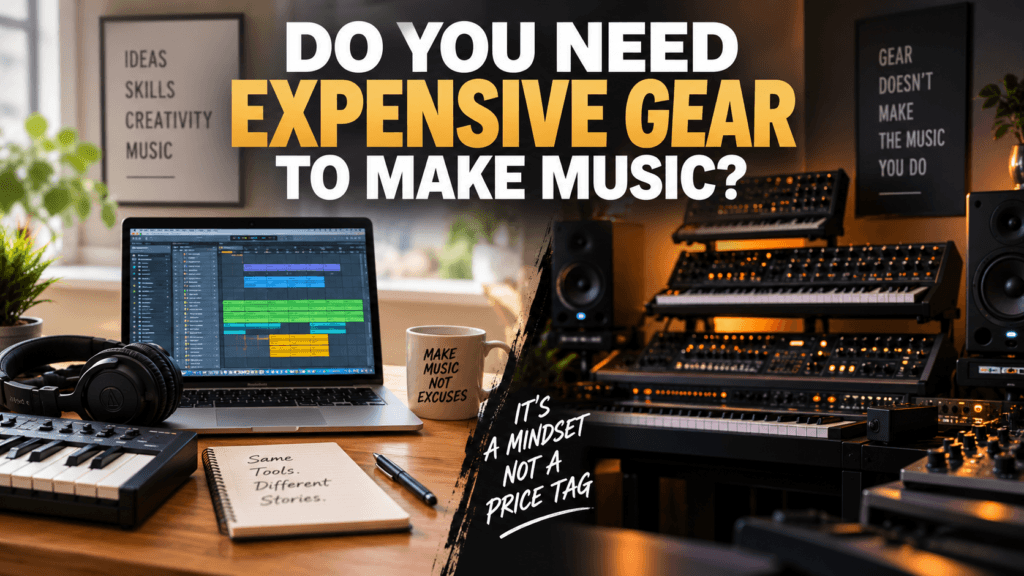
 Do You Really Need Expensive Gear To Make Music?
No.
You don’t need a $3,000 keyboard. You don’t need a wall covered in synthesizers. You don’t need a $5,000 microphone, an enormous mixing console, or a studio that looks impressive on Instagram.
And I say that as someone who loves music gear.
There is nothing wrong with owning great equipment. Hardware synthesizers are inspiring. Nice microphones can sound incredible. Weighted keyboards feel fantastic. Studio monitors matter. There are legitimate reasons professionals invest thousands of dollars into their studios.
But there’s a big difference between wanting better gear and needing better gear before you can make good music.
Those two ideas get confused far too often.
If you have a decent computer, a DAW, headphones, and some good software, you probably already have enough to make something worth listening to.
So let’s talk about what you actually need to make music—and what you probably don’t.
The Modern Producer Has an Incredible Advantage
Music production has changed dramatically.
There was a time when building a serious production setup required hardware samplers, synthesizers, drum machines, mixers, effects processors, recording equipment, and a room capable of holding all of it.
Today?
You can open a laptop and have access to an absurd amount of musical power.
A single software instrument can contain thousands of sounds. A DAW can provide recording, sequencing, mixing, effects, automation, sampling, and mastering tools inside one application.
Your computer effectively becomes the studio.
That doesn’t mean hardware has become useless. Far from it.
It means hardware is no longer necessarily the price of admission.
What Do You Actually Need To Start Making Music?
For most beginners, the list is surprisingly short.
You need:
- A capable computer
- A DAW
- Headphones or monitors
- A way to create or input musical ideas
That last item could be a MIDI keyboard, pad controller, computer keyboard, mouse, or even the touchscreen on a mobile device.
That’s enough to start.
Not enough to build your dream studio.
Enough to make music.
And that’s the distinction that matters.
Your DAW Is Already Ridiculously Powerful
One of the easiest traps for producers to fall into is forgetting how much is already inside their DAW.
We start making music and immediately begin searching for:
The best synth.
The best compressor.
The best EQ.
The best reverb.
The best drum plugin.
Meanwhile, the software already installed on the computer may contain perfectly capable versions of all of them.
Modern DAWs give producers tools that would have required an entire studio decades ago.
Before deciding that your software is holding you back, learn what it can actually do.
You may be surprised.
Software Instruments Have Changed The Equation
This is where things get especially interesting.
Software instruments aren’t just cheap substitutes for hardware anymore.
They’re instruments in their own right.
Plugins can recreate classic synthesizers, model analog circuitry, build entirely new forms of synthesis, manipulate samples, generate textures, create orchestral arrangements, and provide enormous preset libraries.
Something like Roland ZENOLOGY Pro can put decades of Roland-inspired sounds inside your computer.
Virtual versions of classic instruments can give producers access to sounds inspired by hardware that may be expensive, rare, or inconvenient to maintain.
And modern synths can go far beyond recreating old equipment altogether.
That’s why the question shouldn’t always be:
“What hardware should I buy?”
Sometimes the better question is:
“Do I already own software that can make this sound?”
Very often, the answer is yes.
A MIDI Controller Doesn’t Need To Make Sound
This is another area where beginners sometimes overspend.
A MIDI controller doesn’t necessarily generate audio.
It controls your software.
That means a relatively affordable MIDI keyboard connected to a powerful software instrument can give you access to thousands of sounds.
Pianos.
Synths.
Bass.
Strings.
Pads.
Leads.
Drums.
Organs.
Orchestral instruments.
One keyboard can effectively control an entire virtual studio.
A premium workstation keyboard may provide a better keybed, onboard sounds, performance features, hardware controls, and other advantages.
Those things can absolutely be valuable.
But they aren’t automatically required to make better music.
Expensive Gear Can Still Be Worth It
None of this means expensive equipment is pointless.
Sometimes spending more money genuinely improves your workflow.
A better keyboard might provide a more expressive playing experience.
Better monitors may reveal details you weren’t hearing.
A higher-quality microphone may better suit a particular vocalist.
A powerful computer might allow larger sessions.
A hardware synthesizer may encourage you to experiment differently than clicking through a plugin.
And sometimes an instrument simply inspires you.
That’s valuable too.
The important question is whether you’re buying something because it solves a real limitation or because buying equipment feels like progress.
Those aren’t always the same thing.
The Upgrade Question I Think Producers Should Ask
Before buying another piece of gear, ask:
What problem am I trying to solve?
Not:
What do I want?
Those are very different questions.
Maybe your computer genuinely can’t handle your sessions.
That’s a problem.
Maybe your headphones make it difficult to judge bass accurately.
That’s a problem.
Maybe you’ve developed enough piano technique that your current keyboard is limiting your dynamics and expression.
That’s a legitimate reason to consider upgrading.
But:
“That keyboard looks incredible.”
“Everybody on YouTube has one.”
“Maybe this synth will make my beats better.”
Those aren’t technical limitations.
That’s Gear Acquisition Syndrome knocking on the door.
And trust me—producers know that knock.
New Gear Can Become Procrastination
This is the uncomfortable part.
Buying music equipment feels productive.
You’re researching specifications.
Watching demonstrations.
Comparing products.
Reading reviews.
Building shopping carts.
Imagining what your studio will look like after the upgrade.
It feels like you’re working on music.
But you aren’t actually making any.
Sometimes the next upgrade isn’t another plugin, keyboard, microphone, or controller.
It’s finishing the song sitting inside your DAW.
Learn What You Already Own
This may be one of the highest-return investments a producer can make.
Pick one synthesizer and actually learn it.
Learn what the oscillators do.
Understand the filters.
Experiment with envelopes.
Learn modulation.
Build patches instead of endlessly browsing presets.
Do the same with your compressor.
Your EQ.
Your sampler.
Your DAW.
The deeper your understanding becomes, the less dependent you become on constantly buying new tools.
You stop asking:
“Which plugin will give me this sound?”
And start thinking:
“How can I create this sound with the tools I already have?”
That’s a completely different level of confidence.
Skill Compounds. Gear Doesn’t.
A new plugin can give you another option.
Learning synthesis gives you knowledge you can use across dozens of synthesizers.
A new compressor gives you another compressor.
Understanding attack, release, threshold, ratio, and gain reduction gives you knowledge you can apply to almost every compressor you’ll encounter.
A new keyboard gives you another keyboard.
Improving your chord voicings, rhythm, melodies, and playing technique follows you to every keyboard you touch.
That’s why skill is such a powerful investment.
It transfers.
Your Limitations Can Actually Help You
Having fewer tools isn’t always a disadvantage.
Limitations force decisions.
If you have 40 synthesizers, you can spend an hour deciding which synth to use.
If you have two that you know extremely well, you’re probably making music within minutes.
The same applies to effects.
The same applies to drum libraries.
The same applies to hardware.
Creativity doesn’t always need more options.
Sometimes it needs fewer decisions.
Build Your Studio As Your Skills Grow
There’s nothing wrong with wanting a beautiful studio.
Build one.
Just don’t convince yourself that you need the finished studio before you’re allowed to become the producer who deserves it.
Start with what you have.
Make music.
Finish songs.
Learn your tools.
Develop your ears.
Improve your playing.
Study arrangement.
Study mixing.
Then, as you encounter genuine limitations, upgrade intentionally.
Your studio can grow alongside your ability.
That’s a much healthier relationship with gear than constantly searching for something that will magically unlock your creativity.
Final Thoughts
So, do you need expensive gear to make music?
No.
Great equipment can improve workflow, solve problems, inspire creativity, and make certain parts of music production easier.
But equipment doesn’t replace musicianship.
It doesn’t replace taste.
It doesn’t replace arrangement.
It doesn’t replace sound selection.
It doesn’t replace practice.
And it definitely doesn’t replace finishing music.
The producer with modest equipment who deeply understands their tools can accomplish far more than the producer surrounded by expensive equipment they barely know how to use.
Use what you have.
Learn it.
Push it further than you thought you could.
Then, when you eventually upgrade, you’ll know exactly why you’re upgrading.
Until then?
Nope. You’re ready.
Let’s make something.