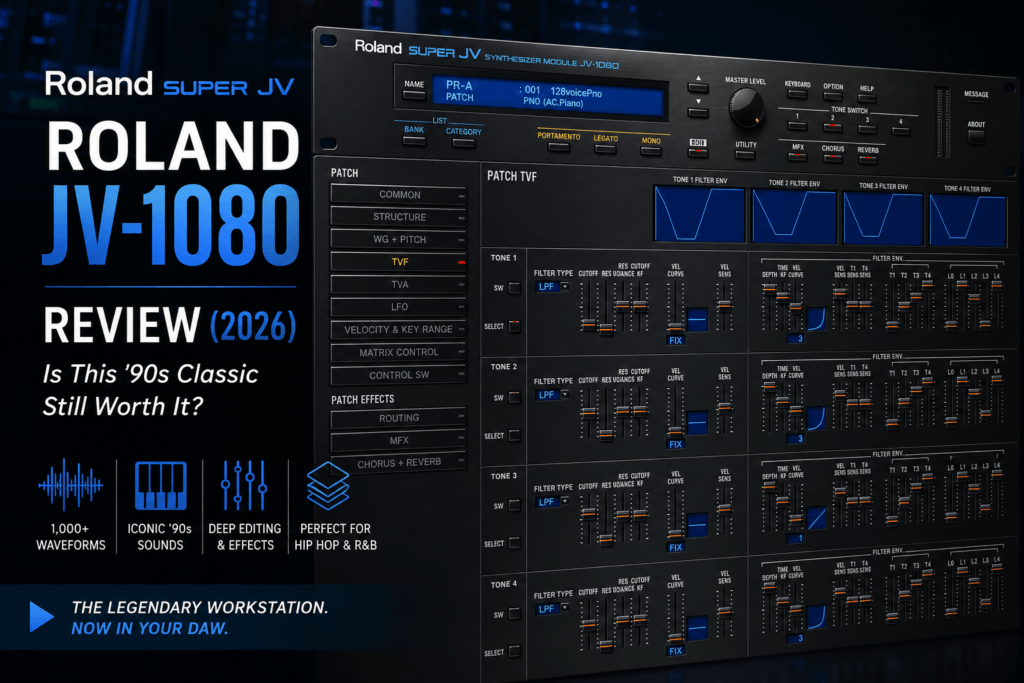
 Long before producers had thousands of virtual instruments sitting inside their laptops, hardware rack modules were one of the easiest ways to expand a studio’s sound library.
And few rack modules became as iconic as the Roland JV-1080.
Originally released in 1994, the JV-1080 became a fixture in professional studios throughout the ’90s. Its massive collection of polished, ready-to-use sounds appeared across R&B, Hip Hop, pop, dance music, film scores, television, and countless other productions.
Today, Roland has brought that classic sound library into software with the Roland JV-1080 Software Synthesizer.
But with modern producers having access to enormous sample libraries, advanced wavetable synths, realistic acoustic instruments, and countless software workstations, does a virtual recreation of a 1994 rack module still make sense?
In this Roland JV-1080 review, we’ll look at its sounds, features, workflow, strengths, weaknesses, and why it remains particularly interesting for Hip Hop and R&B producers in 2026.
Quick verdict: The Roland JV-1080 remains an excellent instrument for producers who love the polished workstation sounds of the 1990s. Its strings, pads, keys, bells, synth textures, basses, orchestral sounds, and unmistakably digital PCM character make it particularly useful for ’90s-inspired Hip Hop and R&B. It won’t replace modern specialized instruments, but that’s not really the point—the JV-1080 gives you access to a specific era of production history.
What Is the Roland JV-1080?
The original Roland JV-1080 was a 2U rackmount digital synthesizer module released in 1994.
Instead of focusing primarily on traditional analog synthesis, it used Roland’s PCM-based synthesis technology to provide producers with a huge collection of instrument sounds inside a single module.
Roland describes the original JV-1080 as one of the company’s most popular rack modules, and its sounds became widely used throughout professional music production.
The idea was simple:
Connect a MIDI keyboard or sequencer and suddenly your studio had access to sounds covering numerous categories.
That included things like:
- Pianos
- Electric pianos
- Organs
- Strings
- Brass
- Guitars
- Basses
- Bells
- Pads
- Synth leads
- Choirs
- Orchestral instruments
- Percussion
- Sound effects
- Digital textures
For producers working during the hardware era, that kind of versatility was extremely valuable.
The software version brings that concept into your DAW while expanding what you can do with the original architecture.
Why Was the JV-1080 So Popular?
To understand the appeal of the software version, you have to understand what instruments like the JV-1080 represented.
Hardware mattered.
A rack module could become an enormous part of a producer’s sonic identity.
The JV-1080 was attractive because it wasn’t designed to do just one thing.
It was essentially a studio sound library in a rack.
You could use one patch for a piano, another for strings, another for bass, another for a pad, and another for a synth texture.
That made it useful across numerous genres.
But for today’s producer, there’s another reason the JV-1080 matters.
Those sounds now have character.
What was once simply contemporary digital technology has become a recognizable vintage aesthetic.
The JV-1080 Sound in 2026
This is the most important thing to understand before buying it.
Don’t approach the JV-1080 expecting every preset to sound like a massive modern cinematic Kontakt library.
That’s not what makes it special.
The JV-1080 has that unmistakable ’90s digital workstation sound.
Some patches are:
Clean.
Some are glossy.
Some are atmospheric.
Some are slightly artificial.
And some immediately sound like they belong on a record made three decades ago.
That’s exactly why the instrument remains useful.
Modern producers spend enormous amounts of time trying to make pristine digital sounds feel older.
They add:
- Saturation
- Chorus
- Tape emulation
- Bit reduction
- Vintage reverb
- Filtering
- Sampling
- Pitch modulation
The JV-1080 starts from a different place.
Its PCM-based character already provides a distinct sonic fingerprint.
The Sound Library
Versatility is still one of the JV-1080’s biggest strengths.
Roland’s software recreation features over 1,000 waveforms, giving the instrument a broad palette from which its presets and layered sounds are constructed.
Instead of downloading separate libraries for every musical role, you can browse one instrument for a huge variety of sounds.
For beatmakers, that’s valuable.
You might start a production with an electric piano.
Then grab a string patch.
Then find a bell.
Then add a pad.
Then layer a digital synth texture underneath everything.
All without leaving the JV-1080.
That can dramatically speed up sound selection.
Pianos and Keys
The keyboard sounds are one of the first places I’d explore when making Hip Hop or R&B.
You’re not buying the JV-1080 because you need the world’s most meticulously sampled concert grand.
You’re buying it for characterful production sounds.
Its keyboard category can work particularly well for:
- R&B chords
- Boom Bap samples
- Neo-Soul-inspired progressions
- Hip Hop melodies
- Pop arrangements
- Layered keyboard parts
The digital nature of these sounds can actually help them sit inside a beat.
A gigantic modern piano library can sometimes occupy too much space.
A workstation-style piano can be easier to place underneath vocals, drums, bass, and other instruments.
Electric Pianos
Electric piano sounds are especially useful for R&B.
Load one up, play some seventh and ninth chords, add a little reverb, and you’re immediately moving toward that smooth ’90s R&B atmosphere.
Try progressions built around:
- Minor 7ths
- Major 7ths
- Minor 9ths
- Major 9ths
- Suspended chords
- Inversions
The JV-1080’s polished digital character can make these sounds feel very different from a modern ultra-realistic Rhodes emulation.
And sometimes that’s exactly what you want.
Strings
Strings are another major highlight.
Again, think workstation strings, not massive modern cinematic orchestration.
That’s actually useful for Hip Hop and R&B.
You can layer strings underneath a chorus without having them completely dominate the arrangement.
Try using them to:
- Reinforce chord progressions
- Add emotion to hooks
- Create dramatic intros
- Layer behind pianos
- Build cinematic Hip Hop beats
- Add tension before transitions
Lower the strings in the mix until you barely notice them.
Then mute them.
If the track suddenly feels smaller, you’ve probably found the right level.
Pads and Atmospheres
This may be one of the best areas of the JV-1080 for modern producers.
Digital pads from this era have a distinctive quality.
They can feel:
- Dreamy
- Dark
- Glassy
- Futuristic
- Nostalgic
- Spacious
That’s a perfect combination for modern R&B and Trap Soul.
Try layering a pad underneath an electric piano and filtering some of the high frequencies.
Add a long reverb.
Then keep the pad relatively quiet.
Suddenly a basic chord progression can feel much larger.
Bells and Digital Plucks
If you produce Hip Hop, you’ll probably spend some time browsing the bell and digital pluck territory.
These types of sounds work beautifully for simple melodies.
Try writing a three- or four-note melody instead of something overly complicated.
Add delay.
Add reverb.
Then pitch the melody up an octave.
Bass Sounds
The JV-1080 also gives you bass patches that can work as alternatives to the modern 808.
This is particularly useful when making:
- ’90s R&B
- Boom Bap
- New Jack Swing-inspired music
- Retro Pop
- Funk-influenced Hip Hop
- Neo-Soul
Sometimes an actual synth or electric-style bass gives a track far more personality than another sub-heavy 808.
You can also layer a JV bass with a subtle sub-bass underneath it.
That gives you the character of the vintage patch while maintaining modern low-end weight.
Synth Sounds
This is where things get particularly interesting.
The JV-1080 comes from an era when digital synthesis had its own distinct aesthetic.
You can find:
- Digital leads
- Soft synths
- Bright textures
- Sweeps
- Layered pads
- Motion sounds
- Atmospheric effects
These aren’t necessarily going to replace a modern wavetable synth.
But that’s not why you’d use them.
A modern synth gives you modern precision.
The JV-1080 gives you a particular flavor.
Having both is better than forcing one instrument to do everything.
Orchestral Sounds
The JV-1080 also contains orchestral material.
You’ll find sounds that can help create:
- Dramatic Hip Hop intros
- Cinematic beats
- Emotional R&B arrangements
- Sample-style compositions
- Dark orchestral Trap
- Boom Bap loops
Again, don’t judge these sounds by modern orchestral-library standards.
Instead, think of them as production textures.
Play a string phrase.
Bounce it to audio.
Pitch it down.
Filter it.
Add saturation.
Chop it.
Now you’re treating the JV-1080 almost like a source for creating your own samples.
That’s where things can become really interesting.
More Than Just Presets
One misconception would be thinking the software JV-1080 is simply a preset browser.
There’s more going on under the hood.
The original JV architecture builds sounds using PCM waveforms combined with synthesis parameters.
That means you can go beyond selecting presets and start modifying the character of patches.
Roland’s software version expands the original hardware concept with additional editing capabilities, including enhanced filters, modulation options, and a graphical interface.
You can adjust things like:
- Filters
- Envelopes
- LFOs
- Pitch
- Modulation
- Effects
This lets you take recognizable JV-style sounds and make them more personal.
Effects
Effects are an important part of workstation-style synthesis.
A relatively basic waveform can become much more interesting once you introduce:
- Chorus
- Delay
- Reverb
- Modulation
- Distortion
- Spatial processing
The software version expands the effects capabilities beyond the original hardware.
For producers, this means you can build more complete sounds inside the instrument before reaching for additional plug-ins.
Of course, you can still combine the JV-1080 with your favorite external effects.
Try running a JV patch through:
Saturation → Chorus → Reverb → Delay
and you can transform an ordinary preset into something much more atmospheric.
The JV-1080 for ’90s R&B
This is probably one of the strongest reasons to own it.
The JV-1080 belongs to the era that helped define the sound of ’90s R&B.
You can use its:
Electric pianos for extended chord progressions.
Strings for emotional layers.
Pads for atmosphere.
Bells for melodic accents.
Basses for warm low-end movement.
Synths for additional texture.
Start with a progression such as:
Fm9 – Dbmaj7 – Abmaj9 – Eb
Play it around 72–82 BPM.
Choose a warm keyboard patch.
Add a quiet pad underneath.
Layer strings during the chorus.
Then program relaxed drums.
You can get into ’90s-inspired territory surprisingly quickly.
The JV-1080 for Hip Hop
Hip Hop producers can approach the instrument differently.
Instead of treating it like a workstation, treat it like a crate of sounds.
Find an interesting patch.
Play four chords.
Bounce them to audio.
Then manipulate the recording.
Try:
- Pitching it down
- Reversing sections
- Chopping it
- Filtering it
- Resampling it
- Adding vinyl effects
- Saturating it
- Changing the tempo
Now the JV-1080 becomes your sample source.
This is an excellent way to combine vintage workstation sounds with modern beatmaking techniques.
Making Modern Beats With the JV-1080
Don’t assume you need to make retro music just because you’re using a vintage-inspired instrument.
You can combine JV sounds with modern production.
For example:
JV-1080 electric piano
Modern Trap drums
Deep 808
Atmospheric vocal texture
Modern mixing
That combination can give you the best of both worlds.
The JV provides character.
The modern drums provide impact.
And your production techniques bring everything into 2026.
Sound Selection Is Fast
One of the underrated advantages of workstation instruments is speed.
Sometimes having endless options slows down production.
You open one synth.
Nothing works.
You open another.
Then another.
Thirty minutes later, you still haven’t chosen a sound.
The JV-1080 encourages a different workflow.
Open one instrument and browse until something inspires you.
Because it covers so many categories, you can potentially build most of the melodic side of a beat using just the JV-1080.
That limitation can actually increase creativity.
Layering JV-1080 Sounds
Layering is another powerful technique.
Try combining two patches rather than searching endlessly for one perfect sound.
For example:
Electric Piano + Pad
creates width and atmosphere.
Bell + Soft Synth
creates a more complex melody.
Strings + Choir
creates emotional depth.
Digital Bass + Sub Bass
creates character and low-end weight.
Piano + Strings
creates a cinematic foundation.
Just remember that layering doesn’t automatically make something better.
Every layer should serve a purpose.
Processing the JV-1080 for a More Vintage Sound
If you want to push the retro character further, try processing the instrument.
A chain might look like:
JV-1080 → Saturation → EQ → Chorus → Reverb
You could also:
- Reduce high frequencies
- Add tape saturation
- Introduce subtle wow and flutter
- Use bit reduction
- Resample the sound
- Pitch the audio down
- Add vinyl noise
The goal isn’t necessarily to destroy the sound.
Small amounts of processing can make the patch feel like it was sampled from an older recording.
Using the JV-1080 as a Sample Generator
This might be my favorite way to use an instrument like this.
Instead of endlessly browsing sample packs, create your own.
Step 1:
Choose a JV-1080 patch.
Step 2:
Write an eight-bar chord progression or melody.
Step 3:
Add effects.
Step 4:
Bounce the result to audio.
Step 5:
Start a new session.
Step 6:
Import your bounced audio.
Now pretend you found it on an old record.
Chop it.
Pitch it.
Reverse pieces.
Rearrange it.
Add drums.
You’ve created a sample-based Hip Hop workflow without sampling someone else’s recording.
Roland JV-1080 vs Modern Synths
It wouldn’t make sense to directly compare the JV-1080 with something like a cutting-edge wavetable synth purely based on synthesis capabilities.
They’re designed for different purposes.
A modern synth may offer:
- More modulation
- More advanced oscillators
- Deeper sound design
- Modern effects
- More visual feedback
The JV-1080’s advantage is different.
It sounds like a JV-1080.
That’s the reason to buy it.
You’re getting access to a particular Roland PCM sound associated with a specific period of music production.
Roland JV-1080 vs XV-5080
These two Roland instruments naturally overlap.
The JV-1080 represents an earlier generation of Roland’s PCM workstation lineage.
The XV-5080 came later and expanded the concept with a larger sound architecture and broader capabilities.
If your main goal is capturing a distinct mid-’90s workstation aesthetic, the JV-1080 is particularly attractive.
If you want a broader representation of Roland’s later rack-module era, the XV-5080 may make more sense.
And if you love this entire period of digital hardware?
There’s a good argument for having both.
Is the Roland JV-1080 Easy to Use?
Yes, especially if you mainly want presets.
You can load the instrument and start browsing sounds immediately.
That’s one of its greatest strengths.
But producers who want to go deeper can edit patches and explore the underlying synthesis parameters.
This creates two different workflows:
Preset producer: Find a sound and make music.
Sound designer: Find a sound and reshape it.
Both are completely valid.
What I Like About the Roland JV-1080
The ’90s Character
This is the biggest reason to own it.
It provides a sound palette that’s genuinely connected to the era many producers are trying to recreate.
Huge Variety
You can move from keys to strings to pads to bells to synths without opening another instrument.
Great for R&B
The combination of keys, pads, strings, bells, and digital textures makes it especially useful for R&B production.
Excellent Sample Source
You can create original compositions and then resample them for Hip Hop production.
Fast Workflow
Preset-based instruments can help you spend less time designing sounds and more time actually making music.
Modern Convenience
You get the character of a classic rack module without needing the original hardware, MIDI cables, audio connections, or rack space.
What Could Be Better?
Some Sounds Are Unmistakably Dated
That’s either a weakness or the entire reason you’re buying it.
Some presets immediately sound like the 1990s.
If you want ultra-modern production sounds straight out of the box, you’ll probably need additional instruments.
Acoustic Sounds Can’t Compete With Massive Modern Libraries
Technology has moved forward considerably since 1994.
Modern dedicated piano, string, guitar, and orchestral libraries can provide dramatically greater realism.
But realism isn’t necessarily the JV-1080’s purpose.
Preset Browsing Can Become Addictive
Having hundreds of options can still lead to endless browsing.
When something sounds good, stop searching.
Make the beat.
Pros and Cons
Pros
- Classic Roland JV sound
- Huge collection of usable presets
- Excellent ’90s character
- Great for Hip Hop
- Excellent for R&B
- Strong selection of pads and textures
- Useful strings and keys
- Great source for creating original samples
- More than 1,000 PCM waveforms
- Deeper editing than simply browsing presets
- Modern software convenience
- Easy to layer with modern instruments
Cons
- Some presets sound dated
- Acoustic sounds aren’t as realistic as modern dedicated libraries
- Not intended to compete with advanced modern wavetable synthesizers
- Retro character won’t suit every production
- Large preset collections can encourage excessive browsing
Who Should Buy the Roland JV-1080?
The JV-1080 is particularly worth considering if you make:
’90s R&B
Hip Hop
Boom Bap
Neo-Soul
Trap Soul
Lo-fi Hip Hop
Retro Pop
Sample-based music
It’s also an excellent choice for producers who enjoy vintage digital hardware but don’t want to maintain an actual rack module.
Who Should Skip It?
You probably don’t need the JV-1080 if you’re only looking for:
- Cutting-edge wavetable synthesis
- Hyper-realistic orchestral instruments
- Massive cinematic sampling
- Modern EDM sound design
- One highly specialized acoustic instrument
There are better tools for those jobs.
The JV-1080 is about character, versatility, nostalgia, and musical usefulness.
Is the Roland JV-1080 Worth It in 2026?
Yes—especially for Hip Hop and R&B producers.
The Roland JV-1080 doesn’t remain relevant because it can outperform every modern virtual instrument.
It remains relevant because it offers something those instruments don’t necessarily have:
Its polished PCM keys, strings, pads, bells, basses, orchestral textures, and digital synth sounds can immediately introduce ’90s character into a production.
And because you’re working with software rather than original rack hardware, you can combine those sounds with modern MIDI editing, automation, effects, resampling, and mixing techniques.
Use it traditionally and you have a versatile workstation.
Use it creatively and you have an enormous source of material for building your own samples.
That makes the JV-1080 far more than nostalgia.
It’s still a genuinely useful production instrument.
Final Rating: 9/10
Best for: Hip Hop, ’90s R&B, Neo-Soul, Boom Bap, Trap Soul, retro production, and producers who love classic Roland workstation sounds.
Skip it if: Your priority is cutting-edge synthesis or extremely realistic modern acoustic instruments.
Bottom line: The Roland JV-1080 remains one of the most interesting ways to bring authentic ’90s digital workstation character into a modern production setup. For Hip Hop and R&B producers in particular, there’s still plenty of inspiration hiding inside this classic Roland sound library.