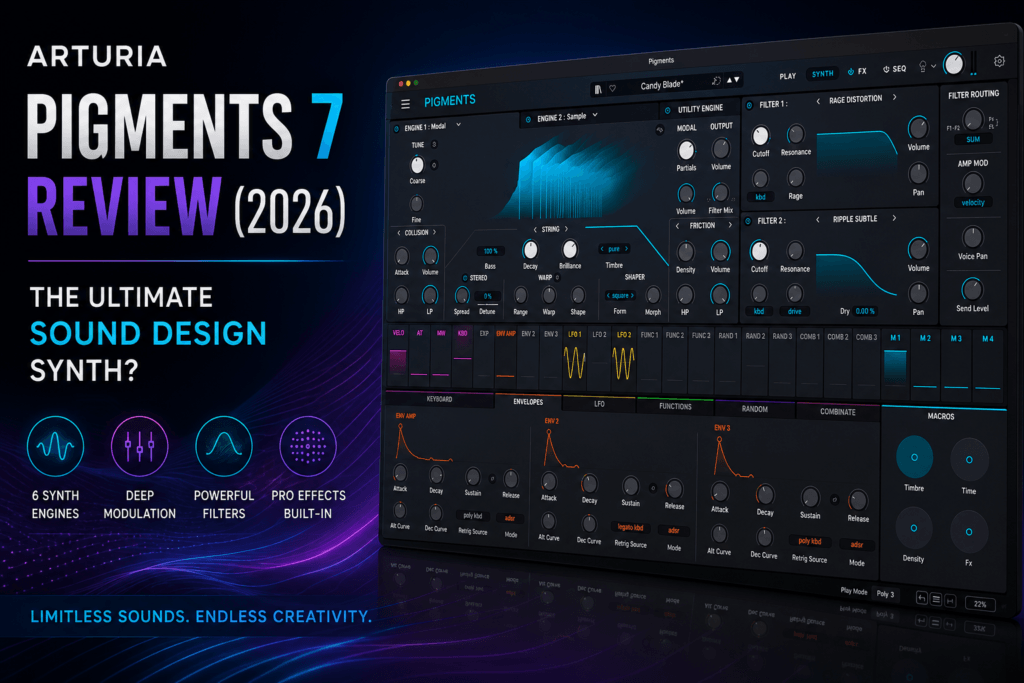
 Arturia Pigments 7 Review: The Ultimate Software Synth for Modern Producers?
Software synthesizers have come a long way over the past decade, but few have earned the reputation that Arturia Pigments has. Since its original release, Pigments has become one of the industry’s most respected soft synths thanks to its intuitive interface, multiple synthesis engines, deep modulation capabilities, and incredible sound quality.
With the release of Pigments 7, Arturia continues to refine what was already one of the best synthesizers available. New filters, performance enhancements, workflow improvements, and expanded creative tools make this version more powerful than ever.
But is Pigments 7 worth upgrading to? And if you’re buying it for the first time, is it the right synthesizer for your productions?
Let’s find out.
What Is Arturia Pigments 7?
Pigments 7 is Arturia’s flagship software synthesizer that combines multiple synthesis methods into one intuitive instrument. Instead of specializing in just one style of sound creation, Pigments lets producers blend several synthesis engines together to create virtually any sound imaginable.
Whether you’re producing:
- Hip-Hop
- Trap
- R&B
- Pop
- EDM
- Lo-Fi
- Synthwave
- Cinematic music
Pigments provides the tools needed to design everything from lush pads and cinematic textures to aggressive basses, modern leads, evolving soundscapes, and realistic hybrid instruments.
One of Pigments’ greatest strengths is that it manages to be incredibly deep without feeling overwhelming.
What’s New in Pigments 7?
Arturia continues to improve Pigments with every major release, and version 7 introduces several welcome additions.
Highlights include:
- Redesigned Play View for improved workflow
- New Rage Filter
- New Ripple Filter
- New Reverb Filter
- New Corroder distortion effect
- Performance optimizations with lower CPU usage
- Enhanced preset browsing
- Improved sound design tutorials
- Additional factory presets
Rather than reinventing the synth, Pigments 7 focuses on making an already outstanding instrument even more creative and efficient.
Six Synthesis Engines in One Instrument
One reason Pigments stands apart is its flexibility.
Instead of locking you into a single synthesis method, Pigments allows you to combine multiple engines within the same patch.
These include:
Virtual Analog
Perfect for:
- Classic polysynths
- Warm pads
- Vintage bass
- Analog leads
Wavetable
Ideal for modern electronic music.
Create:
- Aggressive basses
- Evolving textures
- Metallic leads
- Future bass sounds
Sample Engine
Import your own sounds or manipulate included samples.
Excellent for:
- Hybrid instruments
- Vocal chops
- Organic textures
- Cinematic layers
Granular Engine
One of Pigments’ strongest features.
Granular synthesis transforms ordinary samples into evolving atmospheres, ambient pads, and experimental soundscapes.
Harmonic Engine
Produces complex additive-style tones with exceptional clarity.
Perfect for:
- Bells
- Glass textures
- Ambient sounds
- Cinematic scoring
Modal Engine
Excellent for physical modeling.
Great for:
- Plucked instruments
- Mallets
- Experimental percussion
- Organic textures
Sound Quality
Simply put:
Pigments sounds incredible.
Everything feels polished, detailed, and expensive.
The filters are smooth.
The oscillators remain clean even under heavy modulation.
The effects compete with many standalone plugins.
Whether you’re creating lush cinematic pads or earth-shaking trap basses, Pigments consistently delivers professional results.
User Interface
Arturia has perfected the balance between power and usability.
The interface is beautifully organized.
Color-coded modulation makes complex routing easy to understand.
Every parameter is easy to locate.
The visual feedback throughout the synth helps both beginners and experienced sound designers understand exactly what’s happening.
Despite the enormous feature set, Pigments rarely feels intimidating.
Modulation System
This is arguably Pigments’ biggest strength.
Almost every parameter can be modulated.
Available modulation sources include:
- LFOs
- Function generators
- Envelopes
- Random generators
- Macros
- MIDI controllers
- Keyboard tracking
- Velocity
- Aftertouch
Assigning modulation is as simple as dragging one source onto the destination.
This workflow encourages experimentation and creativity.
Effects Section
Many synthesizers include basic effects.
Pigments includes excellent ones.
Effects include:
- Reverb
- Delay
- Chorus
- Phaser
- Flanger
- Compressor
- Distortion
- EQ
- Filters
- Tape-style processing
- Bit crushing
The new Corroder effect adds another layer of creative distortion that fits perfectly into modern electronic production.
For many presets, the built-in effects are so good that very little additional processing is required.
Factory Presets
Pigments comes loaded with more than 1,700 professionally designed presets.
These cover virtually every genre imaginable.
You’ll find:
- Trap plucks
- Hip-hop keys
- Analog pads
- EDM leads
- Ambient textures
- Lo-Fi sounds
- Basses
- Arpeggios
- Cinematic drones
Even if you never design your own patches, Pigments offers enough inspiration to keep producers busy for years.
Performance
Despite everything happening under the hood, Pigments performs surprisingly well.
Version 7 introduces additional CPU optimizations that make larger projects much easier to manage.
Compatibility includes:
- VST
- VST3
- AU
- AAX
Pigments works flawlessly inside Reason, Ableton Live, FL Studio, Logic Pro, Cubase, Studio One, Pro Tools, and nearly every other professional DAW.
Who Should Buy Pigments 7?
Pigments is ideal for:
Beat Makers
Create custom 808s, synth leads, pads, bells, keys, and atmospheric textures without relying solely on presets.
Sound Designers
Its advanced modulation, granular engine, and multiple synthesis methods make it one of the most capable sound design tools available.
Film Composers
The cinematic capabilities are exceptional, especially when layering granular and harmonic engines.
Electronic Producers
EDM, house, techno, trance, future bass, and synthwave producers will appreciate Pigments’ versatility.
Beginners
Despite its depth, Pigments is surprisingly approachable thanks to its visual interface and intuitive workflow.
Pros
- Outstanding sound quality
- Six powerful synthesis engines
- Beautiful user interface
- Excellent modulation workflow
- Huge preset library
- Outstanding factory effects
- Lower CPU usage in version 7
- Constant updates from Arturia
- Suitable for nearly every music genre
Cons
- The sheer number of features may feel overwhelming for complete beginners.
- Sound designers who prefer hardware-style workflows may face a learning curve.
- While CPU performance has improved, highly complex patches can still demand more system resources than simpler virtual instruments.
Is Pigments 7 Worth It?
Absolutely.
Pigments has already established itself as one of the premier software synthesizers on the market, and version 7 strengthens that reputation with meaningful enhancements rather than unnecessary changes.
Its combination of multiple synthesis engines, intuitive interface, exceptional modulation system, premium effects, and vast preset library makes it one of the most complete synthesizers available today.
Whether you’re creating radio-ready pop records, hard-hitting trap beats, cinematic scores, or experimental electronic music, Pigments 7 provides nearly limitless creative possibilities.
Final Verdict
Arturia Pigments 7 continues to set the standard for modern software synthesizers. Its blend of six synthesis engines, intuitive drag-and-drop modulation, premium effects, and polished interface gives producers an instrument capable of handling virtually any sound design task.
Version 7 builds on an already excellent foundation with smarter workflow enhancements, new creative filters, improved performance, and additional sound-shaping tools. The result is a synth that’s equally appealing to beginners exploring synthesis for the first time and seasoned professionals crafting intricate, expressive patches.
If you’re looking for one software synthesizer that can cover everything from warm analog basses and lush pads to cutting-edge electronic textures and cinematic soundscapes, Pigments 7 is one of the best investments you can make.
Overall Rating: 9.8/10
Pros: Exceptional sound quality, versatile synthesis engines, intuitive interface, deep modulation, premium effects, and excellent long-term value.
Cons: Advanced features may take time to master, and the most complex patches can still be demanding on older systems.
For producers who want a flagship synthesizer capable of growing with their skills, Arturia Pigments 7 earns our highest recommendation.