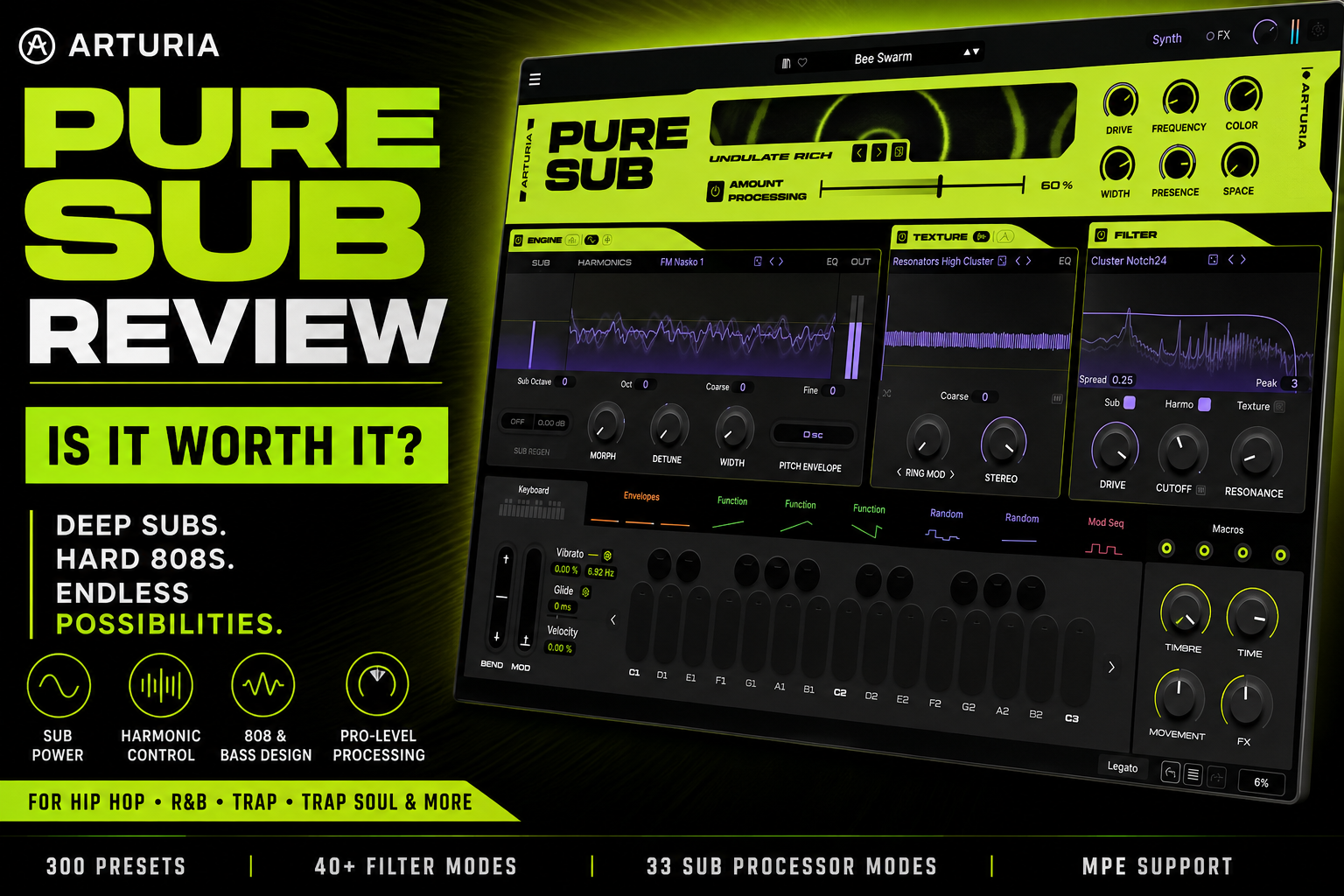
 If you make Hip Hop, R&B, Trap, or any other genre that depends heavily on powerful low end, finding the right bass sound can make or break a track. You can spend a surprising amount of time layering synths, shaping 808s, adding saturation, and trying to get a bass to hit properly without destroying the rest of your mix.
Arturia Pure SUB is designed to make that process much more straightforward.
Rather than trying to be another do-everything synthesizer, Pure SUB focuses specifically on bass and sub-bass sound design. It gives producers dedicated tools for creating deep subs, aggressive basses, textured low end, Reese-style sounds, and modern 808s from one streamlined instrument.
In this Arturia Pure SUB review, we’ll look at what the plugin does, its most important features, how it can fit into Hip Hop and R&B production, and whether it’s worth adding to your plugin collection.
What Is Arturia Pure SUB?
Arturia Pure SUB is a software synthesizer built specifically for creating bass sounds.
That distinction is important.
Most synthesizers give you oscillators, filters, envelopes, modulation, and effects and leave you to build your bass patch from the ground up. Pure SUB takes a more focused approach by organizing the sound around three main components:
- Sub
- Harmonics
- Texture
These layers allow you to control the fundamental low end separately from the harmonics and upper-frequency character of the sound.
That’s incredibly useful when producing bass-heavy music.
You might want a clean sine-like foundation underneath an 808 while introducing distortion, movement, or texture higher in the frequency spectrum. Pure SUB gives you dedicated control over those characteristics without requiring a complicated multi-plugin chain.
The result is an instrument that feels purpose-built for modern bass production.
The Pure SUB Interface
One of the first things I like about Pure SUB is its relatively focused workflow.
Bass sound design can become complicated quickly. Once you’re stacking oscillators, adding saturation, modulating filters, and processing the low end, it’s easy to lose track of what is actually improving the sound.
Pure SUB organizes the process around the three primary sound layers.
Sub
The Sub section handles the fundamental weight of your bass.
This is where much of the deep low-frequency information comes from.
For Hip Hop and R&B producers, this is particularly important because the sub often needs to remain stable underneath everything else happening in the sound.
Instead of adding distortion directly to your entire bass and potentially making the low frequencies unstable, you can maintain a powerful foundation while shaping other parts of the sound separately.
Harmonics
The Harmonics section adds the frequency information that helps your bass develop character and remain audible on smaller playback systems.
This matters more than you might think.
A bass can sound enormous through studio monitors or a subwoofer but practically disappear when someone plays the track through a phone or small Bluetooth speaker.
Harmonic content helps listeners perceive that bass even when the speaker can’t reproduce the lowest frequencies.
It’s also where you can start pushing Pure SUB toward more aggressive bass tones, Reese-style sounds, and other character-heavy patches.
Texture
The Texture section adds another layer of sonic character.
This is useful when you don’t want your bass to sound like a completely clean synthesizer.
Texture can help give a sound additional movement, grit, atmosphere, or personality.
For darker R&B and Trap Soul production, this can be especially useful. A slightly textured bass often sits beautifully underneath atmospheric keys, pads, vocal samples, and washed-out melodies.
The Sub Processor Is One of the Highlights
Pure SUB also includes its dedicated Sub Processor, which provides numerous processing modes for transforming the low end.
This is where the plugin becomes more than a simple sub-bass generator.
You can create different flavors of low-frequency character without immediately reaching for another distortion, saturation, or bass-enhancement plugin.
That’s valuable because bass processing often involves several stages.
A typical bass chain might include:
Synth → saturation → EQ → compression → distortion → limiter
Pure SUB won’t necessarily eliminate every piece of external processing, but having specialized processing inside the instrument can dramatically speed up the sound-design stage.
You can get much closer to a finished bass before reaching for your mixer.
Filters and Sound Shaping
Filtering is another major component of bass sound design.
Pure SUB offers a large selection of filter modes, giving you plenty of options for controlling the frequency spectrum and changing the personality of a patch.
For example, you could create a bright, harmonically rich bass and then use filtering to tame the top end.
Or you could automate or modulate the filter to introduce movement.
This becomes especially interesting for basslines that need to evolve throughout an arrangement.
Instead of playing the same static bass patch for three minutes, subtle changes in filtering, harmonics, and texture can make different sections feel more alive.
Modulation
Pure SUB also provides modulation capabilities for adding movement to your bass sounds.
This opens up considerably more possibilities than simply creating a static 808.
You can use modulation to influence different parameters and create patches that change as you play.
That makes Pure SUB useful for sounds such as:
- Evolving sub basses
- Reese basses
- Pulsating basslines
- Distorted Trap basses
- Moving electronic basses
- Experimental low-end textures
Even subtle modulation can make a bass sound more interesting without distracting from the rest of your beat.
Built-In Effects
Arturia also includes effects for further processing your sounds inside Pure SUB.
This is another workflow advantage.
Sometimes you just want to load an instrument, design the sound, and start making music rather than building a huge processing chain.
Having effects available directly inside the synth means you can shape the character of the bass while you’re creating the patch.
External effects are still useful for final mixing, but Pure SUB gives you enough sound-shaping power to create production-ready starting points.
The Preset Library
Pure SUB includes 300 presets, which is a substantial library for an instrument dedicated primarily to bass.
And presets are especially valuable with a plugin like this.
Not every producer wants to become an expert synthesizer programmer.
Sometimes you’re making a beat and simply need the right bass right now.
A good workflow could be:
- Find a preset close to the sound you want.
- Adjust the Sub level.
- Change the Harmonics.
- Modify the Texture.
- Shape the filter.
- Adjust processing to fit the beat.
You’re designing your own sound without necessarily starting from an initialized patch every time.
For beginners, presets also provide an excellent way to learn the synth. Load a sound you like and study how its different layers interact.
Making 808s With Arturia Pure SUB
This is probably going to be one of the biggest attractions for Hip Hop and Trap producers.
Pure SUB is very well suited to 808-style bass design.
An 808 needs more than low frequencies to work properly in a modern mix. You generally need to think about:
Fundamental + harmonics + character + dynamics
Pure SUB’s architecture lines up nicely with that concept.
The Sub layer can provide the fundamental.
The Harmonics layer can help the 808 cut through the mix.
Texture can add character.
Then the internal processing can push the sound toward something cleaner, warmer, dirtier, or more aggressive.
That gives you significantly more control than simply loading the same 808 sample into every beat.
You can create an 808 specifically for the song you’re producing.
Pure SUB for Hip Hop Production
Pure SUB makes a lot of sense for Hip Hop.
You could use it for everything from clean subs underneath sample-based production to aggressive bass sounds for modern Trap.
For a darker Hip Hop beat, for example, I might start with a simple sub foundation and introduce enough harmonic information to make the bass audible without overpowering the sample.
For Trap, I’d push the processing harder and create something closer to a distorted 808.
For melodic Hip Hop, I might use a smoother bass patch and actually play a more involved bassline.
Because Pure SUB is an instrument rather than simply an 808 sample pack, you’re not locked into one style of bass.
Pure SUB for R&B and Trap Soul
This may be where Pure SUB gets especially interesting.
Modern R&B often needs bass that is deep without being overly aggressive.
Think about a production built around:
- Rhodes or electric piano
- Atmospheric pads
- Soft drums
- Vocal textures
- Sparse percussion
- Deep sub bass
The bass needs to fill the bottom of the track without taking attention away from the vocal or chords.
Pure SUB gives you enough control to create those smooth, understated bass tones.
You could keep the Sub layer prominent while using just enough harmonics to make the sound translate across different speakers.
For darker Trap Soul, you can push the harmonics and texture harder and create something with more attitude.
Pure SUB vs Using 808 Samples
One question worth asking is:
Why use Pure SUB when you already have hundreds of 808 samples?
Samples are definitely faster.
If you already have the perfect 808 for your beat, there’s nothing wrong with dragging it into your DAW and getting to work.
Pure SUB becomes valuable when you want more control.
With a sample, you’re modifying an already-recorded sound.
With a synthesizer, you’re creating the sound itself.
That means you can tailor characteristics such as the fundamental, harmonics, filtering, movement, texture, and processing around the actual song.
You also aren’t constantly searching through folders named things like:
808_Final_Hard_27.wav
Sometimes designing the bass is actually faster than browsing through hundreds of samples.
What I Like About Arturia Pure SUB
The biggest strength of Pure SUB is its focus.
Arturia isn’t trying to give you another massive synthesizer with endless pages of parameters.
The instrument has a specific job:
Create great bass sounds.
I like the separation between Sub, Harmonics, and Texture because it encourages you to think about bass in layers.
That’s useful not only for sound design but also for mixing.
I also like that the instrument can cover several different bass-production workflows.
You can make clean subs.
You can make 808s.
You can create Reese basses.
You can create distorted bass.
You can build evolving bass patches.
And you can do it without assembling an enormous plugin chain.
Potential Downsides
Pure SUB isn’t necessarily something every producer needs.
If you already own a powerful synthesizer and you’re comfortable designing bass patches from scratch, you can probably create many similar sounds with tools you already have.
Likewise, if your entire bass workflow revolves around samples and you’re happy with the results, Pure SUB may not completely change how you work.
Its value comes primarily from speed, specialization, and workflow.
You’re getting a synth designed specifically around the process of creating low end.
For producers who make bass-heavy music regularly, that specialization can be a major advantage.
Who Should Buy Arturia Pure SUB?
Pure SUB makes the most sense for producers working in genres such as:
- Hip Hop
- Trap
- R&B
- Trap Soul
- Electronic music
- Pop
- Bass-heavy cinematic music
I’d especially consider it if you frequently find yourself searching through 808 folders trying to find something that fits your beat.
Instead of searching for the perfect bass sample, Pure SUB gives you the tools to build the bass around the song.
That’s a completely different workflow.
Is Arturia Pure SUB Good for Beginners?
Yes.
In fact, I think its focused architecture could make it easier to understand than some larger synthesizers.
Instead of immediately dealing with dozens of oscillators, modulation matrices, envelopes, and routing options, beginners can focus on the three basic components of the sound.
Start with the Sub.
Add Harmonics.
Introduce Texture.
Then process the result.
That workflow teaches some important sound-design concepts without making the process unnecessarily intimidating.
Is Arturia Pure SUB Worth It?
For producers who regularly make bass-heavy music, Arturia Pure SUB is definitely worth considering.
Its biggest advantage isn’t that bass sounds can’t be created with other synthesizers.
They absolutely can.
The advantage is that Pure SUB puts the tools you need for modern bass design into a workflow built specifically for the job.
The separation of Sub, Harmonics, and Texture gives you meaningful control over the different components of the sound, while the Sub Processor, filters, modulation, effects, and large preset library provide plenty of room for deeper sound design.
For Hip Hop, R&B, Trap, and Trap Soul producers in particular, there’s a lot here to work with.
You can create smooth subs for R&B, heavy 808s for Trap, gritty basses for Hip Hop, and more experimental sounds without leaving the instrument.
Final Verdict
Arturia Pure SUB takes one of the most important elements of modern music production—the low end—and builds an entire instrument around it.
That’s what makes it interesting.
It isn’t trying to replace every synthesizer in your collection. Instead, it’s designed to become the synth you reach for when your track needs bass.
If you’re perfectly happy working exclusively with 808 samples, you may not need it.
But if you want greater control over your low end and like the idea of designing bass sounds specifically for each track, Pure SUB offers a focused and powerful workflow.
For Hip Hop and R&B producers, I think that’s where the plugin makes the strongest argument for itself.
Rating: 4.5/5
Pros
- Purpose-built for bass and sub-bass design
- Excellent fit for Hip Hop, Trap, R&B, and Trap Soul
- Separate Sub, Harmonics, and Texture controls
- Powerful internal bass processing
- Large selection of filters
- Modulation for evolving bass sounds
- 300 factory presets
- Great option for creating custom 808s
- Beginner-friendly approach to bass sound design
Cons
- Producers with advanced synths may already have similar sound-design capabilities
- Sample-based producers may prefer the speed of traditional 808 libraries
- Specialized nature means it won’t replace a general-purpose synthesizer
Bottom Line
Arturia Pure SUB is a specialized bass synthesizer that makes it easier to create custom subs, 808s, Reese basses, and modern low-end sounds. If Hip Hop, R&B, or Trap is a major part of your production workflow, Pure SUB is well worth checking out.