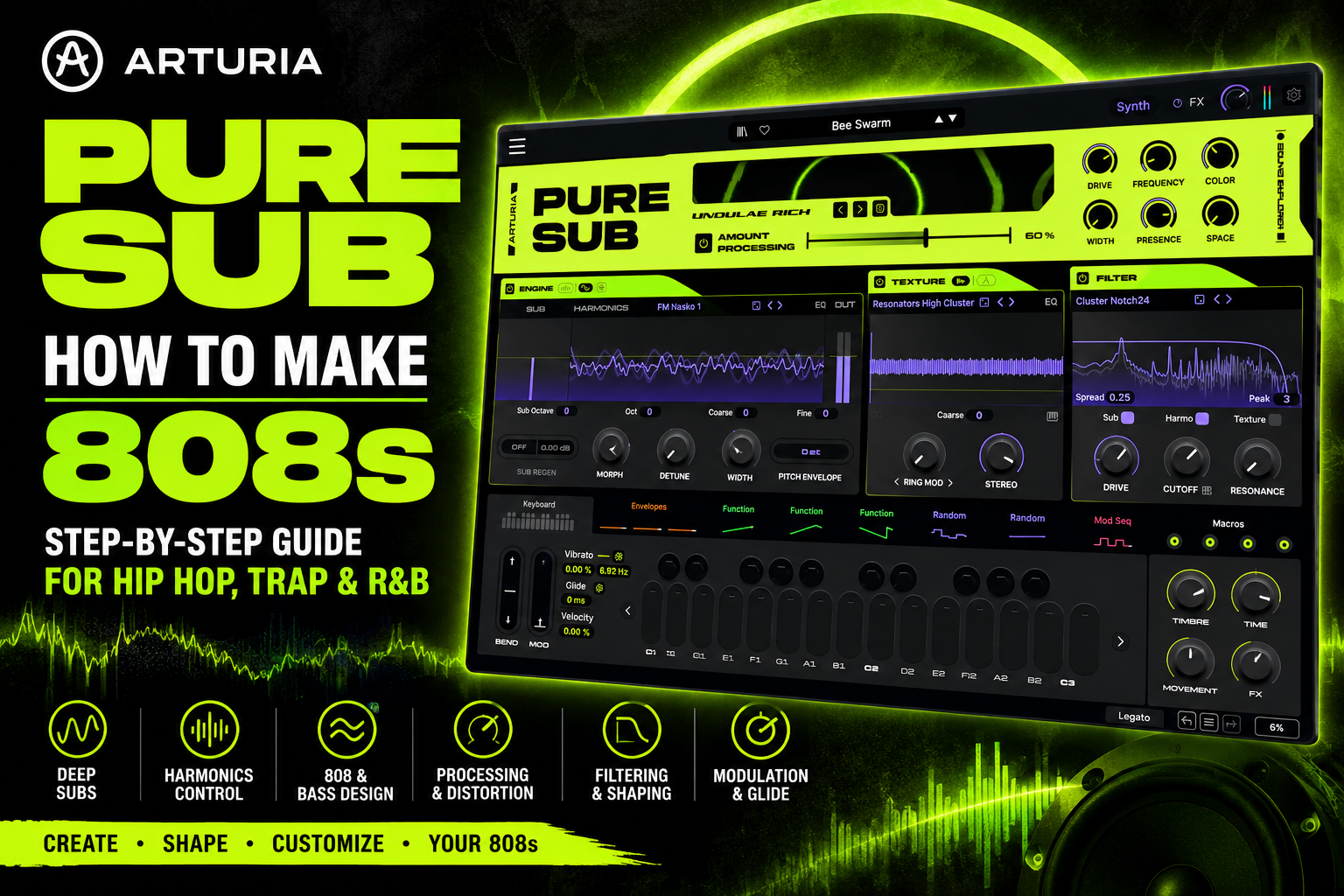
 808s are one of the most important sounds in modern Hip Hop, Trap, R&B, and Trap Soul.
But getting an 808 right isn’t always as simple as loading a sample and playing the root notes of your chord progression.
Sometimes the 808 doesn’t hit hard enough. Sometimes it sounds great through studio monitors but disappears on smaller speakers. Other times, adding enough distortion to make it audible destroys the clean sub frequencies underneath it.
Arturia Pure SUB gives you another approach.
Instead of searching through folders for an 808 that happens to fit your beat, you can design one specifically for the track you’re making.
Pure SUB separates your bass into Sub, Harmonics, and Texture, while giving you additional tools for pitch shaping, filtering, drive, distortion, processing, glide, modulation, and low-end control.
In this guide, we’ll look at how to make 808s with Arturia Pure SUB from the ground up and how to shape them for Hip Hop, Trap, R&B, and Trap Soul.
Why Use Arturia Pure SUB for 808s?
There are thousands of great 808 samples available.
So why bother synthesizing your own?
The biggest advantage is control.
When you use an 808 sample, you’re starting with a sound that has already been designed and processed.
You can manipulate it, but you’re still working backward from someone else’s finished sound.
Pure SUB allows you to build the 808 around your track.
You can control:
- The fundamental
- Harmonic content
- Attack
- Pitch movement
- Texture
- Distortion
- Filtering
- Stereo character
- Glide
- Processing
- Overall output
That means your 808 doesn’t have to be forced into the beat.
You can make the 808 fit the beat.
Understanding What Makes a Great 808
Before opening Pure SUB, it helps to understand what you’re actually trying to create.
A modern 808 can generally be thought of as several components working together.
The Fundamental
This is the deep sub frequency that provides the weight.
It’s the part you feel through larger speakers and subwoofers.
Harmonics
Harmonics give the 808 additional frequencies above the fundamental.
These are extremely important for making an 808 audible through phones, laptops, earbuds, and smaller speakers.
Attack
The beginning of the 808 determines how hard it hits.
A quick pitch movement or transient can give the sound additional punch.
Character
Saturation, distortion, filtering, and other processing determine whether your 808 sounds clean, warm, dirty, aggressive, or completely destroyed.
Movement
Glide and pitch changes allow your 808 to become part of the musical performance rather than simply playing static root notes.
Pure SUB gives you control over all of these elements.
Step 1: Start With a Clean Sub
Start your 808 with the Sub section.
At this stage, don’t worry about making the sound aggressive.
You want a clean foundation.
Play a sustained note and listen to the low-frequency energy.
This is the core of your 808.
Keep the sound relatively simple because everything else we’re going to add will sit on top of this foundation.
Think:
Clean Sub → Harmonics → Attack → Texture → Processing
Starting clean gives you much more control later.
Step 2: Find the Right Octave
Before adding anything else, make sure your 808 is sitting in the correct octave.
This is more important than it seems.
If your 808 is too high, it won’t have enough weight.
But if it’s too low, the fundamental may become difficult to hear.
Extremely low notes can also consume huge amounts of headroom without necessarily sounding more powerful.
Move your bassline between octaves and listen.
You want the 808 to feel deep while still maintaining definition.
Don’t choose an octave based entirely on what the MIDI note looks like.
Use your ears.
Step 3: Tune the 808 to Your Beat
Your 808 needs to work musically with your song.
If your beat is in E minor, for example, an E should sound like home.
But that doesn’t mean every 808 note needs to be E.
Your bassline can follow:
- Root notes
- Chord tones
- Scale tones
- Passing tones
- Octaves
Start by following the root notes of your chord progression.
Once that works, experiment with additional notes.
This is where an 808 stops functioning like a sound effect and starts becoming an actual instrument.
Step 4: Create the 808 Attack With the Pitch Envelope
One of the easiest ways to make an 808 hit harder is using a Pitch Envelope.
Instead of starting immediately at the fundamental pitch, the sound can begin slightly higher and quickly fall into the correct note.
Think:
Punch → Pitch Drop → Sub
This creates additional impact at the beginning of the 808.
Start with a small amount.
You don’t necessarily want to hear an obvious laser-like pitch drop.
You want to feel the attack.
For smoother R&B and Trap Soul 808s, keep the pitch envelope subtle.
For harder Trap production, experiment with a more aggressive pitch movement.
Step 5: Add Harmonics
Now we need to make the 808 audible beyond the sub frequencies.
Move into the Harmonics section.
This is one of the most important steps when designing an 808.
A completely clean sub can sound incredible through a large monitoring system.
Then you play the beat through your phone and wonder:
Where did my 808 go?
The problem isn’t necessarily volume.
The speaker simply can’t reproduce those extremely low frequencies.
Adding harmonics gives the 808 information higher in the frequency spectrum.
That helps the bass remain perceptible even when the deepest fundamental isn’t being reproduced.
Step 6: Start With Pressure Harmonics
For a traditional Hip Hop or Trap 808, I’d start with Pressure in the Harmonics section.
Add it gradually.
You don’t want to completely replace the clean Sub.
You’re layering additional harmonic character around it.
Think:
Sub = Weight
Harmonics = Audibility
Play the beat while increasing the Harmonics.
Stop when the 808 becomes easier to hear without losing its deep foundation.
This is usually more effective than simply turning the entire 808 louder.
Step 7: Experiment With Morph
Now experiment with Morph.
Morph changes the harmonic character of the sound.
Hold an 808 note and slowly move the Morph control.
You’ll hear the personality of the bass change.
Some positions may sound cleaner.
Others may sound more aggressive.
Others may give you additional midrange character.
Find the position that works with your beat.
Don’t design the 808 entirely in solo.
Keep switching back to the full instrumental.
The goal isn’t to create the most impressive 808 by itself.
The goal is to create the right 808 for the song.
Step 8: Add Texture
Next, move into the Texture section.
Texture can add additional detail to the 808.
Depending on how you configure it, you can introduce:
- Grit
- Noise
- Metallic character
- Additional attack
- Distortion-like qualities
- Movement
For most Hip Hop and R&B 808s, you probably won’t need much.
Start subtle.
You might barely hear the Texture when the 808 is soloed.
But inside the full mix, that additional information can help the sound cut through.
For aggressive Trap production, you can push Texture much harder.
Step 9: Shape the 808 With the Filter
Now use Pure SUB’s Filter section to control the tonal balance.
If your Harmonics and Texture have made the 808 too bright, use filtering to tame the upper frequencies.
This allows you to create an aggressive sound without letting the bass dominate the entire frequency spectrum.
For a dark Trap Soul 808, try rolling off some of the brighter harmonic information.
For harder Trap, leave more upper-frequency content.
The filter can become one of the easiest ways to move between:
Dark and smooth
and
Bright and aggressive.
Step 10: Add Filter Drive
Once the basic filtering sounds right, experiment with Drive.
Drive introduces additional harmonic character.
This is where the 808 can start sounding noticeably more aggressive.
Start low.
Increase the Drive while the entire beat is playing.
Listen to what happens around your kick, snare, melodies, and other instruments.
For R&B:
Use less Drive.
For Trap Soul:
Try moderate Drive.
For hard Trap:
Push it further.
There’s no magic number.
The correct amount depends on the track.
Step 11: Use Sub Regen to Protect the Low End
This is where Pure SUB becomes especially interesting for 808 design.
One of the biggest problems with aggressive 808 processing is that distortion can affect the fundamental.
You add saturation.
Then more distortion.
Then clipping.
Suddenly the 808 sounds aggressive, but the bottom end doesn’t feel as stable.
Sub Regen can help you maintain a cleaner low-frequency foundation while processing the rest of the sound.
The concept is extremely useful:
Clean fundamental + aggressive upper harmonics
That’s often what you’re trying to achieve with a modern 808.
You want the bottom to remain powerful and controlled while the upper frequencies provide attitude.
If you’re heavily processing your 808, experiment with Sub Regen and listen to how it changes the foundation.
Step 12: Push the Sub Processor
Now move to Pure SUB’s Sub Processor.
This is where you can start getting creative.
The Sub Processor gives you different ways to transform and process the bass.
Instead of immediately stacking several external distortion plugins, experiment with the processing available directly inside Pure SUB.
Choose a processing mode and slowly increase the Amount Processing control.
Listen for three things:
Is it easier to hear?
Does the low end remain controlled?
If the first two improve but the third gets worse, you’ve probably pushed the processing too far.
Back it down.
Step 13: Don’t Confuse Louder With Better
This is extremely important when processing 808s.
Distortion, saturation, and limiting can make a sound louder.
And louder sounds usually seem better.
That can trick you into over-processing your bass.
Try comparing your processed and unprocessed 808s at similar perceived volumes.
Then ask yourself:
Did the processing actually improve the character?
If not, remove it.
Your goal isn’t maximum loudness during sound design.
Your goal is an 808 that works inside the mix.
Step 14: Use Presence for Translation
If your 808 still disappears on smaller speakers, experiment with Presence.
But don’t immediately reach for Presence without considering your Harmonics first.
The combination of harmonic content and presence can help the bass occupy frequencies that smaller speakers reproduce more easily.
A useful test is to listen at very low volume.
If you can still understand what the 808 is doing without relying entirely on the sub frequencies, you’re moving in the right direction.
Step 15: Be Careful With Width
Pure SUB also gives you control over Width.
This can make bass sounds feel much larger.
But use stereo width carefully with 808s.
The deepest frequencies generally benefit from remaining focused near the center of the stereo image.
You can allow some of the higher harmonic information to become wider while maintaining a solid foundation underneath.
Think:
Mono-ish Sub + Wider Harmonics
rather than:
Entire 808 extremely wide.
That tends to create a much more stable low end.
Step 16: Add Glide for Sliding 808s
Now we’re getting into one of the defining techniques of modern Trap production.
Glide allows your 808 to slide from one note into another.
Instead of:
C → G
you hear:
C ↗ G
with the pitch smoothly traveling between the notes.
Start with a short Glide time.
Then create overlapping MIDI notes.
Increase the Glide until the transition matches the rhythm of your beat.
Don’t Slide Every 808 Note
One of the easiest ways to make an 808 pattern sound amateurish is sliding everything.
Use slides as accents.
For example:
Root → Root → Fifth → Slide → Octave
That one slide can make the entire pattern feel more interesting.
Save your dramatic slides for important moments such as:
- End of every 4 bars
- End of every 8 bars
- Transition into the hook
- Drum fills
- Melody changes
This turns the slide into an arrangement tool rather than a gimmick.
Step 17: Create Variation With Octaves
Another easy technique is using octave changes.
Let’s say your 808 pattern is centered around E.
Instead of playing the same E every time, occasionally jump up an octave.
That immediately creates movement without changing the harmonic function of the bassline.
Try combining octave jumps with Glide.
You can create some very expressive 808 movements with only one note name.
Step 18: Leave Space for the Kick
Your 808 doesn’t have to play every time the kick hits.
And your kick doesn’t have to hit every time the 808 plays.
Space can make both sounds feel bigger.
Try creating a conversation between them.
Kick → 808 → Kick + 808 → Space → 808
That can be much more interesting than stacking both sounds together on every beat.
The exact relationship depends on your production style.
Some Trap beats intentionally layer them heavily.
Some R&B productions allow the kick and bass to operate more independently.
The important thing is making the relationship intentional.
Step 19: Check Your 808 in the Full Mix
Don’t spend 30 minutes designing an 808 in solo.
The sound might be incredible by itself and terrible in the beat.
Regularly play:
Kick + 808
Then:
Drums + 808
Then:
Entire beat
Listen for frequency conflicts.
Does the kick disappear?
Does the 808 overpower the chords?
Does the entire mix become muddy?
Does the bass disappear when the melody enters?
These questions matter more than how impressive the 808 sounds by itself.
Step 20: Keep the Final Processing Simple
Pure SUB gives you plenty of processing options, but that doesn’t mean you need to use all of them.
Your final 808 might only need:
EQ → Saturation → Dynamics
Or it might already sound finished directly from Pure SUB.
Don’t add plugins simply because you think an 808 is supposed to have a huge processing chain.
Solve actual problems.
If there’s no problem, don’t create one.
How To Make a Clean R&B 808 With Pure SUB
For R&B, I’d keep the 808 warm and controlled.
Try this workflow:
Clean Sub
↓
Light Pressure Harmonics
↓
Subtle Pitch Envelope
↓
Minimal Texture
↓
Gentle Low-Pass Filtering
↓
Small Amount of Drive
↓
Light Processing
The goal is a deep bass that supports the chords and vocals without drawing too much attention to itself.
Use longer notes and give the arrangement plenty of breathing room.
How To Make a Trap Soul 808 With Pure SUB
For Trap Soul, I’d add more character.
Try:
Strong Sub
↓
Pressure Harmonics
↓
Pitch Envelope
↓
Texture
↓
Low-Pass Filter
↓
Moderate Drive
↓
Sub Processor
↓
Sub Regen
↓
Glide
This gives you the deep foundation of an R&B bass with the movement and aggression of a Trap 808.
Use slides sparingly and let the 808 follow the emotional movement of your chord progression.
How To Make a Hard Trap 808 With Pure SUB
For aggressive Trap, push the processing further.
Try:
Strong Sub
↓
More Harmonics
↓
Aggressive Pitch Envelope
↓
Additional Texture
↓
Filter Drive
↓
Heavy Sub Processing
↓
Sub Regen
↓
Presence
↓
Glide
↓
Final Saturation/Maximization
The trick is preserving the foundation.
You want the upper frequencies to sound aggressive while the bottom remains deep and controlled.
How To Make Your 808s Hit Harder
If your Pure SUB 808 isn’t hitting hard enough, don’t immediately turn it up.
Check these areas first.
Add a Short Pitch Envelope
This can give the beginning of the 808 additional impact.
Increase Harmonics
This makes the bass more audible.
Add Drive
A little saturation can increase perceived aggression.
Use the Sub Processor
Add additional character.
Check the Octave
Your 808 may simply be playing too low.
Check the Kick
Your kick may be masking the beginning of the 808.
Leave More Space
Sometimes removing other low-frequency information makes the 808 feel dramatically bigger.
The answer isn’t always more processing.
Sometimes the arrangement is the problem.
How To Make Pure SUB 808s Translate on Phones
This is where harmonic content becomes extremely important.
Your phone can’t reproduce the same sub frequencies as a studio monitor or subwoofer.
So instead of trying to make the fundamental louder, create information above it.
Use:
Harmonics + Drive + Texture + Saturation
to generate frequencies that smaller speakers can reproduce.
But maintain your clean fundamental underneath.
That’s the balance you’re looking for:
Subwoofer hears the fundamental.
Phone hears the harmonics.
Your brain interprets both as the same bass.
Common 808 Mistakes to Avoid
Too Much Distortion
Aggression is good until you destroy the low end.
Too Much Sub
More low-frequency energy doesn’t automatically mean a bigger bass.
Playing Too Low
Extremely low notes can disappear on normal speakers.
Too Many Slides
Slides become less effective when every note uses them.
Overly Complicated Patterns
808s often work best when they’re rhythmically simple.
Designing in Solo
Always judge the bass inside the beat.
Ignoring the Kick
Your kick and 808 share valuable low-frequency space.
Treat them as a team.
A Simple Pure SUB 808 Recipe
If you’re just getting started, try this:
1. Start With a Clean Sub
Establish the fundamental.
2. Add a Small Pitch Envelope
Create the attack.
3. Add Pressure Harmonics
Improve translation.
4. Adjust Morph
Find the right character.
5. Add a Little Texture
Introduce grit.
6. Filter the Sound
Control the brightness.
7. Add Drive
Increase aggression.
8. Experiment With the Sub Processor
Add additional character.
9. Use Sub Regen
Maintain a strong fundamental.
10. Add Glide
Create musical slides.
11. Check the Kick
Make sure the two sounds work together.
12. Test on Different Speakers
Make sure the 808 translates.
That’s enough to create a very usable 808 without turning Pure SUB into an unnecessarily complicated sound-design session.
Should You Use Pure SUB Instead of 808 Samples?
Not necessarily.
There’s nothing wrong with using 808 samples.
Samples are fast.
If you have the perfect 808 sitting in your library, use it.
Pure SUB becomes useful when you can’t find exactly what your track needs.
Instead of scrolling through 100 samples, you can create the sound yourself.
You can determine exactly how much Sub, Harmonics, Texture, distortion, attack, and movement you want.
You can also create variations specifically for different songs.
One beat might need a clean 808.
Another might need a distorted 808.
Another might need something between an R&B sub bass and a Trap 808.
Pure SUB gives you the flexibility to create all three.
Final Thoughts
Learning how to make 808s with Arturia Pure SUB is really about learning what makes an 808 work.
Start with a clean Sub to create the foundation.
Use the Pitch Envelope to give the sound attack.
Add Harmonics so the bass remains audible across different speakers.
Use Texture, filtering, and Drive to create character.
Experiment with the Sub Processor when you need additional aggression.
Use Sub Regen to help maintain a strong low-frequency foundation when you’re processing heavily.
Then use Glide and octave changes to turn the 808 into a musical part of your arrangement.
Most importantly, design the 808 while listening to the beat.
The goal isn’t to make the biggest 808 possible.
The goal is to create an 808 that works perfectly with your drums, melodies, chords, and overall production.
That’s where Arturia Pure SUB really starts to make sense.
Instead of searching for the perfect 808, you can build the perfect 808 for the track you’re making.