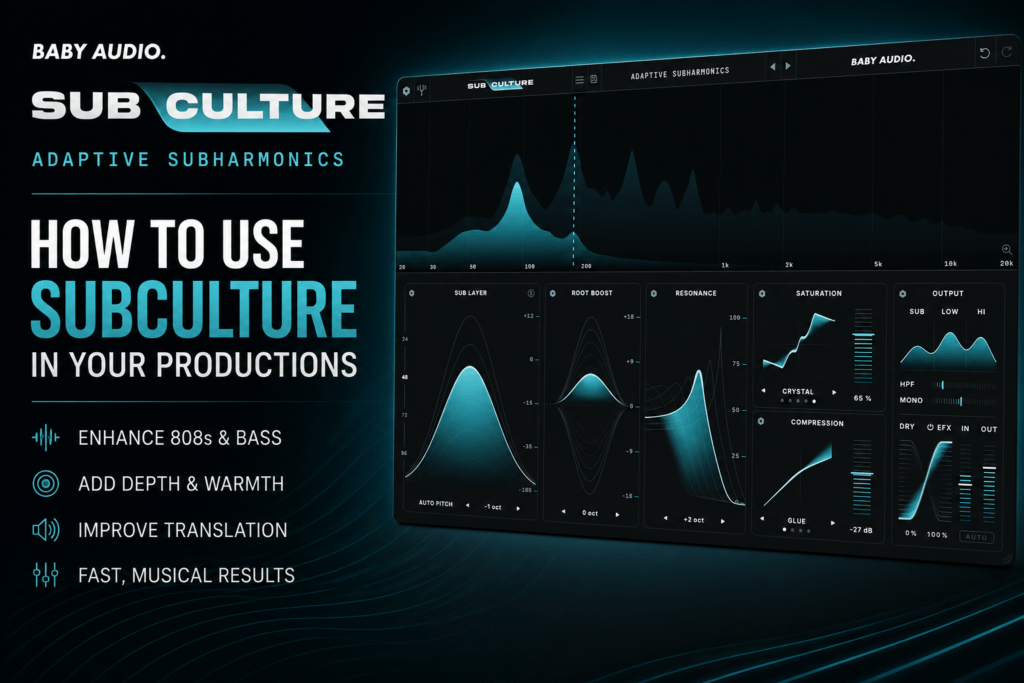
 Introduction
A great mix starts with a solid foundation, and nothing provides a stronger foundation than a well-balanced low end. Whether you’re producing hip-hop, trap, R&B, EDM, or pop, your bass needs to feel powerful without overpowering the rest of the track.
That’s exactly where Baby Audio SubCulture shines.
Unlike traditional bass enhancers that simply boost low frequencies, SubCulture intelligently tracks the pitch of your audio and generates musically accurate subharmonics. The result is bass that sounds deeper, fuller, and more consistent while remaining clean and controlled.
In this guide, you’ll learn practical ways to incorporate Baby Audio SubCulture into your productions, from strengthening 808s to adding warmth to vocals and synths.
Start with Your 808s
For many producers, 808s are the backbone of a beat.
Sometimes an 808 sounds great on studio monitors but disappears on smaller speakers. Other times it has plenty of low end but lacks definition.
SubCulture can solve both problems.
Recommended Workflow
- Load your favorite 808 sample.
- Insert SubCulture after any corrective EQ.
- Increase the Sub Layer until the bass feels fuller.
- Use Root Boost to reinforce the fundamental note.
- Add a small amount of Saturation for extra harmonics.
- Blend using the Output Mix controls.
The goal isn’t to make the bass louder—it’s to make it sound bigger while maintaining clarity.
Give Synth Bass More Weight
Many software synths produce clean bass that lacks physical impact.
SubCulture can transform those sounds into something much more substantial.
This works particularly well for:
- Reese basses
- Analog synth bass
- Moog-style bass patches
- Plucks
- Deep house basslines
Rather than stacking another synth underneath, SubCulture creates additional low-frequency information that follows every note naturally.
Strengthen Live Bass Guitar
Live bass recordings often have inconsistent low end.
Some notes feel huge while others disappear.
SubCulture’s adaptive pitch tracking helps balance those differences by reinforcing each note individually.
After recording your bass:
- Apply gentle compression.
- Insert SubCulture.
- Use moderate Root Boost.
- Add subtle Saturation.
- Blend to taste.
The result feels like a better bass performance instead of obvious processing.
Add Warmth to Kick Drums
Not every kick drum needs more attack.
Sometimes it simply needs more body.
Using SubCulture on kicks allows you to add weight without reaching for aggressive EQ boosts.
A little goes a long way.
Focus on:
- Low Sub Layer settings
- Mild compression
- Conservative saturation
This approach works especially well in trap, R&B, and cinematic productions.
Make Vocals Sound Bigger
This may surprise some producers, but SubCulture can also work on vocals. Especially if your vocalist has that Toni Braxton vibe.
For deeper male vocals, adding a touch of subharmonic enhancement can create a richer, more intimate sound.
Use subtle settings.
Too much low-end enhancement can make vocals muddy.
Instead:
- Keep the mix below 20%.
- Add gentle Saturation.
- Use Root Boost sparingly.
This works particularly well for spoken word, podcasts, R&B, and hip-hop vocals. Try it out on vocals especially; you’ll be pleasantly surprised.
Add Character to Lead Synths
Lead synths often sound bright but lack depth.
SubCulture can create a fuller tonal balance by adding controlled low-frequency harmonics underneath the existing sound.
This is especially effective for:
- Analog leads
- Retro synthwave sounds
- Future bass leads
- Pop melodies
Because the plugin tracks pitch automatically, the added low end stays musical throughout the performance.
Improve Layered Bass Sounds
Many producers stack multiple bass sounds.
For example:
- Sub bass
- Mid bass
- Distorted bass
- Synth bass
Instead of boosting all of them equally, place SubCulture on your bass bus.
This helps glue the entire bass section together while reinforcing the musical foundation.
The built-in compression also helps create a more cohesive sound.
Use Saturation to Improve Translation
One of the biggest challenges in modern production is making bass audible on phones, laptops, and earbuds.
Deep sub frequencies often disappear on smaller speakers.
That’s where SubCulture’s Saturation section becomes extremely valuable.
By introducing harmonic content above the fundamental frequency, listeners perceive more bass even when the deepest frequencies can’t be reproduced.
It’s a subtle trick used in countless professional mixes.
Automate the Effect
One overlooked feature of creative bass processing is automation.
Instead of leaving SubCulture static throughout the song, automate its parameters.
Try increasing:
- Sub Layer during choruses
- Saturation before drops
- Compression during hooks
- Mix amount during transitions
These subtle changes create movement and excitement without overwhelming the listener.
Keep Your Low End in Mono
Most professional mixes keep deep bass centered.
SubCulture includes mono bass controls that help ensure your low frequencies remain focused.
This improves:
- Club playback
- Vinyl compatibility
- Streaming consistency
- Mono compatibility
Even if your synths are wide, keeping the sub frequencies centered creates a tighter, more professional mix.
Less Is More
One of the easiest mistakes producers make is adding too much bass.
SubCulture is capable of dramatic results, but subtle settings almost always sound more professional.
A good rule is this:
If you immediately notice the effect, you’ve probably gone too far.
The best bass enhancement is often felt more than heard.
Final Thoughts
Baby Audio SubCulture isn’t just another bass booster—it’s an intelligent low-end enhancement tool that can improve nearly every stage of your production. Whether you’re reinforcing an 808, adding weight to a synth bass, warming up a vocal, or tightening a bass guitar, its adaptive pitch tracking helps create deeper, more musical results than traditional EQ alone.
The key is to use it with intention. Focus on enhancing what’s already working rather than trying to fix a poor sound at the source. With subtle adjustments to the Sub Layer, Root Boost, Saturation, and Compression controls, SubCulture can become a go-to plugin for creating mixes with a solid, polished low end.
If your productions rely on impactful bass—and most modern genres do—learning how to use Baby Audio SubCulture effectively can elevate your mixes while simplifying your workflow.