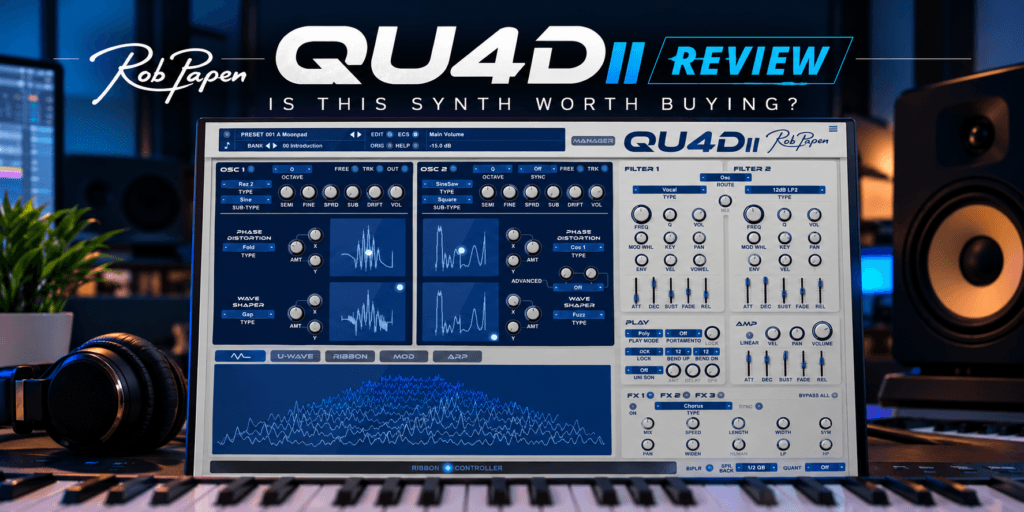
 Rob Papen Quad-2 Review: Is This Synth Worth Buying?
The virtual synthesizer market is crowded with powerful instruments, but every once in a while, a plugin comes along with an approach that makes it worth exploring.
Rob Papen Quad-2 is one of those instruments.
Building on the original Quad synthesizer, Quad-2 combines phase distortion, waveshaping, extensive modulation, and an expanded collection of filters to create a flexible sound-design environment.
What’s particularly interesting is its history. The original Quad was developed specifically for Reason as a Rack Extension before eventually becoming available in other plugin formats.
Now, Quad-2 introduces an updated interface, a new Ribbon Controller, expanded effects, and more than 1,200 presets.
But with synthesizers like Serum, Pigments, and Zebra already offering powerful sound-design capabilities, does Quad-2 bring enough to the table to justify another purchase?
In this Rob Papen Quad-2 review, we’ll examine its features, synthesis engine, workflow, and overall value to help you decide whether it’s worth adding to your production setup.
Editor’s note: This is a feature-based evaluation using the manufacturer’s published specifications and product demonstrations, not a claim of extended hands-on testing.
What Is Rob Papen Quad-2?
Rob Papen Quad-2 is a 16-voice virtual synthesizer designed around phase-distortion and waveshaping synthesis.
Unlike traditional subtractive synthesizers that primarily rely on filtering basic waveforms, Quad-2 allows producers to manipulate the harmonic structure of sounds directly at the oscillator level.
Its synthesis architecture combines two oscillators, extensive modulation options, multiple filter configurations, an advanced arpeggiator, and built-in effects.
The result is a synthesizer designed for both preset-based music production and deeper sound design.
Rob Papen Quad-2 at a Glance
| Feature | Specification |
|---|---|
| Developer | Rob Papen |
| Plugin | Quad-2 |
| Synthesis | Phase distortion and waveshaping |
| Polyphony | 16 voices |
| Oscillators | 2 |
| Filter types | 43 standard filter types |
| Presets | 1,200+ |
| Modulation | Extensive modulation matrices and Ribbon Controller |
| Effects | 3 slots, 48 effect types |
| Formats | VST, VST3, AU, AAX |
| Operating systems | Windows and macOS |
| Listed price | $49 USD |
The $49 price reflects the manufacturer’s published price and may change.
Check Rob Papen Quad-2 at Plugin Boutique
What’s New in Rob Papen Quad-2?
Quad-2 is more than a simple visual refresh of the original synthesizer.
Rob Papen has expanded several important areas of the instrument, particularly modulation, filtering, effects, and performance control.
Let’s examine the most significant additions.
1. Redesigned User Interface
One of the first changes is the updated graphical interface.
Synthesizers with extensive modulation systems can become difficult to navigate, particularly when important parameters are spread across multiple sections.
Quad-2 introduces a revised interface with scalable display options of 100%, 125%, 150%, and 200%.
This flexibility is useful for producers working with different monitor sizes and resolutions.
The interface still contains a considerable amount of information, so beginners should expect some learning time.
However, having oscillator shaping, modulation, and filtering controls accessible within the instrument is valuable for sound designers who prefer hands-on editing.
2. New Ribbon Controller
One of Quad-2’s most interesting additions is its Ribbon Controller.
The Ribbon Controller provides an expressive way to manipulate multiple sound parameters simultaneously.
Rather than adjusting several knobs individually, you can assign modulation destinations and control them through a single performance-oriented interface.
Quad-2 includes a dedicated 12-slot Ribbon modulation matrix.
The controller also supports tempo-based spring-back behavior, quantization options, and unipolar or bipolar operation.
For example, you could potentially assign the Ribbon Controller to manipulate filter cutoff, oscillator shaping, and effects parameters together.
This opens the door to evolving sounds that change dramatically during a performance.
For producers creating atmospheric R&B, Trap Soul, or electronic music, that kind of movement can be especially useful.
3. Expanded Filter Options
Filtering is another major area of improvement.
Quad-2 includes 43 standard filter types, along with additional special filter modes.
These include various low-pass, high-pass, band-pass, notch, vocal, and formant options.
The instrument also incorporates filter designs inspired by Rob Papen’s earlier synthesizers, including the Albino-3 Legend Cream Filter.
Having multiple filter types provides more ways to shape a sound after the oscillators generate its harmonic content.
For example, you might use a low-pass filter to soften a bright synthesizer pad or experiment with formant filtering to create vocal-like textures.
The two filters also support different routing configurations.
You can arrange them in series, parallel, and several oscillator-specific configurations.
This makes the filtering section more flexible than a basic single-filter synthesizer.
4. User Waveform Creation
Quad-2 introduces user waveform functionality that allows producers to create custom waveforms.
Instead of relying entirely on the included oscillator shapes, you can draw your own waveform using the available editing controls.
The instrument supports two user waveforms.
This feature provides another way to develop unusual timbres and personalized sound-design starting points.
For producers who enjoy creating sounds from scratch, custom waveform creation can be a valuable addition.
5. Expanded Arpeggiator
Quad-2 also includes an advanced arpeggiator with up to 16 steps.
Its features include ratcheting, swing, multiple playback modes, velocity control, and modulation-oriented sequencing options.
Ratcheting allows individual steps to produce repeated rhythmic events.
This can be particularly useful for creating fast rhythmic patterns, evolving sequences, and electronic melodic textures.
The arpeggiator also includes a Free setting that can be used for modulation purposes.
That means it isn’t limited to simply repeating notes.
It can become part of the sound-design process itself.
Understanding Quad-2’s Synthesis Engine
The real identity of Quad-2 lies in its combination of phase distortion and waveshaping.
These techniques offer different ways to create harmonic complexity.
Phase Distortion
Phase-distortion synthesis changes how a waveform progresses through its cycle.
By altering the phase relationship within the waveform, the synthesizer can generate new harmonic characteristics.
This approach can produce sounds ranging from relatively smooth and musical to bright, metallic, and aggressive.
For producers, phase distortion offers another method of creating interesting tones without relying exclusively on conventional subtractive synthesis.
Waveshaping
Waveshaping modifies the shape of an audio waveform through a mathematical transfer function.
As the waveform changes, its harmonic content changes as well.
Depending on the waveshaping method and amount, the results can range from subtle harmonic enrichment to heavily distorted textures.
Quad-2 provides multiple waveshaping options within its oscillator architecture.
This allows producers to experiment with different harmonic structures before the signal reaches the filters and effects.
Why Combine Phase Distortion and Waveshaping?
The combination is where Quad-2 becomes particularly interesting.
Phase distortion can reshape the waveform’s harmonic behavior, while waveshaping provides another stage of tonal manipulation.
These processes can interact to create sounds that are more complex than either technique alone.
The instrument’s XY controls and modulation system make it possible to animate these changes over time.
Rather than producing a static tone, you can create a sound that evolves as notes are held or modulation sources move.
That makes Quad-2 worth considering for producers interested in experimental textures, animated pads, and expressive synthesizer sounds.
Quad-2 Oscillators: More Than Basic Waveforms
Quad-2 features two main oscillators.
Each includes familiar waveform options such as sine, saw, square, and triangle, alongside additional additive and spectral waveform choices.
The oscillators also provide sub-oscillator options.
Sub-oscillators can be useful for adding low-frequency weight to a sound.
For example, a producer creating a synthesizer bass might combine a harmonically rich main oscillator with a simpler sub-oscillator to reinforce the fundamental frequency.
Quad-2 also includes oscillator spread controls, tuning adjustments, synchronization options, and additional oscillator interaction modes.
These include forms of frequency modulation, phase modulation, ring modulation, and other signal interactions.
The important takeaway is that Quad-2 doesn’t restrict you to one synthesis technique.
Its architecture encourages experimentation.
Modulation: Where Quad-2 Gets Interesting
Modulation is one of the most important aspects of modern synthesizer sound design.
A basic synthesizer can generate a tone.
A well-designed modulation system can turn that tone into something expressive and constantly changing.
Quad-2 provides extensive modulation capabilities through its modulation matrices, envelopes, LFOs, and Ribbon Controller.
Modulation Matrix
The main modulation matrix contains 12 slots.
It supports numerous MIDI, modulation, and audio sources, along with more than 200 available destinations.
This makes it possible to connect different parts of the synthesizer in creative ways.
For example, you could assign an LFO to oscillator shaping while using an envelope to control filter cutoff.
You could then use velocity or the modulation wheel to influence additional parameters.
The result is a patch that responds dynamically to performance and programming.
LFOs and Envelopes
Quad-2 includes two LFOs and multiple envelope generators.
LFOs can be used to create repeated movement, such as vibrato, tremolo, filter sweeps, or rhythmic modulation.
Envelopes control how parameters change over time.
For example, an amplifier envelope can determine whether a sound behaves like a short pluck or a slowly evolving pad.
These tools are essential for creating patches that respond musically rather than sounding static.
How Does Rob Papen Quad-2 Fit Into Hip-Hop and R&B Production?
Although Quad-2 is capable of complex synthesis, its features can also be applied to everyday music production.
For Hip-Hop, R&B, and Trap Soul producers, several sound categories stand out.
Atmospheric Pads
Atmospheric pads are a major part of modern R&B and Trap Soul.
They can create emotional depth without overwhelming the main melody.
Quad-2’s modulation options, filtering, and built-in effects make it a promising instrument for creating evolving pad textures.
A useful starting point would be a warm oscillator sound with a slower amplifier attack, gentle filter movement, and moderate reverb.
The goal would be to create movement without distracting from the vocal or lead instrument.
Synth Bass
Quad-2’s sub-oscillators and harmonic shaping tools provide options for synthesizer bass design.
You could combine a simple low-frequency waveform with a brighter oscillator to create a bass that has both weight and audible character.
However, producers looking specifically for 808-focused bass synthesis may prefer a more specialized instrument.
Quad-2’s strength is flexibility rather than being dedicated to one bass style.
Leads and Melodies
The Ribbon Controller and modulation matrix could be useful for expressive lead sounds.
For example, a producer could create a lead patch with subtle vibrato, filter movement, and delay.
These elements can help a simple melody feel more animated.
Rhythmic Synth Patterns
Quad-2’s expanded arpeggiator makes it a candidate for rhythmic melodic patterns.
Ratcheting and modulation sequencing could be especially useful for creating electronic accents, transitions, and evolving background elements.
For producers who occasionally struggle with static four-bar loops, evolving synthesizer movement can provide additional arrangement possibilities.
Quad-2’s Built-In Effects
Effects play an important role in how a synthesizer sits within a production.
Quad-2 includes three serial effects slots and 48 available effect types.
These cover a variety of processing categories, including delay, reverb, modulation, distortion, filtering, and equalization.
Delay and Reverb
Delay and reverb can help transform simple synthesizer patches into spacious textures.
For example, a short synthesizer pluck can become a rhythmic melodic element when paired with tempo-synchronized delay.
Similarly, a pad can gain additional depth through reverb.
Modulation Effects
Chorus and other modulation effects can add movement and width.
These can be especially useful for pads, electric-style textures, and atmospheric synthesizer sounds.
Distortion and Saturation
Distortion can add harmonic complexity and aggression.
When used carefully, it can help certain synthesizer sounds become more audible within a dense arrangement.
The benefit of having these effects inside Quad-2 is convenience.
You can create and save complete patches without always needing additional effect plugins.
Quad-2 Presets: More Than 1,200 Starting Points
Quad-2 includes over 1,200 presets.
That’s a substantial collection for a synthesizer in this price category.
Presets can be especially helpful for producers who want to start making music quickly rather than programming every sound from scratch.
However, the number of presets isn’t the only thing that matters.
Organization and usability are equally important.
Quad-2 includes a bank manager designed to help users browse, organize, and locate sounds.
The original Quad preset collection is also accessible through the manager.
One interesting advantage of the updated modulation system is that existing sounds can be explored through the new Ribbon Controller.
That potentially gives older patches additional creative flexibility.
Of course, preset quantity doesn’t guarantee that every sound will suit your productions.
Listening to the official audio demonstrations is still important before purchasing.
Rob Papen Quad-2 vs Serum and Pigments
Quad-2 enters a competitive synthesizer market.
Two instruments producers may already be familiar with are Xfer Records Serum and Arturia Pigments.
Although these instruments overlap in some areas, they emphasize different workflows.
| Feature | Quad-2 | Serum | Pigments |
|---|---|---|---|
| Primary appeal | Phase distortion and waveshaping | Wavetable-focused synthesis | Multiple synthesis engines |
| Modulation | Extensive matrices and Ribbon Controller | Flexible modulation system | Extensive visual modulation |
| Custom sound creation | Yes | Yes | Yes |
| Built-in effects | Yes | Yes | Yes |
| Best reason to consider | Distinctive oscillator shaping | Wavetable workflow | Broad synthesis flexibility |
These aren’t direct replacements for one another.
Serum is particularly associated with wavetable synthesis and visual sound design.
Pigments offers a broad synthesis environment combining multiple sound-generation approaches.
Quad-2 emphasizes its particular combination of phase distortion, waveshaping, oscillator interaction, and performance modulation.
If you already own a powerful synthesizer, the question isn’t whether Quad-2 can do everything your existing instrument does.
The better question is whether its workflow and synthesis character provide something you would actually use.
Is Rob Papen Quad-2 Beginner-Friendly?
Quad-2 offers two different experiences depending on how you approach it.
For producers who primarily use presets, getting started should be relatively straightforward.
Load a sound, play your MIDI keyboard, and begin exploring.
For producers interested in programming their own patches, the learning curve is more substantial.
Phase distortion, waveshaping, oscillator interaction, and modulation routing require some understanding of synthesis.
However, those concepts can be learned gradually.
A good approach would be to begin with a preset and modify one parameter at a time.
Start with the filter.
Then experiment with oscillator shaping.
After that, explore the modulation matrix and Ribbon Controller.
This approach makes complex synthesizers much easier to understand.
Rob Papen Quad-2 Pros and Cons
Pros
Distinctive synthesis architecture: The combination of phase distortion and waveshaping provides a different approach to harmonic sound design.
Extensive modulation: The modulation matrices and Ribbon Controller offer substantial creative flexibility.
Large preset library: More than 1,200 presets provide numerous starting points.
Expanded filtering: Multiple filter types and routing options support detailed tonal shaping.
Built-in effects: Three effects slots allow patches to include creative processing without additional plugins.
Accessible price: At the listed $49 price, Quad-2 offers a substantial feature set.
Cons
Potentially overwhelming interface: Beginners may need time to understand the synthesis architecture and modulation options.
Overlap with existing synthesizers: Producers who already own several advanced synthesizers may find some capabilities redundant.
Not specialized for one genre: Producers seeking only simple 808s, piano sounds, or traditional analog-style patches may not need its deeper features.
Sound quality requires personal evaluation: Specifications alone cannot establish whether its tonal character is right for your music.
Is Quad-2 Worth Upgrading From the Original Quad?
For existing Quad users, the upgrade decision is different from purchasing the instrument for the first time.
Quad-2 adds several meaningful features, including the Ribbon Controller, expanded filtering, an updated interface, custom waveform functionality, and additional effects capabilities.
If you regularly use the original Quad for sound design, these improvements could justify upgrading.
However, if you primarily use a handful of presets and rarely edit patches, the upgrade may be less important.
Rob Papen has announced a $25 upgrade option for eligible existing owners, with free upgrades available to qualifying customers who purchased the original Quad or Quad Rack Extension after July 1, 2026.
Check the developer’s current eligibility requirements before purchasing.
How Much Does Rob Papen Quad-2 Cost?
Rob Papen lists Quad-2 at $49 USD.
At that price, the instrument provides a relatively accessible entry into deeper synthesis.
However, price should never be the only reason to purchase a plugin.
A synthesizer is valuable when it helps you create sounds you actually use.
If your current instruments already cover your needs, another plugin may not improve your productions.
On the other hand, if you’re specifically interested in phase distortion, waveshaping, and expressive modulation, Quad-2 deserves consideration.
You can view the current price, compatibility details, and available offers on Plugin Boutique.
Check Quad-2 Pricing and Availability at Plugin Boutique
Affiliate disclosure: This article may contain affiliate links. If you purchase through qualifying links, Pluginera may earn a commission at no additional cost to you.
Who Should Buy Rob Papen Quad-2?
Quad-2 is worth considering if you:
- Enjoy creating custom synthesizer sounds.
- Want to explore phase-distortion and waveshaping synthesis.
- Produce electronic music, Hip-Hop, R&B, or atmospheric styles.
- Appreciate extensive modulation and performance controls.
- Want a large preset library at a relatively accessible price.
- Already use the original Quad and want the expanded features.
Who Should Skip It?
Quad-2 may not be necessary if you:
- Already have synthesizers that fully meet your needs.
- Prefer extremely simple interfaces.
- Primarily use sampled acoustic instruments.
- Rarely experiment with synthesis.
- Are trying to reduce plugin purchases and focus on mastering your existing tools.
There’s nothing wrong with skipping a plugin that doesn’t fit your workflow.
The best production setup isn’t necessarily the one with the most instruments.
It’s the one that helps you finish music.
Frequently Asked Questions
Is Rob Papen Quad-2 a New Synthesizer?
Quad-2 is an updated version of the original Rob Papen Quad synthesizer, introducing new modulation, filtering, effects, and interface features.
Does Quad-2 Work With Reason?
Quad-2 is available in VST3 format, which can be used in compatible versions of Reason that support VST3 instruments.
The original Quad was also developed as a Reason Rack Extension.
Check your installed Reason version and the plugin’s current compatibility requirements before purchasing.
Is Quad-2 Good for Hip-Hop and R&B?
Its synthesis architecture makes it a potential choice for atmospheric pads, expressive leads, bass sounds, and rhythmic textures.
Whether it fits your productions depends on your preferred sound palette.
How Many Presets Does Quad-2 Include?
Quad-2 includes more than 1,200 presets, with access to the original Quad presets through its bank manager.
Is Quad-2 Better Than Serum?
Neither synthesizer is universally better.
Serum emphasizes wavetable synthesis, while Quad-2 focuses on phase distortion, waveshaping, and extensive modulation.
The better choice depends on your workflow and sound-design goals.
Is Quad-2 Worth $49?
For producers interested in its synthesis techniques and modulation capabilities, the published $49 price makes it an attractive option to investigate.
However, producers who already own several advanced synthesizers should consider whether Quad-2 adds meaningful value.
Related Reading
If you’re exploring synthesizers, sound design, and music production tools, these Pluginera articles are worth checking out next.
1. Zebra 3 vs Serum: Which Synth Is Better?
Compare two powerful synthesizers and discover how their sound-design workflows differ.
Explore another advanced synthesizer and determine whether its features justify adding it to your setup.
Learn about the latest developments in another sound-design-focused virtual instrument.
4. Best Excite Audio Plugins for Beginners
Discover additional creative music production tools and how they fit into a beginner-friendly workflow.
5. Do You Really Need Expensive Plugins to Get a Professional Mix?
Learn why developing your production and mixing skills can matter more than continually purchasing new software.
Add the corresponding internal links to these previously published Pluginera articles.
Final Verdict: Is Rob Papen Quad-2 Worth Buying?
Rob Papen Quad-2 presents an interesting option for producers who enjoy exploring synthesis beyond basic subtractive techniques.
Its combination of phase distortion, waveshaping, extensive modulation, expanded filters, and built-in effects provides a substantial sound-design toolkit.
The new Ribbon Controller is particularly interesting because it offers another way to manipulate sounds expressively.
At the published $49 price, Quad-2 appears competitively positioned for producers who want access to deeper synthesis without spending hundreds of dollars.
However, that doesn’t automatically make it an essential purchase.
If you already own synthesizers like Serum, Pigments, or Zebra, you should consider whether Quad-2’s particular approach offers something missing from your current workflow.
For producers who enjoy experimenting with harmonic textures, evolving pads, expressive leads, and unconventional synthesizer sounds, Quad-2 is worth exploring.
Pluginera’s verdict: Quad-2 looks like a compelling value for sound-design enthusiasts, particularly those interested in phase distortion and waveshaping. Its specifications justify a closer look, but listening to the demonstrations or trying it personally is the best way to determine whether its sound deserves a place in your productions.