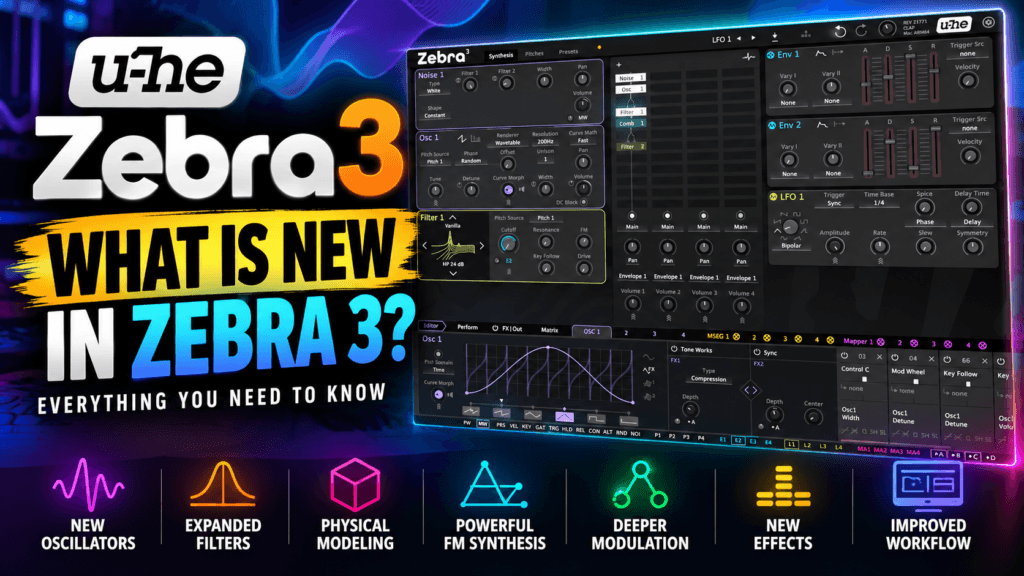
 What Is New in Zebra 3? Everything You Need to Know
Zebra has long been one of the most powerful software synthesizers available for producers and sound designers, but Zebra 3 isn’t simply Zebra 2 with a redesigned interface and a few extra features.
It is essentially a new synthesizer built around the ideas that made Zebra popular in the first place.
u-he rebuilt Zebra 3 from the ground up, introducing new oscillator technology, expanded filters, physical modeling tools, a much deeper modulation system, a redesigned effects architecture, and a more modern workflow.
Quite a lot.
Let’s break down the biggest Zebra 3 changes and, more importantly, what they actually mean when you’re making music.
What Is Zebra 3?
Zebra 3 is u-he’s next-generation modular software synthesizer and the successor to Zebra 2.
The original Zebra became popular because it gave producers an unusually flexible modular environment without forcing them to build every patch completely from scratch.
Zebra 3 keeps that basic philosophy but significantly expands what can happen inside a patch.
The synth combines several approaches to synthesis, including:
- Wavetable synthesis
- Additive synthesis
- FM synthesis
- Virtual analog synthesis
- Physical modeling
- Spectral processing
Zebra 3 was officially released on April 20, 2026, after a lengthy development period. U-He describes it as an entirely new development based on decades of experience with Zebra 2 rather than simply an incremental update.
That distinction is important.
If you’re coming from Zebra 2, you’re getting a new synthesis environment rather than Zebra 2 with a new coat of paint.
What Is New in Zebra 3?
The biggest changes in Zebra 3 revolve around its oscillators, filters, physical modeling capabilities, modulation system, effects, and overall workflow.
Zebra 3 also introduces an adaptive interface where modules appear as you add them to a patch and can be organized through drag and drop.
Let’s look at the major additions individually.
1. Zebra 3 Has New Oscillator Engines
The oscillator section is one of the biggest improvements in Zebra 3.
Each of Zebra 3’s four primary oscillators can operate using two different synthesis engines.
You can use a wavetable engine with up to 16 voices of unison or switch to an additive engine capable of generating up to 1,024 partials. Those partials can also be inharmonic, opening the door to sounds that go far beyond conventional subtractive synthesis.
Zebra 3 also uses a spline-based waveform editor.
Instead of being limited to a collection of static oscillator shapes, you can create and manipulate your own waveforms and morph between them.
The same underlying spline concept is also used elsewhere in Zebra 3, including its MSEG curves.
For producers who enjoy designing sounds from scratch, this makes the oscillator itself a serious sound-design environment.
But you don’t have to be a synth programmer to benefit.
More complex oscillator sources can give you richer starting points for pads, keys, basses, leads and textures before you even begin adding effects.
2. Zebra 3 Adds 20 Oscillator Effects
Zebra 3 doesn’t stop at generating complex oscillator shapes.
Each main oscillator includes two serial oscillator FX slots, with 20 available processes.
These include tools for techniques such as spectral decay, synchronization, phase manipulation and spectral filtering.
That means significant sound shaping can happen directly at the oscillator level.
For example, instead of starting with a relatively simple waveform and relying entirely on filters and external effects to make it interesting, you can transform the oscillator before it moves farther through the signal path.
For modern production, that’s especially useful for creating evolving pads, aggressive bass sounds, unusual plucks and digital textures.
3. Zebra 3 Has a Much Larger Filter System
Filters have also received a major expansion.
Zebra 3 includes 13 filter models, covering familiar designs such as ladder, cascade, and state-variable filters alongside original u-he designs.
Those models can offer multiple responses, giving Zebra 3 more than 100 possible filter responses overall.
Depending on the selected model, you can access different low-pass, high-pass, and band-pass responses along with multiple slopes.
This gives producers considerably more control over how a sound is shaped.
You can use Zebra 3 for traditional warm filtered synth sounds, but the filter system can also become part of more experimental patch design.
4. FM Synthesis Is Much More Powerful
Zebra 3 includes four dedicated FM oscillators.
Each FM oscillator contains a two-operator structure, but Zebra’s modular routing makes things considerably more interesting.
An FM oscillator can accept another signal from the Generator Rack as an additional operator, allowing producers to construct more complex FM relationships without being locked into a traditional fixed FM algorithm.
That’s an important difference.
Traditional FM synthesizers often present you with predefined operator configurations.
Zebra 3 gives you considerably more freedom to decide how those components interact.
For producers, that can translate into everything from glassy keys and bells to metallic percussion, digital basses, and evolving experimental sounds.
5. Zebra 3 Introduces Serious Physical Modeling Tools
One of Zebra 3’s most interesting expansions is physical modeling.
Zebra 3 includes tools such as Modal Resonators, Comb Filters, Noise generators, and Exciters that can interact to create sounds based on the behavior of physical objects.
For example, an Exciter can create the initial energy of a pluck or strike while a Modal Resonator determines how that energy resonates.
That makes it possible to create sounds resembling:
- Bells
- Mallets
- Plucked strings
- Metallic percussion
- Resonant textures
- Experimental acoustic-style instruments
These don’t have to perfectly imitate real instruments either.
The real fun begins when you create instruments that feel physical but couldn’t actually exist in the real world.
For Hip Hop, R&B, Trap, and cinematic production, that can be an excellent source of unusual plucks, bells, and atmospheric textures.
6. Vector and Scan Mixing: Add Another Dimension
Zebra 3 also includes Vector and Scan mixers.
The Vector mixer lets you blend four different sources using an XY-style control.
That movement can also be looped, allowing a patch to evolve between several sound sources automatically.
Scan mixing takes a different approach by moving sequentially through multiple sources.
This is particularly useful when creating evolving sounds.
Instead of a pad remaining relatively static, for example, you can create gradual movement between different tonal layers.
It’s another example of Zebra 3 emphasizing motion as part of the actual patch rather than something that must be created later with external effects.
7. Modulation Is Much Deeper in Zebra 3
This may be one of Zebra 3’s most important improvements for serious sound designers.
Zebra 3 treats modulation almost like its own modular environment.
You get four ADSR envelopes, four LFOs, and four MSEGs, but those familiar tools are only the beginning.
The MSEGs can contain multiple morphable curves along a shared timeline, and Zebra 3 also includes four Mappers and four Mod Math modules.
Mappers can reshape modulation signals or function as step sequencers when used with trigger signals.
Mod Math lets you combine and transform modulation sources before sending the resulting signal somewhere else.
Even pitch, gate, and trigger information can participate in Zebra 3’s modular architecture.
In practical terms, this means movement doesn’t have to be simple.
A producer can create patches where several parameters interact and evolve together, resulting in sounds that can almost feel like performances by themselves.
8. Zebra 3 Has a Redesigned Effects System
Zebra 3 also features a new FX Grid.
Audio from the voice lanes can be routed into a global effects environment containing the main bus plus three auxiliary sends.
Those send levels can even be modulated per voice.
Available effects include tools such as:
- Chorus
- Flanging
- Phasing
- Delay
- Multitap delay
- Reverb
- Compression
- EQ
- Distortion
- Ring modulation
- Wavefolding
- Filtering
Some of the same processing modules found in the Generator Rack can also appear in the effects environment.
That means Zebra 3 can take a sound surprisingly far before you reach for another plugin in your DAW.
9. Zebra 3 Has a New Adaptive Interface
A synth this deep could easily become overwhelming.
u-he addresses some of that complexity with Zebra 3’s adaptive interface.
Modules only appear when you actually add them to the patch, and they can be organized using drag and drop.
That keeps the interface from displaying every possible synthesis option at once.
It’s an important workflow improvement because Zebra 3 isn’t lacking features.
The challenge is making those features manageable.
The modular interface allows a simple patch to remain relatively simple while still giving advanced users room to build extremely complex sounds.
10. Zebra 3 Includes More Than 1,200 Factory Presets
You don’t need to build every sound yourself.
Zebra 3 ships with more than 1,200 factory presets, which is especially important for producers who want Zebra’s sound quality without becoming professional sound designers first.
That also makes the synth useful as both a preset instrument and a deep sound-design platform.
You can load a preset and start producing immediately, modify an existing patch, or build something completely from scratch.
For beatmakers, that’s probably the best way to approach a synthesizer this deep.
You don’t need to understand every Zebra 3 module before you can make music with it.
Zebra 3 Has Already Received Additional Improvements
Zebra 3’s initial 3.0 release wasn’t the end of development.
Version 3.0.1 added several improvements, including a global trigger option for MSEGs, improved macro behavior for the ABCD performance controls, additional MPE functionality and expanded modulation ranges for FMO and envelope parameters.
u-he followed that with version 3.0.2 on July 15, 2026, which fixed an issue involving the ABCD controls after reopening the interface.
At the time of writing, 3.0.2 is the latest Zebra 3 version listed in u-he’s official release history.
Zebra 3 vs Zebra 2: What Changed?
The easiest mistake is thinking of Zebra 3 as a conventional upgrade to Zebra 2.
It isn’t.
The fundamental Zebra philosophy is still here: flexible routing, modular synthesis and deep sound design.
But Zebra 3 was rebuilt around a new architecture.
The new oscillator system, expanded filters, physical modeling modules, deeper FM implementation, spline editing, advanced modulation tools, and redesigned effects environment make Zebra 3 a substantially different synthesizer.
That also means longtime Zebra 2 users shouldn’t necessarily expect every workflow to behave exactly as it did before.
Think of Zebra 3 as the next generation of the Zebra concept rather than Zebra 2.5.
What Do the Zebra 3 Changes Mean for Beatmakers?
This is where Zebra 3 becomes especially interesting.
You could look at the feature list and assume Zebra 3 is primarily intended for hardcore sound designers.
It certainly can be that instrument.
But producers don’t have to use it that way.
If you’re producing Hip Hop, R&B, Trap, Pop, or similar genres, Zebra 3’s expanded synthesis engine gives you a massive palette for creating:
Pads: Use wavetable morphing, modulation and effects to create atmospheric sounds that move behind the record.
Plucks and bells: Combine Exciters, Modal Resonators and FM synthesis for melodic sounds that can stand out from conventional preset libraries.
Basses: Oscillator effects, filters, FM, and wavefolding provide plenty of options for both clean sub-oriented patches and aggressive bass textures.
Keys: Additive and FM synthesis can create glassy, digital, and electric-piano-inspired tones.
Textures: Vector mixing, modulation, and physical modeling make Zebra 3 particularly strong for sounds that sit somewhere between an instrument and an atmosphere.
And because the synth includes more than 1,200 presets, none of this requires starting from an Init patch every time.
Is Zebra 3 Easier to Use Than Zebra 2?
That’s a complicated question.
Zebra 3’s adaptive interface can make patch construction feel cleaner because unused modules don’t need to clutter the screen.
But Zebra 3 is still an extremely deep synthesizer.
If your goal is simply to choose a preset and make a beat, you can absolutely do that.
If your goal is to understand every oscillator mode, modulation possibility, physical modeling tool, and routing option, expect a learning curve.
That’s not necessarily a negative.
Zebra 3’s complexity is part of the reason it can cover so much sonic territory.
The trick is not assuming you need to master everything before making music.
Is Zebra 3 Worth Upgrading To?
For Zebra 2 users, the answer depends largely on how much you value the new synthesis architecture.
If you’re interested in deeper oscillator design, physical modeling, expanded modulation, more sophisticated filtering, and a more modern modular workflow, Zebra 3 offers considerably more than a cosmetic update.
However, Zebra 2 remains a capable synthesizer in its own right.
It’s also worth checking your upgrade eligibility before purchasing. U-he states that people who bought a Zebra 2 license before November 1, 2022 should check their account for available upgrade options, while Zebra Legacy owners do not currently have a crossgrade path.
For a deeper buying discussion, check out our Is Zebra 3 Worth Buying? review.
And if you’re deciding between two modern powerhouse synths, read our Zebra 3 vs Serum comparison.
Frequently Asked Questions
When Was Zebra 3 Released?
Zebra 3 was officially released on April 20, 2026.
How Many Presets Does Zebra 3 Have?
Zebra 3 includes more than 1,200 factory presets.
Does Zebra 3 Have Wavetable Synthesis?
Yes. Zebra 3’s primary oscillators can operate as wavetable engines with up to 16 voices of unison. They can also operate as additive oscillators with up to 1,024 partials.
Does Zebra 3 Have FM Synthesis?
Yes. Zebra 3 includes dedicated FM oscillators with flexible routing that allows other rack signals to participate in more complex FM structures.
Does Zebra 3 Support MPE?
Yes. Zebra 3 supports MPE along with microtuning and MTS-ESP real-time tuning.
What Plugin Formats Does Zebra 3 Support?
Zebra 3 is available in CLAP and VST3 formats across supported desktop platforms, with AUv2 available on macOS and AAX available on macOS and Windows. U-he currently provides versions for macOS, Windows, and Linux.
Final Thoughts: Zebra 3 Is More Than a Zebra 2 Update
The biggest thing to understand about Zebra 3 is that “what’s new?” isn’t answered by one headline feature.
The entire instrument has evolved.
New oscillator engines, spline waveform editing, expanded FM, physical modeling, more than 100 filter responses, deeper modulation, vector mixing, and a redesigned effects environment collectively make Zebra 3 a significantly more ambitious synthesizer than its predecessor.
And yet you don’t have to use every feature.
A producer can browse the 1,200+ presets, find an inspiring pad or pluck and start making music.
A sound designer can go several layers deeper and build an instrument from oscillators, resonators, modulation, and effects.
That’s arguably Zebra 3’s biggest strength.
It can be as straightforward or as ridiculously deep as you want it to be.
For more Zebra 3 coverage, read Is Zebra 3 Worth Buying? and our Zebra 3 vs Serum comparison next.