 Is Zebra 3 Worth Buying? An In-Depth Review for 2026
If you’re looking at u-he Zebra 3 and wondering whether it’s worth buying, there’s a good chance one thing has already caught your attention: this is not a cheap software synth.
At $245 at the time of writing, Zebra 3 sits firmly in premium soft-synth territory. That makes the decision a little different from grabbing another $49 plugin during a sale. At this price, you should be getting an instrument you can build a serious part of your production workflow around.
The good news is that Zebra 3 gives you an enormous amount to work with.
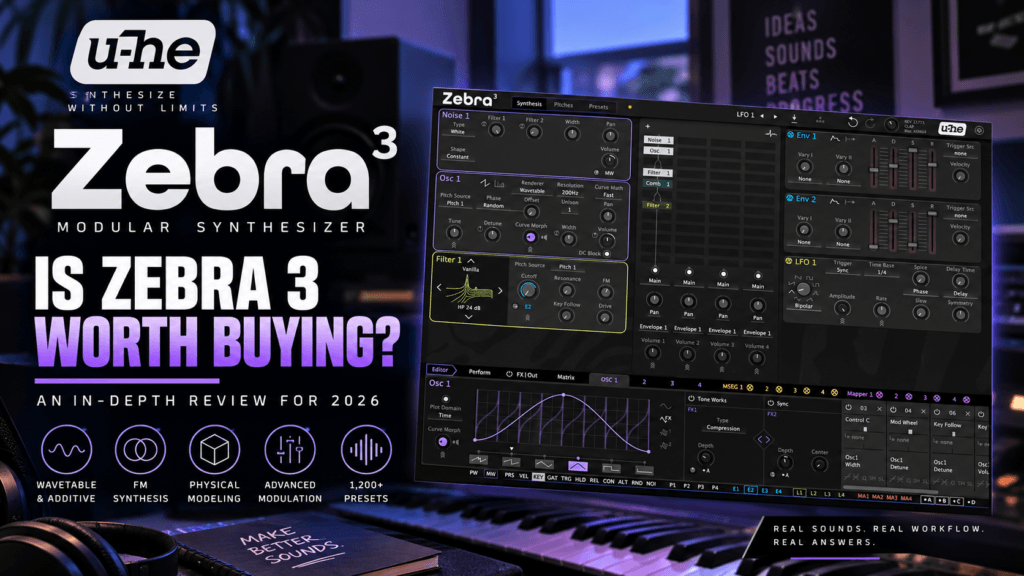
Released in April 2026, Zebra 3 is a complete ground-up rebuild of u-he’s long-running Zebra concept rather than a simple refresh of Zebra 2. It combines wavetable and additive synthesis, FM, physical modeling, extensive modulation, powerful filters, modular routing, and a substantial effects section inside one instrument.
It also ships with more than 1,200 factory presets.
For producers and sound designers who want a deep synthesizer they can continue exploring for years, I think Zebra 3 makes a very strong case for its price. However, producers who mainly browse presets or already own several powerful flagship synths may want to think carefully about whether they’ll actually use that depth.
Let’s dig into why.
What Is Zebra 3?
Zebra 3 is a semi-modular software synthesizer from u-he.
The easiest way to understand it is to stop thinking of it as one specific type of synth.
It isn’t simply a wavetable synth.
It isn’t just an additive synth.
And it isn’t simply a virtual analog instrument.
Instead, Zebra 3 gives you a modular environment where multiple forms of synthesis and processing can work together inside the same patch.
Its Generator Rack can contain oscillators, FM oscillators, noise generators, exciters, modal resonators, comb filters, wavefolders, ring modulation, distortion and filtering.
You then decide how those components interact.
That flexibility is one of the biggest reasons Zebra 3 is interesting. Rather than forcing you into one synthesis workflow, Zebra gives you a collection of tools and lets you construct the instrument you need.
Zebra 3 Is More Than a Zebra 2 Update
This distinction matters if you’re wondering whether Zebra 3 deserves its premium price.
u-he describes Zebra 3 as an entirely new development built from the experience gained through previous generations of Zebra.
One of the biggest changes is its adaptive interface. Modules appear as you add them to your patch, helping keep the interface relatively organized even as the underlying sound becomes more complicated.
That approach fits Zebra’s long-standing “wireless modular” philosophy.
You get modular-style flexibility without covering your screen in virtual patch cables.
For producers who have always been interested in modular synthesis but don’t necessarily want to build enormous cable-filled patches, Zebra 3 occupies an interesting middle ground.
The Oscillators Are Ridiculously Deep
This is where Zebra 3 starts separating itself from a lot of conventional software synthesizers.
Its main oscillators can operate using two different rendering engines: wavetable or additive.
In wavetable mode, Zebra 3 supports up to 16-voice unison.
Switch to additive rendering and the oscillator can use as many as 1,024 sine partials, including the ability to create inharmonic spectra.
That opens the door to everything from relatively straightforward synth tones to bells, metallic sounds, evolving textures and sounds that become difficult to categorize.
Zebra 3 also uses a spline-based waveform editor.
Instead of being restricted to a collection of static oscillator shapes, you can draw and manipulate waveforms and morph between them.
For somebody interested in actual sound design, this alone provides a huge playground.
But Zebra doesn’t stop at the oscillator.
Each oscillator also includes two serial effects slots with 20 available processes, including tools for spectral manipulation, synchronization and phase processing.
You can therefore start transforming a sound before it even reaches the rest of the synth.
FM Without Being Locked Into a Fixed Algorithm
FM synthesis can be incredibly powerful, but traditional FM synthesizers can also feel like you’re solving a math problem instead of making music.
Zebra 3 takes a more flexible approach.
It provides four FM oscillators, with each containing a modulator/carrier pair. Signals from elsewhere in the Generator Rack can also be fed into the FM structure as another operator.
That means you’re not restricted to a collection of predefined FM algorithms.
You can construct your own relationships between sound sources.
For producers making modern R&B, Hip Hop, Trap Soul, electronic music or cinematic music, that can be particularly useful for creating bells, keys, plucks, evolving pads and unusual textures.
And that’s where I think Zebra 3 becomes more interesting than simply looking at its specifications.
You don’t have to use every synthesis technique in every patch.
You can build something simple when that’s what the song needs and go ridiculously deep when inspiration takes you there.
Physical Modeling Makes Zebra 3 Even More Interesting
Zebra 3 also includes tools for physical-modeling-style synthesis.
Noise generators and Exciters can interact with Modal Resonators, allowing you to create sounds based around the behavior of struck, plucked or resonating objects.
That can produce things like mallets, bells, plucked textures and sounds that fall somewhere between acoustic and synthetic.
This is an area I think producers can easily overlook when evaluating Zebra 3.
You might already own a great wavetable synth.
You might already own an excellent analog emulation.
You may even have FM covered.
But Zebra’s ability to combine these different synthesis techniques inside the same modular environment is a large part of what you’re actually paying for.
The Filter Section Is Huge
Once you’ve generated the sound, Zebra 3 gives you plenty of ways to shape it.
There are 13 filter models with more than 105 responses available across those models.
That includes familiar low-pass, high-pass and band-pass responses alongside more specialized options.
And because this is Zebra, filtering doesn’t have to be the end of the signal chain.
Filters can become part of much more elaborate patches involving modulation, distortion, wavefolding, resonators, FM and other modules.
That’s an important distinction.
A lot of synthesizers give you a powerful oscillator section followed by a fairly conventional subtractive signal path.
Zebra 3 encourages you to think about the entire patch as a sound-design environment.
Modulation Is One of Zebra 3’s Biggest Strengths
A powerful synthesizer becomes much more interesting when you can make it move.
Zebra 3 gives you four ADSR envelopes, four LFOs and four MSEGs, along with Mappers, modulation math and extensive modulation routing.
The MSEGs are particularly interesting because they use the same spline-based editing concept found in the oscillator.
You can create detailed modulation curves, establish loop points and use them to introduce rhythmic or evolving movement into patches.
Pitch, gate and trigger signals also play an important role in Zebra’s modulation architecture.
For producers, this means you can create patches that aren’t simply static sounds waiting for MIDI notes.
A Zebra patch can essentially become a performance.
Pads can evolve.
Textures can move.
Sequences can develop.
Parameters can interact.
And once you start combining modulation sources, things can get extremely deep.
Don’t Want to Build Sounds? You Get More Than 1,200 Presets
Now let’s address something important.
Not everybody wants to become a synth programmer.
Sometimes you need a sound right now because you’re making a beat.
Zebra 3 ships with more than 1,200 factory presets, which makes the synth useful even before you understand its deeper architecture.
That’s important for producers who want to gradually learn synthesis instead of spending the first week staring at an initialization patch.
Start with presets.
Find something close to what you need.
Change the filter.
Adjust the envelopes.
Modify an effect.
Then eventually start investigating how the patch was constructed.
That’s one of the best ways to learn a synthesizer this deep.
Zebra 3’s Effects Section Could Almost Be Its Own Plugin
The Effects Rack continues the modular philosophy.
Zebra 3 includes modulation effects, delays, reverbs, compression, EQ, filters, distortion, ring modulation and wavefolding.
There are also multiple mixers for routing and combining signals.
One particularly interesting feature is Zebra’s handling of effects sends. Its voice lanes feed global buses, while send levels can be modulated per voice.
That provides another layer of movement and expression beyond simply putting reverb or delay at the end of your patch.
For sound designers, that’s huge.
For everyday producers, it means many Zebra patches can come out of the instrument already sounding polished and production-ready.
Is Zebra 3 Good for Hip Hop and R&B?
Absolutely, but with an important qualification.
You don’t need a synth this deep to make Hip Hop or R&B.
Let’s get that out of the way.
Countless incredible records have been created with much simpler instruments.
But Zebra 3 gives producers a huge palette for creating the types of sounds these genres regularly use: atmospheric pads, dark keys, synth basses, bells, plucks, evolving textures, leads, and unusual melodic sounds.
I can see it being particularly useful for producers who don’t want every beat to begin with the same preset packs everyone else owns.
If you’re willing to customize sounds—even slightly—Zebra 3 gives you an enormous amount of room to establish your own sonic identity.
And for genres like Trap Soul and atmospheric R&B, its modulation and physical-modeling capabilities could be especially interesting.
Zebra 3’s Biggest Strength Is Also Its Biggest Weakness
Here’s where the buying decision gets more complicated.
Zebra 3 is deep.
Very deep.
That’s fantastic if you’re interested in sound design.
But depth isn’t automatically valuable.
If your normal workflow is opening a synth, clicking through presets until something sounds good and immediately recording a melody, you may never use most of what makes Zebra 3 special.
There’s nothing wrong with that workflow, either.
Making music is the goal.
The question is whether it makes sense to spend $245 on a synth whose biggest advantage is an architecture you don’t intend to explore.
For some producers, the answer will be no.
Zebra 3 Pros and Cons
Pros
- Extremely deep synthesis architecture
- Wavetable and additive oscillator rendering
- Up to 1,024 partials in additive mode
- Powerful FM capabilities
- Physical-modeling tools
- More than 1,200 factory presets
- Extensive modulation system
- Huge filter selection
- Flexible modular routing
- Strong onboard effects
- MPE and microtuning support
- Available in VST3, AU, AAX and CLAP formats
- Windows, macOS and Linux support
Cons
- $245 is a substantial investment for a software synth
- The depth can be intimidating for beginners
- Preset-focused producers may not take advantage of its strongest features
- If you already own several flagship synthesizers, Zebra 3 may overlap with capabilities you already have
- Learning the instrument properly requires time
Who Should Buy Zebra 3?
Zebra 3 makes the most sense for producers who want to go beyond presets and develop a deeper understanding of synthesis.
It’s also compelling for sound designers, electronic musicians, composers and producers who want one synth capable of covering an enormous amount of sonic territory.
If you enjoy opening a synthesizer and wondering, “What happens if I connect this to that?” Zebra 3 is practically built around that mindset.
It’s the kind of instrument you could spend years learning.
That’s a meaningful advantage when you’re spending premium-plugin money.
Who Should Skip Zebra 3?
If you’re primarily looking for a large collection of immediately usable presets, Zebra 3 may be more synthesizer than you actually need.
Likewise, producers who already own multiple deep synths should ask themselves a difficult question before buying it:
What will Zebra 3 allow me to do that I’m not already doing?
That’s a much better question than asking whether Zebra 3 is powerful.
Of course it’s powerful.
The issue is whether that power solves a problem in your workflow.
If you already own synths capable of wavetable synthesis, additive synthesis, FM, complex modulation and advanced sound design—and you barely scratch the surface of those—you probably don’t need another synth.
Learn the instruments you already own.
Your music will benefit more from mastering one great synthesizer than collecting ten of them.
Try Zebralette 3 First
There’s another option worth mentioning before spending $245.
u-he offers Zebralette 3 for free.
Zebralette 3 essentially takes one of Zebra 3’s oscillators and places it inside a smaller synthesis environment with an envelope, MSEG, LFOs, modulation matrix, delay and reverb.
That makes it an excellent way to experience part of Zebra’s approach to synthesis without spending anything.
If you’re intrigued by Zebra 3 but aren’t sure whether you’ll enjoy its workflow, start there.
If you find yourself disappearing into Zebralette 3 for hours designing sounds, that’s a pretty good indication that the full Zebra 3 might be worth exploring.
So, Is Zebra 3 Worth Buying?
Yes—for the right producer.
At $245, Zebra 3 isn’t an impulse-buy synth, and I don’t think it should be treated like one.
Its value comes from depth.
You’re getting wavetable synthesis, additive synthesis, flexible FM, physical modeling, extensive modulation, a huge filter collection, modular routing, a serious effects environment and more than 1,200 presets inside one instrument.
For producers and sound designers who genuinely want to explore those capabilities, Zebra 3 offers enough depth to remain useful long after the excitement of buying a new plugin disappears.
But if you’re primarily looking for another preset library—or you already own several advanced synths you haven’t learned yet—save your money.
The best synth isn’t necessarily the one with the longest feature list.
It’s the one you actually learn well enough to make music with.
And if Zebra 3’s modular approach to synthesis sounds like something you want to grow into rather than something you’ll avoid, then yes, Zebra 3 is worth buying.
Final Thoughts
Zebra 3 feels less like purchasing another plugin and more like purchasing a synthesis platform.
That’s what ultimately makes the price easier to understand.
You can use it simply: load a preset, tweak a few controls and make music.
Or you can keep digging into oscillators, FM, physical modeling, modulation and routing until you’re designing sounds that barely resemble the patch you started with.
That gives Zebra 3 something I value highly in production software: room to grow.
You don’t have to understand everything on day one.
Start making music.
Learn one piece at a time.
And when you’re ready to go deeper, Zebra 3 probably still has another rabbit hole waiting for you.
Nope. You’re ready. Let’s make something.