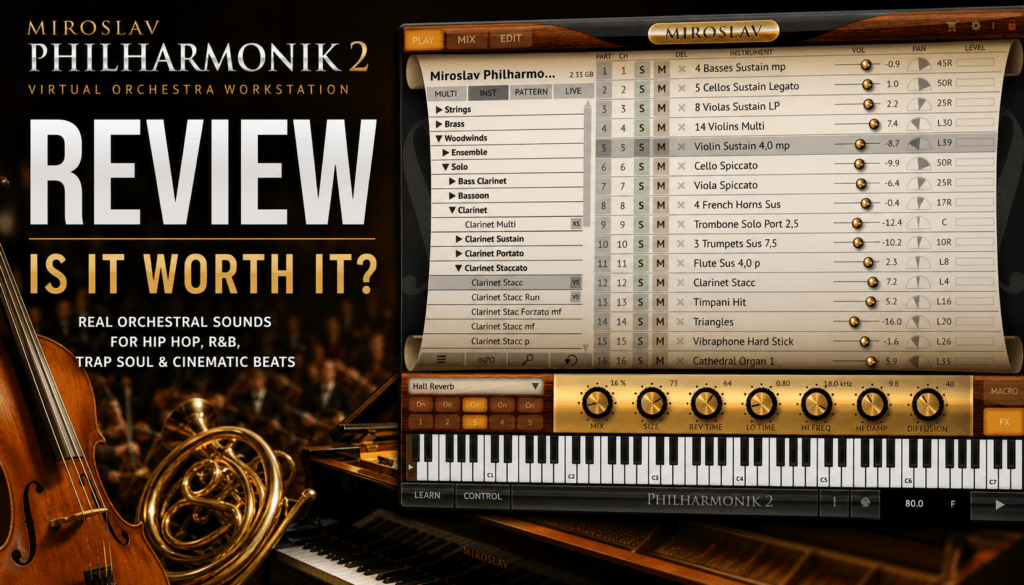
 Miroslav Philharmonik 2 Review: Is It Worth It for Music Producers?
Building convincing orchestral arrangements inside a DAW can be challenging. You need realistic strings, expressive brass, detailed woodwinds, percussion, choirs, and enough articulations to make those instruments feel like they are actually being performed.
IK Multimedia Miroslav Philharmonik 2 attempts to put all of that into one virtual instrument.
Built around orchestral recordings associated with renowned bassist and composer Miroslav Vitous, Miroslav Philharmonik 2 provides a massive collection of orchestral sounds designed for composers, producers, beatmakers, and musicians.
But with so many newer orchestral libraries available today, is Miroslav Philharmonik 2 still worth adding to your setup?
In this Miroslav Philharmonik 2 review, we’ll look at its sounds, workflow, features, effects, and potential uses—and, importantly for beatmakers, how well it works for Hip Hop, R&B, Trap Soul, and cinematic production.
What Is Miroslav Philharmonik 2?
Miroslav Philharmonik 2 is a virtual orchestral workstation from IK Multimedia.
Instead of requiring you to purchase separate libraries for strings, brass, woodwinds, percussion, choir, and other orchestral sounds, Philharmonik 2 combines a large collection of instruments inside a single environment.
The library contains more than 58 GB of 24-bit/96 kHz samples and over 2,700 stereo instruments.
The collection covers categories including:
- Strings
- Brass
- Woodwinds
- Choirs
- Orchestral percussion
- Chromatic instruments
- Grand pianos
- Classical instruments and additional orchestral sounds
This makes Philharmonik 2 less like a single-purpose plugin and more like an entire orchestral sound collection.
And you certainly don’t have to be scoring a Hollywood movie to take advantage of it.
These sounds can be extremely useful for Hip Hop and R&B producers.
Miroslav Philharmonik 2 Sound Library
The size of the library is one of Philharmonik 2’s biggest attractions.
You aren’t simply getting a handful of ensemble patches.
According to IK Multimedia and Plugin Boutique, the collection contains thousands of instruments and variations, including hundreds of string, brass, woodwind, choir, percussion, and chromatic instrument sounds.
That gives you plenty of room to build arrangements ranging from a simple emotional string layer behind an R&B progression to a massive cinematic Hip Hop instrumental.
Strings
Strings are probably going to be one of the first sections many producers explore.
Miroslav Philharmonik 2 includes instruments such as:
- Violins
- Violas
- Cellos
- Double basses
- String ensembles
- Solo strings
- Pizzicato sounds
- Sustained articulations
- Short articulations
Having multiple articulations is especially important.
A sustained violin patch may work beautifully underneath an R&B chord progression, while shorter string articulations can add rhythmic movement to a Hip Hop arrangement.
You can also layer different sections.
For example, try using cellos underneath your main progression while violins play a higher counter melody.
That immediately creates more depth than simply loading one giant string patch.
Brass
The brass collection opens up another side of orchestral production.
Trumpets, trombones, French horns, tubas, and brass ensembles can add enormous amounts of energy to an instrumental.
For Hip Hop producers, brass works particularly well for:
- Dramatic intros
- Chorus sections
- Hard-hitting accents
- Cinematic melodies
- Trap arrangements
- Victory-style beats
- Dark orchestral production
You don’t necessarily need to create complicated orchestral arrangements either.
Sometimes one powerful brass chord layered underneath your drums is enough to transform a section.
Woodwinds
Woodwinds can be easy to overlook when making beats, but they’re useful for adding character without taking over an arrangement.
Flutes, clarinets, oboes, bassoons, and other woodwinds can provide melodic textures that contrast nicely with synths, pianos, guitars, and strings.
A flute melody over a soulful chord progression, for example, can instantly create a different atmosphere.
You can also use woodwinds for subtle counter melodies instead of making them the centerpiece of the beat.
Choirs
Choirs are where things can get especially interesting for modern producers.
Choir sounds can add emotion, darkness, tension, spirituality, or cinematic scale depending on how they’re used.
Try layering a choir quietly behind:
Piano + strings + bass + drums
Rather than making the choir obvious, lower it until you mostly feel the additional texture.
That technique can make an instrumental sound much larger without overcrowding the arrangement.
For darker Hip Hop and Trap production, choir sounds can also become the main melodic element.
Add reverb, filter some high frequencies, pitch the sound creatively, and suddenly the orchestra library starts behaving more like a sound-design instrument.
Orchestral Percussion
Another valuable part of Miroslav Philharmonik 2 is its orchestral percussion.
These sounds can complement traditional Hip Hop drums rather than replace them.
Imagine your normal drum foundation:
Kick + snare + hi-hats + 808
Then layer orchestral percussion during transitions or chorus sections.
Timpani, cymbals and other dramatic percussion sounds can help emphasize important moments in the arrangement.
This works particularly well when you’re trying to make a beat evolve beyond an eight-bar loop.
Instead of constantly adding new melodies, orchestral percussion can create transitions and dynamics while allowing the musical foundation to remain intact.
How Does Miroslav Philharmonik 2 Sound?
The character of Philharmonik 2 is arguably more important than the sheer number of sounds included.
The library has an expressive, performance-oriented quality.
Rather than everything sounding aggressively polished and hyper-modern, many sounds have a musical character that can work beautifully when you’re looking for emotion.
That’s particularly useful for R&B.
A string arrangement doesn’t always need to sound enormous.
Sometimes you want strings that sit underneath a Rhodes or piano progression and provide emotional movement.
That is an area where Philharmonik 2 makes a lot of sense.
For cinematic Hip Hop, you can go in the opposite direction and stack strings, brass, choir, percussion, and piano to create something much larger.
Articulations Make a Huge Difference
One of the biggest mistakes producers make when first working with orchestral libraries is treating orchestral instruments like synthesizer presets.
Real musicians don’t play every note exactly the same way.
A violinist might sustain one note, play another note quickly, change dynamics throughout a phrase, or use an entirely different articulation.
Those variations are what make orchestral arrangements feel alive.
Miroslav Philharmonik 2 provides multiple articulations that allow you to create more expressive performances.
The trick is actually using them.
Instead of programming an entire string section with one articulation, experiment with changing articulations throughout the arrangement.
You can have long strings supporting the verse and introduce shorter, more aggressive strings during the hook.
That creates natural arrangement contrast without changing your chord progression.
16-Part Multitimbral Workflow
Miroslav Philharmonik 2 supports up to 16 parts, allowing multiple sounds to be loaded inside a single instance.
That’s extremely useful for building complete orchestral arrangements.
You could create something like:
Part 1: Violins
Part 2: Violas
Part 3: Cellos
Part 4: Double bass
Part 5: French horns
Part 6: Flutes
Part 7: Choir
Part 8: Timpani
Now you have the foundation of an entire orchestra inside one plugin.
You don’t have to work this way, of course.
Some producers may prefer loading separate instances on individual DAW tracks because it makes mixing and routing easier.
Either approach works.
Built-In Effects
Miroslav Philharmonik 2 isn’t simply a sample playback engine.
It includes a collection of built-in processing options.
There are 34 professional effects, giving you tools for shaping sounds without immediately reaching for external plugins.
Effects include processing for areas such as:
- EQ
- Compression
- Reverb
- Delay
- Modulation
- Saturation
- Dynamics
- Sound shaping
One particularly important feature for orchestral production is ConvoRoom.
Convolution reverb can help place multiple instruments into a shared acoustic environment.
That’s important because an orchestra shouldn’t necessarily sound like every instrument was recorded in a completely different space.
Placing your strings, brass, woodwinds, and percussion within a similar room can help glue the arrangement together.
Using Miroslav Philharmonik 2 for Hip Hop
This is where I think the plugin becomes particularly interesting outside traditional composition.
Orchestral sounds have been part of Hip Hop production for decades.
Strings, brass, choirs, pianos, and dramatic orchestral samples can be heard throughout countless styles of Hip Hop.
With Philharmonik 2, you don’t have to search for an orchestral sample every time you want that sound.
You can actually compose it.
Start with something simple.
Create a minor-key piano progression.
Then add:
Cellos → Violins → Choir → Brass → Orchestral percussion
Don’t bring everything in simultaneously.
Start with the piano.
Introduce the cellos.
Bring violins into the next section.
Save the brass for the hook.
Add orchestral percussion around transitions.
Now your arrangement grows naturally.
You can still add your traditional Hip Hop drums and 808 underneath everything.
The result can sound enormous.
Using Miroslav Philharmonik 2 for R&B
For R&B, I would approach the plugin differently.
Instead of trying to build a massive orchestra, use individual sections to support your harmony.
Start with an extended chord progression using something like:
Rhodes + electric piano + acoustic piano
Then layer soft strings underneath.
Use the cellos to reinforce lower chord tones while violins carry higher extensions.
You might add a subtle flute or woodwind counter melody.
Keep the orchestral elements relatively quiet.
In this context, they’re there to enhance the emotion of the progression rather than dominate it.
This can work particularly well for:
- Contemporary R&B
- Neo Soul
- Slow jams
- Trap Soul
- Gospel-influenced R&B
- Soul
- Cinematic R&B
Sound Design Potential
Don’t assume you have to use Philharmonik 2 realistically.
This is something beatmakers should experiment with.
Take an orchestral patch and process it.
Try:
- Filtering it
- Adding saturation
- Using heavy reverb
- Adding delay
- Reversing rendered audio
- Pitching audio down
- Resampling phrases
- Chopping melodies
- Layering orchestral instruments with synths
You can turn a recognizable orchestral instrument into something completely different.
For example, record a four-bar string progression, bounce it to audio, reverse portions of it, pitch it down and chop the result.
Now you’re approaching Philharmonik 2 more like a source for creating your own samples.
That dramatically expands its usefulness for Hip Hop production.
Is Miroslav Philharmonik 2 Beginner-Friendly?
Mostly, yes.
The biggest challenge isn’t necessarily learning the plugin.
It’s learning orchestration.
You can load a violin patch and start playing immediately.
The harder questions come afterward:
Which articulation should you use?
Where should the cello sit?
Should the violins play the root note?
How should brass be voiced?
How do you make MIDI strings sound realistic?
Those aren’t really Miroslav Philharmonik problems. They’re part of learning how orchestral instruments work.
Fortunately, you don’t need an orchestration degree to start experimenting.
Begin with ensembles.
Once you’re comfortable, start separating your arrangements into individual sections.
That gradual approach makes orchestral production much less intimidating.
Miroslav Philharmonik 2 Pros and Cons
Pros
Huge orchestral library
More than 2,700 instruments gives you an enormous palette to explore.
Multiple orchestral families
Strings, brass, woodwinds, choirs, percussion, pianos, and other classical sounds are available from one instrument.
Expressive character
The sounds can work especially well when emotional performances are more important than sterile perfection.
Multiple articulations
Articulation options make more realistic and dynamic arrangements possible.
Built-in processing
The included effects and convolution reverb provide plenty of sound-shaping possibilities.
16-part multitimbral operation
You can build substantial arrangements without constantly opening additional plugin instances.
Useful beyond film scoring
Hip Hop, R&B, Trap Soul, Pop, Neo Soul, and sample-based production can all benefit from the library.
Cons
Large library
More sounds also means more storage space and more presets to navigate.
Realistic orchestration requires practice
Buying an orchestra library doesn’t automatically make MIDI programming sound realistic.
Producers may not need everything
If you only need occasional strings, a massive orchestral workstation could be more than necessary.
Newer orchestral libraries provide competition
There are many excellent orchestral libraries available today, so Philharmonik 2 isn’t your only option.
Who Should Buy Miroslav Philharmonik 2?
Miroslav Philharmonik 2 makes the most sense for producers who want a broad orchestral palette instead of purchasing numerous specialized libraries.
It’s particularly interesting for:
Hip Hop producers who want strings, choirs, brass, orchestral percussion, and cinematic textures.
R&B producers who want expressive strings and acoustic instrumentation to support chord progressions.
Film and game composers who need access to multiple orchestral families.
Songwriters who want realistic acoustic textures when creating demos.
Beatmakers who want orchestral sounds that can be resampled and manipulated.
Beginner composers looking for one environment where they can start exploring orchestration.
Is Miroslav Philharmonik 2 Worth It?
Yes—with an important qualification.
Miroslav Philharmonik 2 makes the most sense if you actually want access to a substantial orchestral library.
If all you need is one decent string patch for occasional background layers, you probably don’t need thousands of instruments.
But if you want strings, brass, woodwinds, choirs, percussion, pianos, multiple articulations, built-in effects, and enough material to create complete orchestral arrangements, there’s a lot here to explore.
For beatmakers, its value extends even further.
You don’t have to use Miroslav Philharmonik 2 like a traditional composer.
You can layer its strings behind R&B chords.
You can use its brass for aggressive Hip Hop hooks.
You can build dark melodies from choirs.
You can combine orchestral percussion with Trap drums.
And you can resample practically anything inside the library and turn it into something completely new.
That versatility is what makes Philharmonik 2 interesting.
Final Verdict
Miroslav Philharmonik 2 is a massive orchestral workstation that can be useful for far more than traditional orchestral composition.
Its combination of strings, brass, woodwinds, choirs, percussion, pianos, articulations, effects, and multitimbral operation gives producers an enormous collection of acoustic sounds to work with.
For Hip Hop and R&B producers specifically, I think the best approach is to stop thinking of it simply as an “orchestra plugin.”
Think of it as a 58+ GB sound-design library filled with real orchestral textures.
Those textures can become emotional R&B string arrangements, cinematic Hip Hop melodies, dark Trap samples, soulful chord layers, dramatic intros, or completely unrecognizable sounds after processing and resampling.
If you’ve been looking for a way to introduce more organic instrumentation into productions that are dominated by synths and samples, Miroslav Philharmonik 2 is absolutely worth exploring.