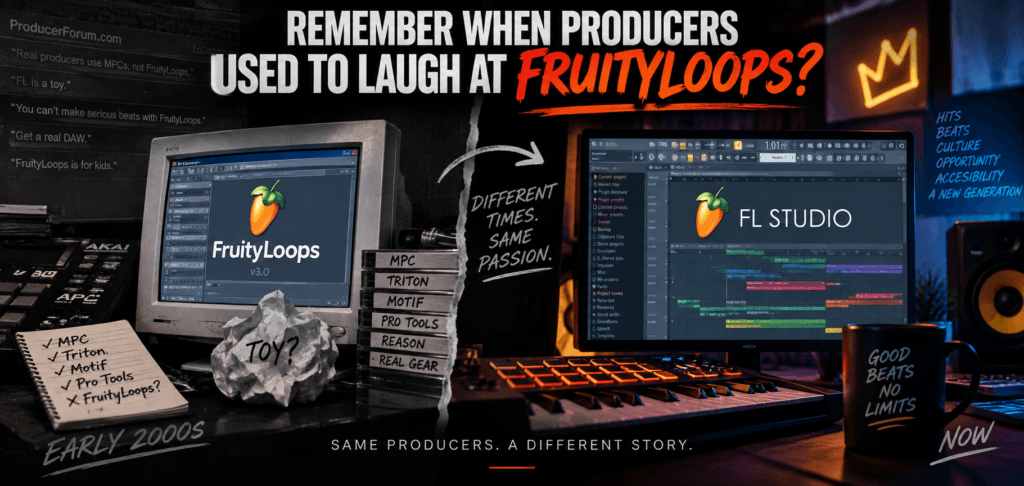
 Remember When Producers Used to Laugh at Fruity Loops?
There was a time when telling another producer you made beats in FruityLoops could get you laughed out of the conversation.
I’m serious.
Today, FL Studio is one of the most recognizable DAWs in Hip Hop and beatmaking. Open YouTube, watch producer streams, browse tutorials, or look over the shoulder of a young beatmaker and you’re almost guaranteed to encounter that familiar interface eventually.
But if you weren’t around during the earlier days of software beatmaking, you might not realize just how different the perception used to be.
I remember it well.
Back in the 2000s, producers would argue on internet forums about everything.
Hardware versus software.
MPC versus keyboard workstation.
Reason versus FruityLoops.
And yes, I was firmly on Team Reason.
We would go back and forth.
But underneath all the jokes and arguments was a much bigger question:
Could you really make professional music with software?
Looking back more than 20 years later, the answer seems obvious.
But it wasn’t obvious to everyone back then.
FruityLoops Wasn’t Always Considered a “Serious” Production Tool
Before FL Studio became FL Studio as we know it today, many of us knew it simply as FruityLoops.
And the name probably didn’t help its reputation.
At the time, a certain image surrounded what a “real” Hip Hop producer was supposed to use.
You had MPCs.
You had Roland workstations.
Korg Tritons.
Yamaha Motifs.
ASR-10s.
Pro Tools.
Large mixing consoles.
Racks of equipment.
Then someone would show up talking about making beats with FruityLoops on their computer.
You can probably imagine how some producers responded.
It was treated by some people like a toy.
Something beginners played around with.
Something that couldn’t possibly compete with the expensive equipment sitting in professional studios.
Of course, history had other plans.
I Was on Team Reason
I’ll admit my bias.
I was a Reason guy.
I still am.
When I started producing in 2005, Reason immediately clicked with me. Its virtual rack approach made sense to my brain in a way few other pieces of production software ever have.
And back in those forum days, there was definitely a little Reason versus Fruity Loops rivalry among users.
We defended our software.
They defended theirs.
Sometimes those discussions were productive.
Sometimes they were ridiculous.
That’s what forums were for. 😂
But there’s something wonderfully ironic about looking back at those arguments today.
Because FL Studio ultimately accomplished exactly what its users were telling everybody it could do.
It became a legitimate professional music-production platform.
More importantly, producers made music people actually wanted to hear with it.
At that point, the argument was over.
Hip Hop Didn’t Care What DAW You Used
This is one of my favorite things about Hip Hop.
Eventually, results win.
Listeners don’t hear your DAW.
Nobody puts on their favorite record and says:
“That hi-hat pattern would have been considerably better if the producer had used a more respected sequencer.”
😂
They hear the beat.
They hear the drums.
They hear the melody.
They hear the artist.
They feel something—or they don’t.
And once producers started creating records people loved with FL Studio, it became increasingly difficult to dismiss the software simply because of what somebody thought a professional studio was supposed to look like.
Then a New Generation Arrived
This is where the story gets much bigger than FL Studio.
Music-production software dramatically lowered the barrier to entry.
You didn’t necessarily need an expensive workstation.
You didn’t necessarily need an MPC.
You didn’t necessarily need access to a commercial studio.
You needed access to a computer and production software.
And suddenly kids who might never have been able to assemble the traditional studio setup could start experimenting with beats.
That accessibility mattered.
A lot.
It meant someone could start making music in a bedroom.
They could learn through experimentation.
They could share techniques online.
They could collaborate with other producers.
They could upload music to the internet.
And eventually, some of those bedroom producers started influencing the sound of mainstream music.
Soulja Boy Represented Something Bigger
Soulja Boy is an important name when talking about this era—not simply because of the software associated with his early production, but because of what his rise represented.
Here was a young artist using consumer-accessible technology and the internet in ways the traditional music industry was still figuring out.
The barriers between:
producer → artist → audience
were collapsing.
You didn’t necessarily need someone at a record label to decide you were ready.
You could make something.
Put it online.
And potentially find an audience yourself.
That sounds completely ordinary in 2026.
It wasn’t ordinary then.
That DIY mentality became an enormous part of modern Hip Hop culture.
And accessible production software was one of the technologies that helped make it possible.
The “Toy” Became a Standard
That’s the part I find fascinating.
The software some producers once laughed at became one of the defining production environments of subsequent generations.
FL Studio didn’t need everybody on the forums to agree that it was professional.
Producers simply kept using it.
They got better.
The software got better.
Records got made.
Hits got made.
More young producers adopted it.
Tutorial communities grew.
Knowledge became easier to share.
Eventually the argument started sounding silly.
You can’t keep calling something a toy when professionals are using it to make professional music.
And there’s a larger lesson there that goes far beyond FL Studio.
We’re Doing the Same Thing Again
Here’s where this gets personal for me.
Today, I sometimes see Reason treated the way FruityLoops was once treated.
Reason doesn’t always get invited into the big DAW conversations.
You’ll hear:
FL Studio.
Ableton Live.
Logic Pro.
Pro Tools.
Sometimes Reason feels like the forgotten stepchild sitting in the corner.
And yes, I’ve heard the jokes.
As someone who has used Reason for more than 20 years, they don’t bother me much.
Because I’ve already watched this movie.
I remember when people laughed at FruityLoops.
Look how that turned out.
Popularity and Capability Aren’t the Same Thing
This is something every producer should understand.
A DAW being popular doesn’t automatically make it better for you.
And a DAW being less popular doesn’t make it incapable of professional results.
Personally, I consider Reason one of the most powerful creative environments available to producers.
That’s my preference.
Someone else may open FL Studio and immediately feel at home.
Another producer may think Ableton Live is the greatest thing ever invented.
Someone may swear by Logic.
Fine.
Make music.
That’s the point.
The question shouldn’t always be:
“What DAW do the most producers use?”
Sometimes the better question is:
“What environment makes me want to create?”
Because the most powerful DAW in the world isn’t very useful if opening it kills your inspiration.
The Producer Makes the Tool Dangerous
I’ve spent more than two decades around music-production technology, and one thing has become increasingly clear to me:
We give tools their power.
A synthesizer doesn’t write a great melody.
A compressor doesn’t create a great mix by itself.
An MPC doesn’t automatically produce better drums.
And FL Studio doesn’t make someone a great beatmaker simply because successful producers use it.
The person operating the tool matters.
Their taste.
Their experience.
Their musical instincts.
Their willingness to experiment.
Their understanding of the software.
Give a talented producer enough time with almost any capable modern DAW and they’ll eventually find ways to make that thing dangerous.
Accessibility Changes Music
And this is where the FruityLoops story connects directly to what I believe about software production.
Accessibility matters.
I was fortunate when I started making beats in 2005.
I walked into Guitar Center with roughly $10,000 and left with a Roland Fantom X8, an iMac G5, Pro Tools and an Mbox 2, monitors, headphones, Reason and more.
I had the expensive equipment.
And ironically, I fell in love with Reason.
That experience eventually taught me that I didn’t need thousands of dollars worth of hardware before I could be creative.
Software could be the studio.
That’s one of the reasons I believe so strongly in what programs like FL Studio helped accomplish.
They put music production into the hands of people who otherwise might never have gotten started.
And some of those people changed music.
Don’t Let Somebody Else Validate Your DAW
Maybe you’re reading this while using something people online don’t consider cool.
Maybe it’s Reason.
Maybe it’s GarageBand.
Maybe it’s an inexpensive DAW.
Maybe you’re using stock plugins while everybody on YouTube seems to own thousands of dollars worth of software.
Here’s my advice:
Stop waiting for permission.
If your software lets you record, sequence, arrange, mix and export music, you’ve got an extraordinary amount of creative power sitting in front of you.
Learn it.
Push it.
Figure out what it does better than anything else.
Figure out what you do better with it.
Then make records.
Because the internet’s opinion about your tools won’t matter very much when the music is good.
Today’s Joke Could Be Tomorrow’s Standard
That’s what the FruityLoops story should teach us.
There was a time when some producers could say:
“You make beats in FruityLoops?”
…and the question itself was meant as an insult.
Today, saying you make beats in FL Studio barely requires explanation.
My, how the tables turn.
So I’m not particularly interested in fighting another DAW war.
I’ve already lived through one.
I’ll keep opening Reason.
FL Studio producers can keep opening FL Studio.
Ableton producers can open Ableton.
Logic producers can open Logic.
And instead of arguing about whose software makes them more legitimate, maybe we should all do the thing that ultimately settled the FruityLoops debate in the first place:
Make something undeniable.
Because history has already taught us the lesson.
The DAW doesn’t become legitimate and then people make hits with it.
People make hits with it, and everybody else eventually decides it was legitimate.
And if you’re sitting there wondering whether your supposedly uncool DAW is enough to get started?
You already know what we’re going to say around here.
Nope. You’re ready. Let’s make something.