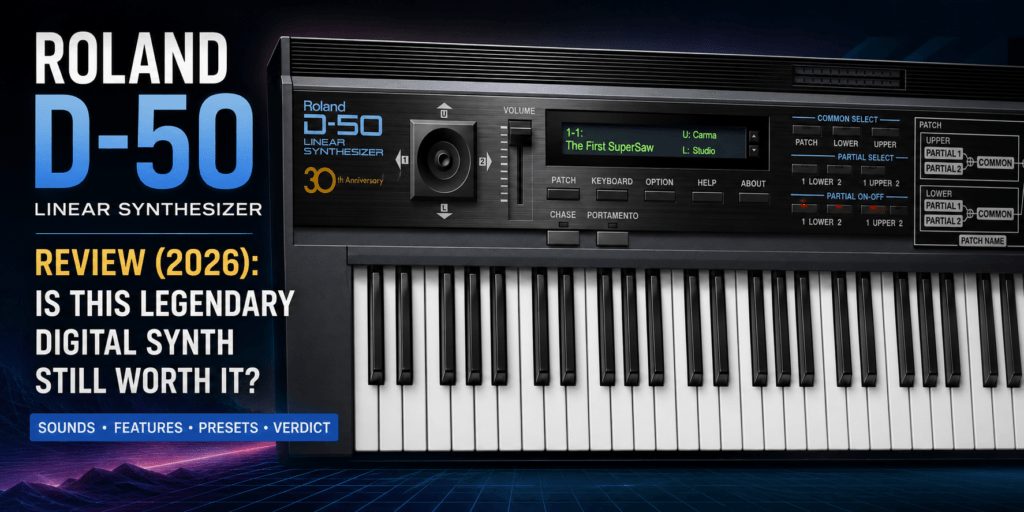
 Roland D-50 Review: Is This Legendary Digital Synth Still Worth It In VST Form?
Few synthesizers have achieved legendary status quite like the Roland D-50. Originally released in 1987, it helped define the sound of late-’80s pop, film scores, new age music, and countless chart-topping records. Today, Roland has faithfully recreated this classic through the Roland Cloud D-50 plugin, giving modern producers access to one of the most influential digital synthesizers ever made.
But in a world filled with powerful software instruments like Serum, Pigments, Omnisphere, and Arturia V Collection, is the Roland D-50 still worth buying in 2026?
After spending time exploring its iconic presets, unique synthesis engine, and updated workflow, here’s my complete review.
What Is the Roland D-50?
The Roland D-50 is a software recreation of Roland’s legendary hardware synthesizer. Instead of traditional analog synthesis, the D-50 introduced Linear Arithmetic (LA) Synthesis, combining short sampled attack transients with synthesized sustain waves.
This hybrid approach allowed the D-50 to create sounds that were incredibly realistic for the late 1980s while still retaining the flexibility of a synthesizer.
The result?
Warm digital pads.
Glassy bells.
Expressive keys.
Lush strings.
Dreamy textures.
Massive cinematic atmospheres.
Many of its factory presets have become iconic, especially:
- Fantasia
- Digital Native Dance
- Soundtrack
- Staccato Heaven
- Glass Voices
- Living Calliope
Even if you don’t recognize the names, you’ve almost certainly heard these sounds in countless hit records.
Installation and First Impressions
Installing the D-50 through Roland Cloud is straightforward.
After authorization, the plugin loads quickly inside any modern DAW.
One thing immediately stands out:
Roland preserved the look and feel of the original hardware while making it much easier to edit sounds.
You can switch between the classic hardware interface and the expanded editor, which makes programming significantly more approachable than on the original keyboard.
Sound Quality
⭐⭐⭐⭐⭐ (5/5)
This is where the Roland D-50 continues to shine.
The plugin delivers:
- Rich evolving pads
- Crystal-clear digital textures
- Warm atmospheric layers
- Bright bells
- Expressive synth keys
- Cinematic soundscapes
Unlike many modern synths that chase aggressive EDM sounds, the D-50 excels at creating movement and emotion.
Its patches evolve naturally over time, making them perfect for producers looking to add depth without overwhelming a mix.
Whether you’re producing R&B, synthwave, ambient, pop, gospel, cinematic music, or lo-fi, the D-50 offers sounds that remain surprisingly fresh decades after their creation.
Understanding Linear Arithmetic (LA) Synthesis
One of the reasons the D-50 sounds so unique is its synthesis method.
Rather than relying solely on oscillators or samples, LA synthesis combines the strengths of both.
Here’s how it works:
- Sampled attacks create realistic instrument beginnings.
- Synthesized sustain waves provide endless tonal shaping.
- Filters and envelopes sculpt the sound.
- Built-in effects add polish and width.
This combination gives the D-50 an unmistakable character that sits somewhere between a sampler and a traditional synthesizer.
Even today, very few instruments recreate this specific sonic approach.
Presets That Defined an Era
The factory presets alone make the D-50 worth exploring.
Some of the most recognizable include:
Fantasia
Perhaps the most famous preset ever created.
Perfect for:
- Ballads
- R&B intros
- Worship music
- Pop
- Film scoring
Digital Native Dance
An unmistakably ’80s sound with percussive attacks and evolving textures.
Great for:
- World music
- Experimental productions
- Ambient compositions
Soundtrack
A lush cinematic pad that instantly creates emotion.
Ideal for:
- Movie scores
- Trap intros
- Vocal backgrounds
- Emotional transitions
Glass Voices
A shimmering vocal-style pad that still sounds beautiful today.
Excellent for layering underneath pianos or modern synths.
User Interface
⭐⭐⭐⭐☆
Roland has done an impressive job modernizing the interface without sacrificing authenticity.
Highlights include:
- Resizable plugin window
- Virtual PG-1000 style editor
- Easy access to parameters
- Patch browser
- Modern preset management
- Hardware-inspired layout
While the classic interface may feel intimidating to beginners, the expanded editor makes sound design significantly easier than programming the original hardware.
Effects
One often-overlooked aspect of the original D-50 was its onboard effects.
The plugin recreates them beautifully.
Included are classic:
- Chorus
- Stereo effects
- Reverb
- Delay
These effects contribute heavily to the spacious, polished sound that made the D-50 famous.
Many presets simply wouldn’t sound the same without them.
CPU Performance
⭐⭐⭐⭐⭐
Despite producing lush, layered sounds, the plugin is surprisingly efficient.
Even multiple instances performed smoothly during testing.
This makes it practical for modern production sessions without worrying about excessive CPU usage.
Best Genres for the Roland D-50
One of the D-50’s strengths is its versatility.
It excels in:
- R&B
- Neo Soul
- Synthwave
- Hip Hop
- Ambient
- Gospel
- Cinematic
- Lo-Fi
- Pop
- Worship
- Film scoring
It may not be your first choice for aggressive EDM basses or hardstyle leads, but for expressive textures and timeless digital character, it remains exceptional.
Pros
- Legendary factory presets
- Beautiful evolving pads
- Authentic Roland sound
- Excellent effects
- Modern interface improvements
- Low CPU usage
- Fantastic for layering
- Great value compared to vintage hardware
Cons
- Learning LA synthesis takes time
- Not designed for modern EDM sound design
- Some users may prefer a cleaner preset browser
- Vintage workflow may feel unfamiliar to beginners
Who Should Buy the Roland D-50?
The Roland D-50 is an excellent choice for:
- Producers seeking authentic vintage digital sounds
- Synthwave creators
- Film and game composers
- Worship keyboardists
- Neo soul musicians
- Hip hop producers looking for lush textures
- Anyone building a collection of classic synthesizers
If your productions need warmth, movement, and unmistakable late-’80s character, the D-50 delivers in a way few modern instruments can.
Final Verdict
Overall Rating: ⭐⭐⭐⭐⭐ (4.9/5)
The Roland D-50 isn’t just a nostalgic recreation—it’s a genuinely inspiring instrument that still earns its place in modern music production. Its distinctive LA synthesis engine, iconic presets, and expressive textures continue to offer sounds that stand apart from today’s virtual analog synths.
While it may not replace a modern sound-design powerhouse like Pigments or Serum, that’s not its purpose. The D-50 excels at delivering timeless digital pads, cinematic atmospheres, shimmering bells, and evolving textures that instantly add character to a track.
If you’re a producer who appreciates vintage instruments, writes R&B, synthwave, cinematic music, pop, or lo-fi, the Roland D-50 deserves a spot in your plugin library.
Pluginera Score: 9.8/10
Pros: Legendary sounds, authentic recreation, inspiring presets, efficient performance, and a workflow that’s more accessible than the original hardware.
Cons: LA synthesis has a learning curve, and its vintage architecture may not appeal to producers focused solely on modern EDM sound design.
For anyone chasing the unmistakable sound of the late ’80s—or simply looking for a synth with a unique voice that still holds up today—the Roland D-50 remains one of the finest classic software instruments available.