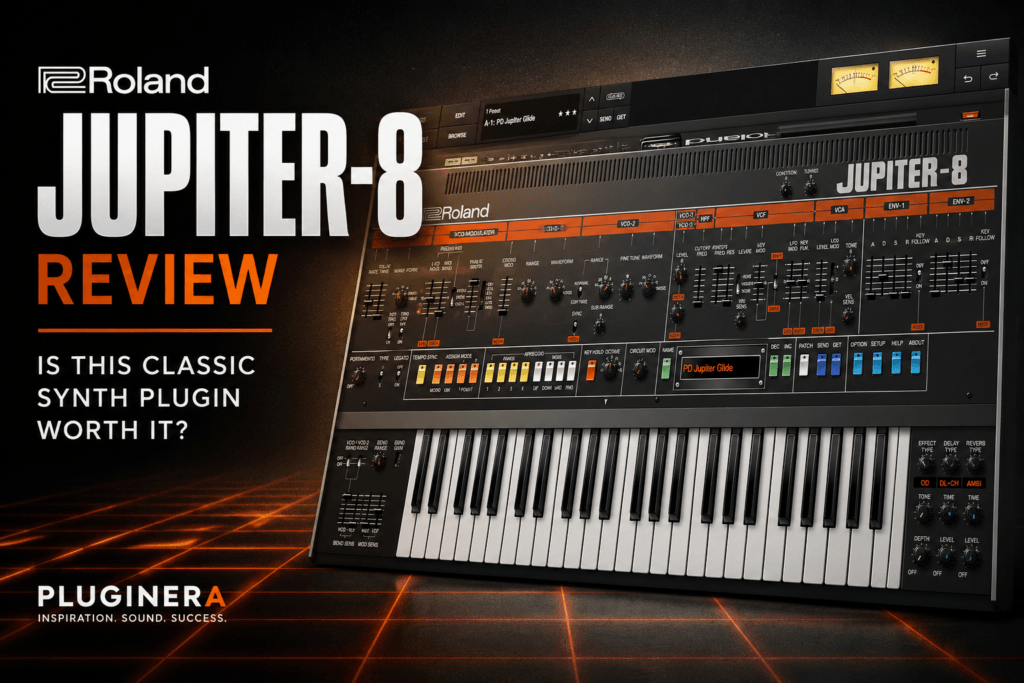
 Roland JUPITER-8 VST Review: Is This Classic Synth Plugin Worth It?
Few synthesizers have achieved the legendary status of the Roland JUPITER-8. Originally released in 1981, the eight-voice analog polysynth became known for its huge pads, silky strings, powerful basses, and unmistakably rich analog character.
The problem? Buying an original JUPITER-8 today is unrealistic for most producers.
That’s where the Roland JUPITER-8 Software Synthesizer comes in.
Using Roland’s Analog Circuit Behavior (ACB) technology, the plugin recreates the circuitry and behavior of the original instrument while adding several features designed for modern music production. You can load it directly into your DAW and get remarkably close to the JUPITER sound without having a vintage synthesizer taking up half your studio.
But does the Roland JUPITER-8 plugin still make sense for producers today?
In this Roland JUPITER-8 review, we’ll look at its sound, workflow, features, presets, sound-design capabilities, and how useful it is for modern Hip Hop, R&B, Trap Soul, Pop, Synthwave, and other genres.
What Is the Roland JUPITER-8 Plugin?
The Roland JUPITER-8 Software Synthesizer is Roland’s official software recreation of its classic JUPITER-8 hardware synthesizer.
Rather than simply sampling sounds from the original instrument, Roland uses its ACB modeling technology to recreate the behavior of the original circuitry.
That distinction is important.
You aren’t limited to static recordings of JUPITER-8 presets. You get a programmable synthesizer where oscillators, filters, envelopes, modulation, and other components interact to create the sound.
The plugin maintains much of the straightforward architecture of the original JUPITER-8 while adding modern features including:
- Adjustable polyphony from two to eight notes
- Velocity sensitivity
- Extended oscillator ranges
- Advanced arpeggiator
- Tempo-synced modulation
- Built-in effects
- Circuit Mod
- Condition control
- Modern preset browser
- Resizable high-definition interface
- VST3, AU, and AAX support
- Apple silicon support
- Roland SYSTEM-8 PLUG-OUT compatibility
The result is essentially an ’80s analog polysynth adapted for a modern DAW workflow.
Roland JUPITER-8 Sound Quality
Sound is the biggest reason to consider this plugin.
The JUPITER-8 has a particular combination of warmth, clarity, width, and movement that makes relatively simple patches sound expensive.
You don’t necessarily need complicated modulation or massive effect chains.
A basic two-oscillator patch through the filter can already produce a rich foundation for a track.
The synth is especially good at:
Analog Pads
Pads may be one of the JUPITER-8’s biggest strengths.
You can create everything from soft background textures to enormous cinematic chords.
For R&B and Trap Soul, try lowering the filter cutoff, slowing the attack slightly, and increasing the release. Add some chorus and reverb and you can quickly create a wide atmospheric pad behind your main chord progression.
Synth Strings
The JUPITER-8 became famous partly because of its lush string sounds.
They remain extremely useful today.
Layer a JUPITER string patch underneath electric piano chords and you can add width and emotion without completely changing the character of the progression.
This works particularly well for:
- R&B
- Soul
- Neo-Soul
- Pop
- Synthwave
- Cinematic Hip Hop
Bass
Don’t assume the JUPITER-8 is only useful for pads.
Its oscillators and filter can create surprisingly powerful analog basses.
For Hip Hop and R&B, you can use it for warm sub-style basses, funky synth basses, retro bass sounds, or aggressive analog bass layers.
You probably aren’t replacing every 808 with the JUPITER-8, but it gives you another bass palette when an 808 isn’t the right choice.
Leads
JUPITER leads can sound smooth, aggressive, futuristic, or distinctly retro depending on the patch.
Oscillator sync and cross-modulation expand the possibilities considerably.
These sounds work especially well for melodic hooks and countermelodies.
Arpeggios
The onboard arpeggiator makes the JUPITER-8 surprisingly effective for rhythmic melodic parts.
A simple minor seventh or ninth chord can become an entirely new musical element once you run it through an arpeggio.
That can be useful when your beat needs movement without another full melody competing with the vocal space.
The Oscillators
At the heart of the JUPITER-8 sound are its two oscillators per voice.
The original hardware provided multiple waveforms along with oscillator sync and cross-modulation, and Roland recreates that architecture in the software version.
Having two oscillators gives you plenty of room to build larger sounds.
You can slightly detune them for width, place them in different octave ranges, combine different waveforms, or use oscillator sync and cross-modulation for more aggressive tones.
For example, a simple R&B patch could start with two saw-based oscillators slightly detuned from one another.
Run those through a darker filter setting, soften the envelope, and add chorus.
You can go from an initialized patch to a lush chord sound surprisingly quickly.
That immediacy is one of the JUPITER-8’s greatest strengths.
The Famous JUPITER Filter
A great analog-style synthesizer needs a great filter.
The JUPITER-8 gives you a resonant low-pass filter with selectable two-pole or four-pole operation, along with a non-resonant high-pass filter.
This gives the synth considerable tonal flexibility.
Lowering the cutoff can turn a bright sawtooth patch into a dark atmospheric texture. Increasing resonance emphasizes frequencies around the cutoff and can make leads and effects more expressive.
For Hip Hop and R&B production, filter automation is particularly useful.
Try opening the filter gradually during the introduction of your beat before allowing the full patch to appear when the drums enter.
It’s an easy way to create transitions without adding another sound.
Circuit Mod and Condition
Two of the most interesting additions to the software version are Circuit Mod and Condition.
Vintage analog synthesizers didn’t behave like perfectly calibrated software instruments.
Components drifted, tolerances varied, and aging could slightly change the character of the instrument.
Roland’s Circuit Mod feature lets you alter aspects of that modeled circuit behavior using a single control.
The Condition parameter takes the concept further by letting you simulate different states of the instrument.
Instead of every patch sounding pristine and mathematically perfect, you can introduce additional analog personality.
That’s especially valuable when you’re making Hip Hop or R&B and want your synths to feel less sterile.
Built-In Effects
Roland didn’t limit the software recreation to the effects capabilities of the original hardware.
The JUPITER-8 plugin includes effects such as:
- Chorus
- Reverb
- Delay
- Flanger
- Overdrive
Having effects directly inside the synth makes preset creation much faster.
Chorus can turn a relatively basic patch into a wide vintage texture, while delay and reverb can transform leads and arpeggios into atmospheric elements.
Overdrive can add additional harmonics when you want something more aggressive.
You can obviously use your favorite third-party effects afterward, but having these tools available directly inside the instrument is convenient.
Presets and Sound Browser
Not everyone wants to design every synth sound from scratch.
Fortunately, the JUPITER-8 includes the original JUPITER-8 patches along with additional sounds designed for contemporary production.
Roland has also built a much more modern preset browsing system around the instrument.
You can search installed patch banks, organize sounds, rate favorites, make notes, and make quick adjustments.
This becomes increasingly valuable as your preset library grows.
For beatmakers, presets are often starting points rather than finished sounds anyway.
Find something close to what you’re hearing in your head, adjust the filter, envelope, effects, or oscillators, and keep moving.
Making Hip Hop with the Roland JUPITER-8
Despite being based on a synthesizer released in 1981, the JUPITER-8 works surprisingly well for modern Hip Hop.
One of the easiest approaches is using it for melodic layers rather than trying to make it carry the entire instrumental.
For example:
Main chords: Electric piano or sampled keys
Layer: Dark JUPITER-8 pad
Bass: 808
Countermelody: Filtered JUPITER lead
Texture: JUPITER arpeggio with heavy reverb
Now the JUPITER isn’t necessarily the obvious centerpiece of the beat, but its analog character is helping give the production depth.
That’s where vintage synthesizers can become extremely useful in modern production.
Making R&B and Trap Soul
This might be an even better application.
Modern R&B frequently relies on lush chords, warm textures, evolving pads, synth basses, and atmospheric melodies.
Those are all areas where the JUPITER-8 excels.
Try playing extended chords such as:
Minor 7ths
Minor 9ths
Major 7ths
Major 9ths
11th chords
through a warm JUPITER pad.
Reduce the filter cutoff, increase the attack slightly, lengthen the release, and add chorus and reverb.
You can quickly get the type of wide harmonic bed that leaves plenty of room for drums, bass, vocals, and countermelodies.
The synth also works extremely well for darker Trap Soul production.
A filtered pad combined with an 808, sparse drums, and a simple lead can create an entire atmosphere without requiring dozens of tracks.
What I Like About the Roland JUPITER-8
The Sound Is Immediately Musical
Some synthesizers make you work hard to create something usable.
The JUPITER-8 rarely feels that way.
Even relatively basic patches can sound rich.
Excellent for Chords
If you make chord-heavy music, this is where the instrument really shines.
Pads, strings, brass-style patches, and other polyphonic textures sound great underneath extended chords.
Simple Enough to Learn
Compared with modern synthesizers containing huge modulation matrices and dozens of pages, the JUPITER-8 architecture is relatively approachable.
That makes it a good instrument for learning subtractive synthesis.
Vintage Character Without Vintage Hardware
The obvious advantage is having the JUPITER sound inside your DAW.
You get instant recall, automation, multiple instances, preset management, and MIDI editing.
Modern Improvements Actually Help
Velocity sensitivity, tempo synchronization, effects, Circuit Mod, Condition, and the improved browser make the plugin significantly more practical for modern production.
What Could Be Better?
No synth is perfect.
One consideration is that the JUPITER-8 intentionally maintains a relatively traditional synthesizer architecture.
If you want massive wavetable libraries, granular synthesis, hundreds of modulation destinations, complex sequencing, or extremely experimental sound design, there are more advanced modern synthesizers available.
The interface may also look intimidating initially if you’ve never used a traditional analog synth.
There are a lot of sliders.
Once you understand the basic signal flow, however, the layout becomes much easier to navigate.
Finally, producers who already own several convincing JUPITER-style emulations may need to decide whether Roland’s official ACB recreation provides enough additional value to justify another synth.
Who Is the Roland JUPITER-8 For?
The Roland JUPITER-8 makes the most sense for producers who want classic analog character inside a modern DAW.
It’s particularly attractive for producers making:
- Hip Hop
- R&B
- Trap Soul
- Pop
- Synthwave
- Funk
- Electronic music
- Cinematic music
- ’80s-inspired production
It’s also worth considering if you’re trying to learn synthesis.
Because the controls are relatively direct, you can actually see the relationship between oscillators, filters, envelopes, modulation, and the resulting sound.
Is the Roland JUPITER-8 Good for Beginners?
Yes — with one qualification.
If you’ve never touched a synthesizer before, the interface can initially look complicated.
But underneath all those sliders is a fairly logical subtractive synthesis architecture.
Once you understand:
Oscillator → Filter → Amplifier
and then learn how envelopes and LFOs modify those sections, the instrument becomes much easier to understand.
In fact, learning on a synth like this can be beneficial because you aren’t constantly disappearing into menus.
You move a control and hear what happens.
Roland JUPITER-8 vs Modern Synth Plugins
Modern synthesizers can obviously do things the original JUPITER designers could never have imagined.
But that’s not really the point.
You buy something like the JUPITER-8 because you want its particular character and workflow.
Think of it less as a replacement for a modern powerhouse synth and more as another instrument in your collection.
A modern wavetable synth might handle aggressive digital textures and extremely complicated modulation.
The JUPITER-8 can handle the warm pad underneath those sounds.
Both have a place.
Is the Roland JUPITER-8 Worth It?
For producers who love analog synthesizers, yes — the Roland JUPITER-8 is absolutely worth considering.
Roland has taken one of its most celebrated hardware instruments and recreated it using its ACB circuit-modeling technology while adding enough modern functionality to make it practical inside today’s production environment.
Its biggest strength isn’t having thousands of flashy features.
It’s how quickly you can get to a musical sound.
Pads feel lush.
Strings feel wide.
Basses have weight.
Leads cut through.
And relatively simple patches can add character to an arrangement without needing complicated processing.
For Hip Hop and R&B producers in particular, the JUPITER-8 can be an excellent source of pads, synth basses, melodic layers, leads, arpeggios, and vintage textures.
Final Verdict
Rating: 9/10
The Roland JUPITER-8 is a strong example of why classic synthesizer designs continue to matter decades after their introduction.
You get the character of an iconic analog polysynth combined with modern conveniences like plugin automation, preset browsing, tempo synchronization, built-in effects, velocity sensitivity, Circuit Mod, and scalable graphics.
There are certainly more complicated synthesizers available.
But complicated isn’t always better.
Sometimes you just want to load a synth, play a chord, move a few sliders, and immediately hear something inspiring.
That’s exactly where the Roland JUPITER-8 Software Synthesizer shines.
Check the latest Roland JUPITER-8 price and availability at Plugin Boutique.
Disclosure: This article may contain affiliate links. If you purchase through one of these links, we may earn a commission at no additional cost to you.