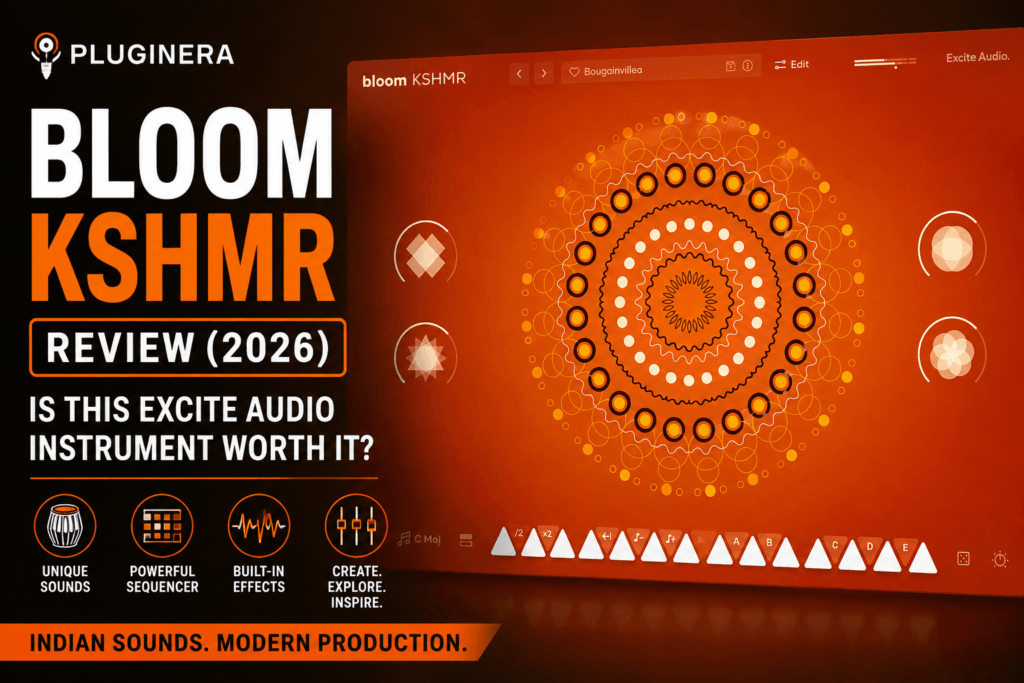
 Bloom KSHMR Review: Is This Excite Audio Instrument Worth It?
Finding sounds that immediately make a beat feel different can be surprisingly difficult.
Most producers already have access to hundreds of synths, drum kits, sample packs, and virtual instruments. The problem isn’t necessarily having enough sounds — it’s finding sounds that inspire you to create something you wouldn’t normally make.
Bloom KSHMR, created by Excite Audio in collaboration with producer KSHMR, takes a different approach.
Rather than giving you another collection of familiar synth patches, Bloom KSHMR focuses on sounds inspired by Indian and South Asian musical traditions, combining instruments, percussion, vocals, phrases, and modern sequencing tools inside one playable instrument.
That makes it particularly interesting for producers looking to introduce new textures into Hip Hop, R&B, Trap, Pop, EDM, cinematic music, and other modern genres.
But is Bloom KSHMR actually useful beyond its distinctive sound library?
Let’s take a closer look.
What Is Bloom KSHMR?
Bloom KSHMR is a sample-based virtual instrument developed by Excite Audio alongside producer and sound designer KSHMR.
The instrument combines traditional South Asian-inspired sounds with a modern production workflow.
Instead of simply browsing through static loops, you can perform, sequence, manipulate, and process the included sounds directly inside the plugin.
The full version includes 250 presets covering sounds such as:
- Tabla and percussion
- Drum circles
- Sitar
- Bansuri-style flute sounds
- Plucked instruments
- Vocal performances
- Melodic phrases
- Rhythmic sequences
- Atmospheric textures
The idea is to make these sounds accessible within contemporary production without requiring producers to manually search through massive sample libraries.
And that’s one of Bloom KSHMR’s biggest strengths.
You can load the plugin and start experimenting almost immediately.
Bloom KSHMR Sound Library
The sound library is easily the main attraction.
Bloom KSHMR isn’t trying to replace your favorite analog synth or workstation. Instead, it gives you a specialized palette that can complement the instruments you already use.
This is particularly valuable if your productions have started sounding too similar.
You might already have hundreds of piano presets.
You probably have plenty of synth pads.
And you almost certainly don’t need another basic trap hi-hat.
Bloom KSHMR gives you sounds capable of taking a production somewhere else entirely.
Percussion
The percussion is one of the most useful areas of the plugin.
Traditional percussion can add rhythmic movement around otherwise straightforward modern drum patterns.
For example, you could build a typical Hip Hop or Trap groove using:
Kick + Snare + Hi-Hat
Then use Bloom KSHMR to introduce an additional percussion layer underneath it.
Instead of replacing your modern drums, Bloom becomes the rhythmic seasoning.
That can make relatively simple patterns feel much more detailed.
Melodic Instruments
The melodic content is equally interesting.
Plucked strings, sitar-inspired sounds, flutes, and other acoustic textures can quickly become the centerpiece of a beat.
These sounds work especially well when layered against modern production elements such as:
- 808s
- Synth pads
- Electric pianos
- Analog basses
- Atmospheric textures
- Trap drums
- Vocal chops
That contrast between organic instrumentation and electronic production can produce some very interesting results.
The Bloom Workflow
One reason the Bloom series works well for beatmakers is its relatively immediate workflow.
You don’t necessarily have to approach Bloom KSHMR like a traditional sampler.
Instead, the plugin encourages experimentation.
Load a preset.
Play different keys.
Trigger different samples and phrases.
Adjust the macros.
Change the sequence.
Manipulate the sound.
Then record whatever catches your attention.
This makes Bloom KSHMR particularly useful during the early stages of making a beat.
Sometimes you don’t need another synthesizer with thousands of parameters.
You need something that makes you say:
“Wait…that sounds crazy.”
Bloom KSHMR is very good at creating those moments.
The Sequencer Is a Major Part of the Instrument
Bloom KSHMR becomes considerably more powerful once you move beyond preset browsing.
The built-in sequencing system allows you to create rhythmic performances directly inside the plugin.
You can control elements including:
- Step rate
- Swing
- Sequence length
- Velocity
- Probability
- Attack
- Release
- Timing
- Performance behavior
Probability is particularly useful.
Rather than having every percussion hit occur during every repetition, you can introduce controlled variations.
That makes patterns feel less robotic.
For Hip Hop and R&B production, this can be extremely useful when creating percussion beds that evolve underneath the main drums.
Instead of manually programming every variation inside your DAW, Bloom can generate some of that movement internally.
Sample Editing
Bloom KSHMR also gives you control over the underlying samples.
Depending on what you’re creating, you can manipulate characteristics such as:
- Start and end points
- Attack
- Release
- Pitch
- Fine tuning
- Pan
- Volume
- Playback behavior
This means you aren’t completely locked into the factory presentation of a sound.
A sample that initially sounds too recognizable can often be transformed into something more personal.
Try pitching it down.
Reverse it.
Shorten the sample.
Increase the attack.
Process it heavily.
Then layer it underneath another instrument.
Suddenly the original sound becomes something completely different.
That’s where Bloom starts feeling less like a preset library and more like an actual production tool.
Built-In Effects
Bloom KSHMR also includes onboard effects for shaping sounds without immediately reaching for additional plugins.
The effects section includes tools such as reverb, dynamics, and noise, along with global tone-shaping controls.
The reverb section provides different spaces including:
- Plate
- Hall
- Spring
There are also controls for parameters such as size, length, pre-delay, filtering, and ducking.
The noise processor is another interesting creative tool.
You can introduce textures such as tape-style noise, vinyl crackle, hiss, and other environmental characteristics.
That can work particularly well when you’re creating:
- Lo-fi Hip Hop
- Alternative R&B
- Sample-inspired beats
- Atmospheric Trap
- Cinematic productions
You don’t have to use these effects, of course.
You can always send Bloom into your favorite third-party processors.
But having creative effects inside the instrument makes it easier to move from preset to finished sound quickly.
Using Bloom KSHMR for Hip Hop
This is where Bloom KSHMR becomes especially interesting.
At first glance, you might assume this instrument is primarily designed for Bollywood-inspired music, EDM, or cinematic production.
I wouldn’t limit it that way.
Hip Hop has always been built around taking sounds from different places and putting them into new contexts.
Bloom KSHMR gives beatmakers another palette to explore.
Imagine starting with a dark plucked phrase.
Pitch it down.
Add an atmospheric pad underneath it.
Program a hard snare.
Add sparse hi-hats.
Then bring in a deep 808.
You could quickly turn something traditionally inspired into a modern Hip Hop production.
And because the source material is different from the sounds many producers typically reach for, your melodies can immediately have more character.
Using Bloom KSHMR for Trap
Trap producers could get a lot out of this instrument.
Instead of beginning another beat with a piano or bell preset, try starting with:
Sitar/pluck → dark processing → 808 → trap drums.
Or build the rhythm first:
Tabla/percussion → hi-hats → snare → kick → 808.
The traditional percussion doesn’t need to dominate the beat.
Keep it relatively low in the mix and let it create movement behind your primary drum pattern.
This is one of the easiest ways to make a familiar Trap rhythm sound less predictable.
Using Bloom KSHMR for R&B
Bloom KSHMR can also work surprisingly well for modern R&B.
The key is restraint.
You don’t necessarily need a complicated melodic performance.
Instead, use Bloom to provide texture.
For example:
Rhodes chords
Bloom flute phrase
Atmospheric pad
Sub bass
Sparse R&B drums
That could create a beautiful foundation for a vocalist.
You could also use vocal textures from Bloom as atmospheric layers.
Pitch them.
Reverse them.
Add reverb.
Filter out some high frequencies.
Place them quietly behind the main instrumentation.
Little details like this can make an R&B production feel considerably more expensive and immersive.
The Four Macro Controls
Another feature that makes Bloom KSHMR approachable is its macro system.
Four central macro controls provide quick access to major characteristics of the current sound.
This is useful because sometimes you don’t want to spend ten minutes adjusting individual parameters.
You want to perform the sound.
Macros allow you to make broader tonal or rhythmic changes quickly.
They’re also useful for automation.
Record macro movement throughout an arrangement and a relatively static phrase can gradually evolve.
That can help with one of the biggest problems producers encounter:
Making loops feel like complete songs.
Automation gives the listener something slightly different as sections progress.
Importing Your Own Samples
One of the more interesting possibilities is the ability to bring your own samples into the Bloom environment.
That expands the instrument beyond the included factory library.
You could potentially load your own:
- Percussion
- Vocal chops
- Melodic samples
- Textures
- One-shots
Then use Bloom’s editing and sequencing workflow to manipulate them.
This adds considerably more longevity to the plugin.
Even after you’ve explored the factory presets, the underlying workflow can remain useful.
Bloom KSHMR for Sound Design
You don’t necessarily have to use Bloom’s sounds exactly as they’re presented.
In fact, producers willing to experiment may get even more value from it.
Try taking a melodic phrase and:
- Pitching it down an octave.
- Reversing the playback.
- Changing the start position.
- Adding heavy reverb.
- Filtering the high frequencies.
- Resampling it into your DAW.
- Chopping the resulting audio.
Now you’ve created something that may sound completely different from the original preset.
This is particularly powerful for producers who enjoy sample-based production but don’t always want to search for external samples.
Bloom can become your source material.
What I Like About Bloom KSHMR
The Sound Palette Is Different
This is easily the biggest advantage.
Most producers already own enough conventional synth sounds.
Bloom KSHMR gives you another sonic vocabulary.
That alone can make it useful.
It’s Easy to Get Ideas Started
Bloom is designed around experimentation.
You can quickly browse sounds, trigger phrases, manipulate sequences, and start recording ideas.
That makes it an excellent tool when you’re dealing with producer’s block.
The Percussion Is Extremely Useful
You don’t have to build an entire production around South Asian instrumentation.
Sometimes adding one subtle percussion pattern is enough.
That makes Bloom useful even when you’re creating relatively conventional Hip Hop, Trap, Pop, or R&B.
There’s More Depth Than Preset Browsing
The sequencer, sample editing, effects, macros, and sample-import capabilities mean there’s plenty of room to manipulate the source material.
That’s important.
Otherwise Bloom could easily feel like another loop library packaged inside a plugin.
Instead, producers are given tools to reshape those sounds.
Potential Downsides
Bloom KSHMR won’t necessarily be essential for everyone.
It’s a Specialized Instrument
If you’re looking for one plugin that provides pianos, basses, analog synths, orchestral instruments, guitars, drums, and everything else, this isn’t it.
Bloom KSHMR is about a specific sonic identity.
That’s simultaneously its biggest strength and biggest limitation.
Some Sounds May Be Immediately Recognizable
This is something to consider with any sample-based instrument.
If producers simply load presets and use phrases unchanged, there’s always the possibility of other people using the same material.
That’s why I recommend treating the presets as starting points.
Pitch them.
Chop them.
Reverse them.
Layer them.
Automate them.
Resample them.
Make the sounds yours.
You May Already Own Similar Sounds
Producers with enormous world-instrument libraries or extensive South Asian sample collections may already have access to much of this sonic territory.
In that situation, Bloom’s value will depend more heavily on whether you like its workflow.
Who Should Buy Bloom KSHMR?
I’d particularly recommend checking it out if you produce:
- Hip Hop
- Trap
- R&B
- Pop
- EDM
- Lo-fi
- Cinematic music
- Experimental music
It’s also worth considering if you frequently struggle with finding interesting starting points for beats.
Sometimes a new sonic palette is more valuable than another massive synthesizer.
Who Should Skip It?
You might want to skip Bloom KSHMR if you primarily need a traditional workstation or bread-and-butter instrument collection.
If you’re looking for realistic grand pianos, acoustic basses, guitars, strings, brass, and general-purpose instruments, there are better tools for that job.
Bloom should be viewed as a specialized creative instrument, not your only virtual instrument.
System Compatibility
Bloom KSHMR is available for both macOS and Windows.
Plugin formats include support for common standards such as:
- VST
- VST3
- AU on macOS
- AAX
- Standalone operation
Excite Audio also lists compatibility with major production environments including Ableton Live, Logic Pro, FL Studio, Pro Tools, Cubase, Reaper, and Reason, among others.
As always, check the current system requirements before purchasing, particularly if you’re using an older operating system or DAW.
Is Bloom KSHMR Worth It in 2026?
For the right producer, absolutely.
The reason isn’t simply that Bloom KSHMR contains good sounds.
It’s that those sounds occupy a space many producers don’t already have covered by dozens of other plugins.
If you already own multiple synths, another synth might not dramatically change your music.
A completely different collection of instruments, percussion, vocal textures, and rhythmic phrases might.
That’s the appeal of Bloom KSHMR.
It gives producers access to a distinctive sound palette while still providing enough sequencing, editing, effects, and performance control to transform the material.
For Hip Hop and R&B producers specifically, I wouldn’t approach Bloom KSHMR as a plugin you need to use on every track.
I’d treat it as a secret-weapon instrument.
Pull it out when your beats are starting to sound predictable.
Grab an unusual percussion groove.
Find a haunting flute.
Manipulate a plucked instrument.
Build something around a vocal texture.
Then combine those sounds with the modern drums, 808s, synths, and effects you already use.
That’s where Bloom KSHMR becomes genuinely exciting.
Final Verdict
Bloom KSHMR is one of the more distinctive instruments in Excite Audio’s Bloom series.
Its combination of Indian and South Asian-inspired instrumentation, percussion, vocals, sequencing, sample manipulation, and effects gives producers a creative environment that feels different from the typical virtual instrument.
It’s especially appealing for producers who want to introduce unexpected textures into Hip Hop, Trap, R&B, Pop, and cinematic productions.
Pluginera Rating: 8.8/10
Best for: Producers looking for unique percussion, melodic textures, vocal phrases, and South Asian-inspired sounds.
Biggest strength: A distinctive sound palette combined with an easy, creative workflow.
Biggest weakness: Its specialized nature means it won’t replace a general-purpose workstation or synthesizer.
Bottom line: If your plugin collection is already overflowing with synths but your productions could use a fresh source of inspiration, Bloom KSHMR is absolutely worth a look.