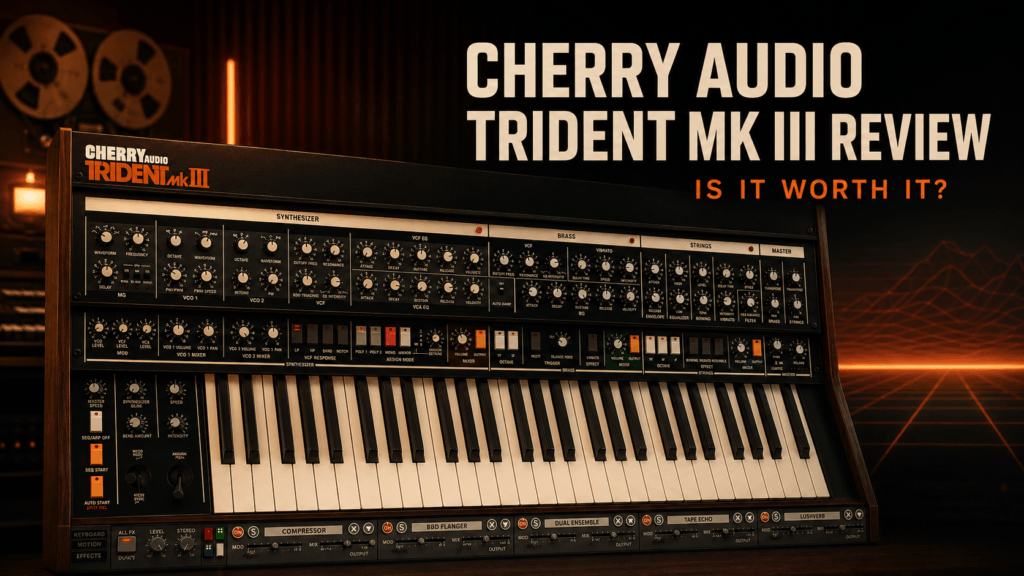
 The original Korg Trident was an ambitious analog instrument that combined a polyphonic synthesizer with dedicated brass and string sections. Released during the early 1980s, it became known for lush pads, sweeping strings, warm brass, and the colorful analog textures associated with that era.
Cherry Audio’s Trident Mk III Synthesizer brings that concept into the modern studio. Rather than creating a strict one-to-one reproduction, Cherry Audio has expanded the vintage design with additional polyphony, flexible keyboard zones, sequencing tools, extensive effects, and more than 370 presets.
The result is a virtual instrument designed to capture the spirit of the original hardware while providing the flexibility expected from a contemporary synth plugin.
But does Trident Mk III offer enough to stand out in an already crowded market? In this review, we’ll examine its sound architecture, workflow, effects, presets, strengths, and potential limitations.
What Is Cherry Audio Trident Mk III?
Cherry Audio Trident Mk III is a software synthesizer inspired by the Korg Trident Mk I and Mk II hardware instruments released in 1981 and 1982.
Like the original, the plugin contains three primary sound sections:
- Synthesizer
- Brass
- Strings
Each section operates like an individual instrument with its own sound-shaping controls and mixer. You can play the sections independently, stack them into large composite patches, or assign them to different areas of your MIDI keyboard.
Cherry Audio has expanded the original concept by providing as many as 16 voices for each section. The plugin also supports velocity, aftertouch, polyphonic aftertouch, and expression-pedal assignments.
This makes Trident Mk III more expressive than the vintage hardware and considerably easier to incorporate into a modern production setup.
Three Instruments in One Plugin
Trident Mk III’s greatest strength is its multitimbral architecture. Instead of loading several separate plugins to construct a layered sound, you can combine synth, brass, and strings inside a single interface.
Synthesizer Section
The synthesizer section is the most flexible of the three sound engines. It includes two oscillators, multiple voice modes, two envelopes, a modulation generator, and a multimode filter modeled after the original instrument’s SSM 2044 design.
The available voice modes include monophonic, polyphonic, and several unison configurations. Using four, six, or eight unison voices can produce thick basses, forceful leads, and wide analog textures.
Oscillator one offers sawtooth, pulse-width, and PWM waveforms. Oscillator two includes sawtooth, triangle, and pulse-width options. Oscillator sync and modulation make it possible to move beyond straightforward vintage patches and create more aggressive or animated sounds.
The filter can operate in low-pass, high-pass, band-pass, and notch modes. That added flexibility helps the plugin fit into contemporary productions where sounds frequently need to be shaped around vocals, drums, and bass.
Brass Section
The brass section is designed for bold analog brass sounds rather than realistic orchestral emulation. It has a dedicated filter, envelope intensity, resonance, vibrato, and performance controls.
This section works particularly well for:
- Short chord stabs
- Funk-inspired riffs
- Synthwave harmonies
- Retro pop arrangements
- Layered R&B chords
- Cinematic chord swells
The brass engine can sound powerful on its own, but it becomes even more useful when quietly layered beneath the primary synthesizer. That additional layer can give a patch more body without requiring another plugin instance.
String Section
The string section provides the sweeping ensemble character associated with vintage string machines. It includes its own attack and release envelope, filter, equalizer, bowing control, and vibrato.
These are electronic string textures rather than deeply sampled orchestral strings. That distinction is important. Producers looking for realistic violins and cellos should use a dedicated orchestral library, while those seeking warm, nostalgic string pads will find plenty to explore here.
The string section is especially suited to synthwave, dream pop, classic soul, R&B, ambient music, and film-inspired production.
Splits, Layers, and Keyboard Zones
Trident Mk III allows each of its three sections to have an independent keyboard range. Producers can create splits and layers using draggable zone handles or start with one of the included Quick Split templates.
For example, you could place a synth bass in the lower octaves, brass chords in the middle, and strings across the upper range. Alternatively, you could layer all three engines across the keyboard to create a massive performance patch.
Crossfades can smooth the transition between zones, making the instrument useful for live performance as well as studio production.
This system also encourages experimentation. A relatively simple synthesizer patch can become more interesting when blended with a soft string layer and a touch of brass.
Motion, Sequencing, and Arpeggiation
The Motion panel significantly expands Trident Mk III beyond the capabilities of the original hardware. It includes a 16-by-2 polyphonic step sequencer and two assignable arpeggiators.
Patterns can be entered step by step or captured from a real-time performance. The sequencer supports ties, accents, pattern variations, and DAW synchronization.
The two arpeggiators offer four modes:
- Arp
- Leap
- Order
- Random
Swing, Chance, and Feel controls introduce variations that can keep patterns from sounding overly rigid. These tools are useful for synthwave bass lines, pulsing pads, rhythmic chord sequences, electronic melodies, and evolving background textures.
Because the sequencer and arpeggiators are built into the instrument, you can save the motion of a sound as part of the preset instead of recreating the MIDI pattern in every project.
Built-In Effects
Trident Mk III contains 17 effects that can be arranged across four customizable chains. The synth, brass, and string sections can each use an independent effects chain, while a fourth chain processes the combined output.
Available processors include:
- BBD flanger
- Compressor
- Digital delay
- Digital reverb
- Distortion and EQ
- Dual delay
- Dual ensemble
- Dual phaser
- Envelope filter
- Flanger and chorus
- Galactic reverb
- Lo-fi
- Lushverb
- Ring modulator
- Seven-band EQ
- Spring reverb
- Tape echo
The BBD flanger is particularly appropriate for recreating the swirling character of the original Trident. Ensemble, chorus, and reverb can transform the string section into a wide cinematic pad, while tape echo and spring reverb add convincing retro coloration.
Having independent effects chains is an important advantage. You might add ensemble and reverb to the strings, compression to the brass, and delay to the synthesizer before applying global processing to the finished layer.
This makes the plugin feel more like a self-contained sound-design workstation than a basic vintage emulation.
Presets and Workflow
Trident Mk III includes more than 370 professionally designed presets organized into 14 categories. The library covers basses, leads, pads, brass, strings, splits, layers, arpeggiated sounds, and cinematic textures.
The presets make it possible to start creating immediately, but they also demonstrate how the instrument’s three sections can work together. Examining the layers of a preset is an effective way to learn the architecture.
Cherry Audio also includes its Focus feature, which enlarges a selected area of the interface. This is helpful because Trident Mk III contains a substantial number of controls across multiple panels.
Nearly every parameter supports MIDI control and DAW automation, while MIDI Learn makes it relatively easy to connect the plugin to a hardware controller.
Using Trident Mk III for Modern Production
Although Trident Mk III is rooted in early-1980s analog synthesis, it is not limited to retro music.
For R&B and trap soul, the string and synthesizer sections can produce warm pads for extended chords. Filtering the top end, increasing the attack, and adding Lushverb can create a spacious foundation that leaves room for vocals.
Hip-hop producers can use the plugin for dark analog basses, filtered chord progressions, vintage leads, and melodic textures that can be resampled and processed. The lo-fi effect, tape echo, and modulation effects are particularly useful when transforming clean presets into something more atmospheric.
Synthwave is perhaps the most natural match. Analog brass, ensemble strings, arpeggiators, unison leads, and synchronized sequences provide most of the essential ingredients for an ’80s-inspired arrangement.
It should also work well well for pop, funk, ambient music, cinematic scoring, and electronic production.
System Requirements
Trident Mk III is available as a standalone instrument and in common 64-bit plugin formats.
For macOS, it supports macOS 10.13 or later and works with Intel and Apple Silicon processors. Windows support begins with Windows 7 and includes Windows 11. Cherry Audio recommends a quad-core processor and 8GB of RAM, while the installation requires approximately 110MB of storage.
An internet connection is required for activation. Current compatibility details should always be confirmed on the Plugin Boutique product page before purchasing.
Trident Mk III Pros and Cons
Pros
- Combines synthesizer, brass, and string engines
- Captures a distinctive vintage analog aesthetic
- Up to 16 voices for each section
- Flexible keyboard splits, layers, and crossfades
- Built-in polyphonic step sequencer
- Two versatile arpeggiators
- Four independent effects chains
- Includes 17 effects
- More than 370 presets
- Velocity and aftertouch support
- Suitable for several modern genres
- Standalone version included
Cons
- The large interface may initially feel overwhelming
- Brass and strings are intentionally synthetic rather than realistic
- Producers seeking modern wavetable or granular synthesis may find the architecture traditional
- The number of sections and effects could encourage overly dense patches
- Internet access is required for activation
Is Cherry Audio Trident Mk III Worth It?
Trident Mk III is worth considering if you enjoy vintage analog sounds but want more control than a historically exact emulation would provide.
Its strongest feature is the ability to build complete layered patches from three complementary sound engines. The combination of synth, brass, and strings gives it a recognizable character, while the sequencer, arpeggiators, keyboard zones, modulation, and effects make it practical for contemporary production.
It may not be the right choice for producers who want realistic orchestral instruments or cutting-edge wavetable synthesis. However, it fills a different role: warm analog polyphony, electronic strings, vintage brass, and animated retro textures inside one instrument.
For R&B, synthwave, pop, hip-hop, funk, and cinematic production, that combination can be both inspiring and efficient.
Final Verdict
Cherry Audio Trident Mk III modernizes a fascinating vintage instrument without losing the character that made the original concept special.
The three-part architecture provides considerably more variety than a conventional analog polysynth. Its flexible layering system can produce everything from simple basses and brass stabs to wide, evolving patches that sound like an entire keyboard rig.
The expanded polyphony, performance controls, sequencer, dual arpeggiators, extensive effects, and large preset library make Trident Mk III more than a nostalgic recreation. It is a capable production instrument with a distinctive identity.
Producers looking for warm pads, sweeping strings, analog brass, vintage leads, and instantly recognizable early-’80s color should place Trident Mk III high on their list.
Rating: 4.6 out of 5