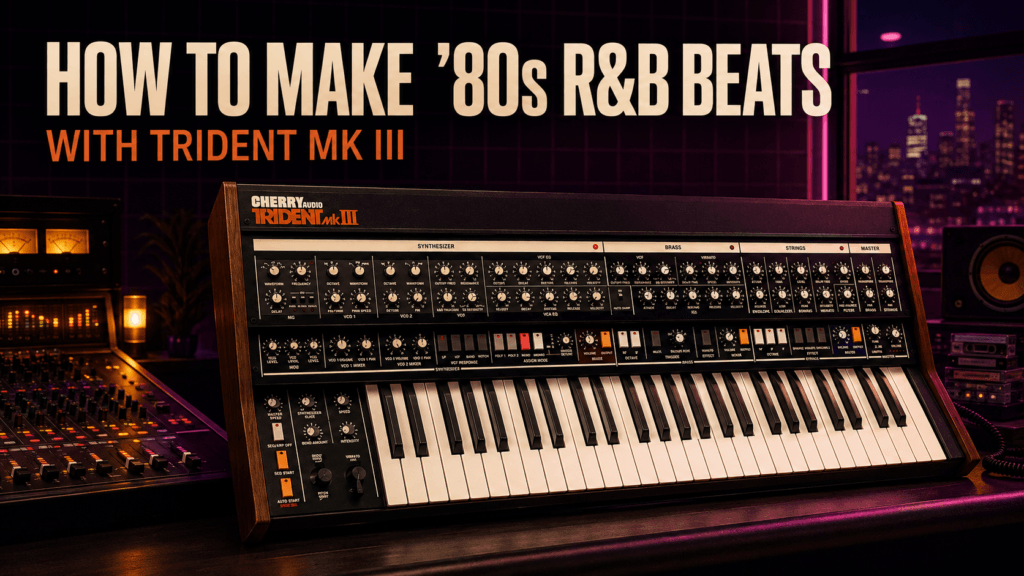
 The sound of ’80s R&B was defined by more than drum machines and glossy production. Much of its emotional character came from warm analog chords, sweeping string machines, expressive synth brass, melodic bass lines, and spacious effects.
Cherry Audio’s Trident Mk III is particularly well suited to this style. Inspired by the original Korg Trident hardware synthesizers, it combines separate synthesizer, brass, and string sections inside one virtual instrument. These engines can be played individually or layered to create the rich keyboard textures associated with classic R&B, boogie, funk, quiet storm, and synth-driven soul.
In this guide, we’ll build an ’80s-inspired R&B beat using Trident Mk III as the main melodic instrument. You can follow these steps in Reason or practically any other DAW.
Start with the Right Tempo and Key
Most ’80s R&B grooves feel energetic without becoming overly fast. A good starting range is between 88 and 110 BPM.
Choose the tempo according to the mood you want:
- 88–94 BPM for slow jams and quiet storm
- 95–102 BPM for midtempo R&B
- 103–110 BPM for boogie, funk, and dance-oriented tracks
For this example, set the project to 98 BPM and work in E minor.
E minor is a useful key because it can sound emotional, mysterious, or uplifting depending on the chords and voicings. It also places the root notes comfortably on a MIDI keyboard.
Build an Emotional Chord Progression
Rich chord voicings are one of the most important ingredients in classic R&B. Basic triads can work, but seventh, ninth, and suspended chords will give the progression more personality.
Try this four-chord progression:
Em9 – Cmaj7 – Am9 – B7sus4
The notes are:
- Em9: E–G–B–D–F♯
- Cmaj7: C–E–G–B
- Am9: A–C–E–G–B
- B7sus4: B–E–F♯–A
Resolve the B7sus4 to B7 during the final part of the measure by moving E down to D♯. That small movement creates tension before the progression returns to E minor.
Instead of playing every chord in root position, spread the notes across two octaves. Keep the root in your left hand and place the third, seventh, and ninth in your right hand.
For example, voice Em9 like this:
- Left hand: E and B
- Right hand: D, F♯, and G
This creates a wide, polished chord without occupying too much space in the middle of the mix.
Record the progression for eight bars. Allow the chords to sustain, but add a few short rhythmic hits near the ends of phrases. Those accents will help the part interact with the drums.
Choose a Warm Synthesizer Patch
Open Trident Mk III and begin with the Synthesizer section. You can select a warm polyphonic preset or initialize the patch and build one manually.
For a classic analog R&B tone:
- Select a polyphonic voice mode.
- Use a sawtooth wave on the first oscillator.
- Add a quieter pulse wave from the second oscillator.
- Detune the second oscillator slightly.
- Lower the filter cutoff to soften the top end.
- Use moderate filter resonance.
- Set a medium attack and medium-long release.
- Add a small amount of vibrato or pulse-width modulation.
The goal is a smooth, warm chord sound rather than an aggressive lead. If the patch feels too bright, close the filter instead of immediately reaching for an external EQ.
Velocity sensitivity can add expression to the performance. Play important chord accents slightly harder while keeping the sustained chords softer.
Layer the String Section
The Trident’s String section is ideal for adding width and emotion. Instead of making it equally loud as the main synthesizer, use it as a supporting layer.
Raise the string attack so it swells gently behind each chord. A slightly slower attack prevents the strings from competing with the initial impact of the synth.
Increase the release until neighboring chords blend smoothly, but avoid making the tail so long that the harmony becomes cloudy. Add vibrato and ensemble-style modulation for movement.
The string layer should become noticeable when muted, but it does not need to dominate while the entire track is playing.
Use Trident Mk III’s keyboard-zone controls if you want to prevent the strings from playing in the lowest octave. Removing the string layer from the bass register will reduce muddiness and leave space for the bass line.
Add Analog Brass Accents
The Brass section can give the beat more rhythmic energy. Rather than layering brass beneath every sustained chord, assign it to selected chord stabs.
Create a new MIDI part or use a keyboard split to trigger the brass separately. Add short brass hits on beats two and four or place them just before the snare.
For example, during the fourth bar, play a short B7 brass chord on the “and” before beat four. This creates a strong pickup into the next phrase.
Use a fast attack, medium decay, short release, and a moderately open filter. The brass should sound bold and synthetic—not like a realistic horn section.
Keep the brass relatively dry compared with the strings. A short reverb or subtle room sound will preserve its impact.
Program an ’80s R&B Drum Groove
The drums should feel tight, punchy, and slightly mechanical while still having enough swing to support the R&B feel.
Start with a kick, snare, clap, closed hi-hat, open hi-hat, and a few electronic percussion sounds.
Kick
Place the main kick on beat one. Add additional kicks around beat three and before selected snare hits.
A simple one-bar pattern might place kicks on:
- Beat 1
- The “and” after beat 2
- Beat 3
- The “and” after beat 3
Avoid filling every available space. The bass line will supply additional movement.
Snare and Clap
Place the snare on beats two and four. Layer it with a bright clap for the polished, gated character associated with ’80s production.
You can create a gated snare effect by sending the snare to a bright reverb and shortening the reverb tail with a gate or envelope. The result should sound large but stop abruptly instead of washing into the next beat.
Hi-Hats
Program closed hi-hats in eighth notes. Vary the velocity and add occasional sixteenth-note pickups.
Place an open hi-hat before beat four or at the end of every second bar. This helps mark transitions without overcrowding the groove.
Add a small amount of swing if the pattern feels too rigid. Around 54–57% is often enough, although the ideal setting depends on your DAW and drum pattern.
Percussion
Electronic toms, cowbells, shakers, and rimshots can add authentic period flavor. Use them selectively as fills and accents rather than placing every sound throughout the track.
Create a Melodic Synth Bass
Classic R&B bass lines often do more than follow the roots. They connect the chords with passing notes, octave jumps, and short melodic phrases.
Use a second instance of Trident Mk III or create a separate synthesizer layer. Select monophonic mode and start with a sawtooth or pulse wave.
For the bass envelope:
- Use a fast attack
- Set a short-to-medium decay
- Lower the sustain
- Keep the release short
- Close the filter until the bass sounds rounded
Begin with the root movement:
E – C – A – B
Then introduce passing notes. You could move from E down through D to C, walk from C through B to A, and approach B from F♯ or A.
Leave occasional gaps before the kick or snare. A bass line becomes more effective when it breathes with the drums instead of playing continuously.
Keep the lowest frequencies centered and consider using light sidechain compression if the kick and bass compete.
Write a Simple Lead Melody
An ’80s R&B lead should feel memorable without becoming too busy. A short motif of three or four notes is often enough.
Create a new Trident instance and choose a soft lead, synth flute, or gentle unison patch. Use the E natural minor scale:
E–F♯–G–A–B–C–D
Emphasize chord tones on strong beats. Over Em9, target E, G, B, D, or F♯. When the progression reaches B7, introduce D♯ to reflect the dominant chord and create a stronger resolution back to E minor.
Add pitch bends at the end of selected phrases. A short glide between two notes can also produce an expressive, vocal-like character.
Use delay to create space between phrases, but keep the dry melody clear.
Use Trident’s Built-In Effects
Trident Mk III includes independent effects chains for its sound sections, making it possible to process the synth, brass, and strings differently.
For the main chord patch, try:
- Compressor for gentle control
- BBD flanger or dual ensemble for movement
- Seven-band EQ for tonal shaping
- Lushverb for space
For the strings, use ensemble and reverb to create width. Keep the low end filtered so the effect does not overwhelm the bass.
For the brass, add a small amount of compression and short reverb. If you use delay, keep the feedback low.
Tape echo works well on leads and melodic accents. Synchronize it to the tempo and use a filtered repeat so the echoes sit behind the original performance.
The key is restraint. Because the plugin can run separate effects chains, it is easy to make every section sound enormous. Decide which layer should feel closest to the listener and push the supporting layers farther back.
Arrange the Beat into a Complete Song
Once the eight-bar loop is working, turn it into a complete arrangement.
A practical structure is:
- 4-bar intro
- 16-bar verse
- 8-bar pre-chorus
- 8-bar chorus
- 16-bar second verse
- 8-bar chorus
- 8-bar bridge
- 8-bar final chorus
- 4-bar outro
Start the intro with filtered chords or strings. Introduce the drums gradually instead of playing the complete groove immediately.
During the verse, use the main synth chords with a restrained drum pattern. Save the full string layer, brass accents, open hi-hats, and lead melody for the chorus.
For the pre-chorus, remove the kick for the first few bars and allow the strings to become more prominent. Automate the filter cutoff upward to build anticipation.
In the chorus, activate all three Trident sections. Add wider voicings, stronger brass stabs, fuller drums, and a more active bass line.
The bridge should introduce a noticeable change. You could switch to C major, simplify the drums, or feature a Trident arpeggio before returning to the final chorus.
Add Transitions and Ear Candy
Transitions prevent the arrangement from sounding like the same loop repeated for several minutes.
Try adding:
- Reverse cymbals before new sections
- Electronic tom fills
- Filter automation on the chord layer
- Delayed brass hits
- Pitch-bent synth effects
- Drum-machine fills
- Muted beats before the chorus
- Reverb throws on the final chord of a phrase
Trident Mk III’s sequencer and arpeggiators can create additional rhythmic textures. Program a simple sixteenth-note pattern and introduce it only during the pre-chorus or bridge.
Use the Chance and Feel controls to keep the pattern from repeating identically every time.
Mix the Beat
Start by balancing the track at a moderate volume. The drums and bass should establish the foundation, while the Trident layers fill the middle and upper frequencies.
High-pass the strings and brass where necessary. The exact cutoff will depend on the patch, but removing unnecessary low frequencies will make space for the bass and kick.
If the chords feel crowded, reduce one of the layers before applying more EQ. The Synthesizer section may already provide enough body, allowing the Brass and Strings sections to function as quieter colors.
Pan percussion and selected melodic accents to create width, but keep the kick, snare, bass, and main vocal space near the center.
Use bus compression lightly. ’80s-inspired production can be punchy, but excessive compression will remove the dynamics that make the arrangement feel expressive.
Final Thoughts
Cherry Audio Trident Mk III provides nearly everything needed to establish the melodic foundation of an ’80s R&B beat. Its synthesizer section delivers warm chords, basses, and leads, while the dedicated brass and string engines add the layered character associated with classic analog keyboard arrangements.
The most important technique is not simply choosing an ’80s preset. The sound comes from how the parts work together: extended chords, melodic bass movement, expressive voicings, electronic drums, spacious effects, and an arrangement that gradually introduces new layers.
Start with a strong chord progression, keep the initial loop simple, and use Trident’s three sound sections to build intensity as the song develops. With careful layering and restraint, Trident Mk III can produce nostalgic ’80s textures that still feel polished enough for modern R&B.