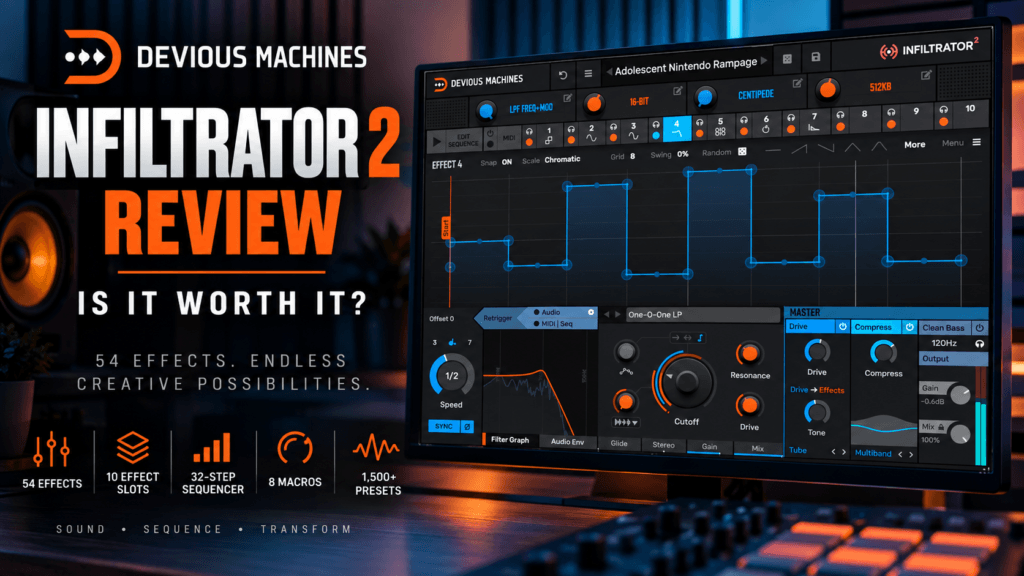
 Devious Machines Infiltrator 2 Review: Is It Worth It?
Devious Machines Infiltrator 2 is the kind of plugin that can completely change the way you think about effects.
Instead of loading separate distortion, filter, delay, reverb, modulation, and glitch plugins across several insert slots, Infiltrator 2 puts a huge collection of effects inside one creative multi-effects environment.
But its biggest strength isn’t simply the number of effects included.
It’s movement.
Infiltrator 2 lets you sequence, modulate, automate, and combine effects to turn relatively simple sounds into rhythmic, evolving textures. That makes it especially interesting for producers working in Hip Hop, R&B, Trap Soul, electronic music, Pop, and other genres where ear candy and transitions can make an arrangement feel much more polished.
In this Devious Machines Infiltrator 2 review, we’ll look at how the plugin works, its major features, how it can be used in real-world music production, and whether it’s worth adding to your plugin collection.
What Is Devious Machines Infiltrator 2?
Infiltrator 2 is a creative multi-effects plugin developed by Devious Machines.
Rather than giving you a single processor, Infiltrator 2 provides 54 different effects that can be loaded into a chain containing as many as 10 effect modules simultaneously.
These effects cover a huge range of processing possibilities, including:
- Filters
- Distortion
- Delay
- Reverb
- Modulation
- Pitch processing
- Spectral effects
- Lo-fi processing
- Dynamics
- Glitch effects
- Time-based effects
- Frequency manipulation
But Infiltrator 2 isn’t simply an effects rack.
The plugin includes a powerful sequencer and modulation system that allows effects to appear, disappear, move, pulse, and change throughout a pattern.
That’s where Infiltrator becomes particularly interesting.
You aren’t just processing a sound.
You’re essentially performing the effects themselves.
How Does Infiltrator 2 Work?
At its core, Infiltrator 2 revolves around an effects chain.
You can load up to 10 effects into the chain and process your source through them in sequence.
For example, you could build a chain like:
Filter → Distortion → Chorus → Delay → Reverb
That’s already useful, but Infiltrator 2 takes things much further.
Its 32-step sequencer lets you determine when different effects become active during a pattern.
Imagine processing a four-bar synth melody.
Instead of having a filter running continuously, you could activate it only on certain steps. A delay might appear toward the end of the phrase, while distortion hits briefly before a reverb wash finishes the sequence.
Suddenly, a loop that originally sounded repetitive starts evolving.
This makes Infiltrator 2 particularly useful when you’re trying to turn a 4- or 8-bar loop into a complete arrangement.
54 Effects Inside One Plugin
One of the biggest attractions of Infiltrator 2 is the sheer amount of processing available.
With 54 effects available, you can build everything from subtle mixing chains to completely destructive sound-design sequences.
The effects aren’t limited to standard studio processors either.
You’ll find more experimental processing designed to manipulate pitch, rhythm, frequency, stereo movement, and texture.
That means Infiltrator 2 can play several different roles in your production workflow.
You could use it as:
- A subtle modulation processor
- A creative delay
- A rhythmic filter
- A distortion unit
- A glitch processor
- A transition generator
- A sound-design tool
- An ear-candy generator
- A multi-effects performance processor
That versatility is one of the plugin’s strongest selling points.
The 32-Step Sequencer Is the Real Star
The effects are impressive, but the 32-step sequencer is arguably what makes Infiltrator 2 special.
Effects can be sequenced rhythmically against your DAW’s tempo, allowing processing to become part of the groove.
This is extremely useful for modern production.
Take a sustained pad, for example.
Normally, you might use automation to open and close a filter throughout the arrangement.
With Infiltrator 2, you can create a rhythmic pattern where the filtering changes automatically while other effects enter at specific points.
You could have:
Steps 1–8: Filter movement
Steps 9–16: Filter + saturation
Steps 17–24: Pitch or modulation processing
Steps 25–32: Delay + reverb
Now your pad isn’t simply holding chords.
It has become an evolving rhythmic texture.
Modulation Makes Sounds Feel Alive
Modern productions often rely heavily on movement.
Listen closely to polished Hip Hop and R&B records and you’ll frequently hear small changes happening behind the main musical elements.
Filters move.
Reverbs expand.
Delays appear for a moment.
Sounds become wider or narrower.
Textures briefly distort.
Elements disappear and return.
These small changes help prevent arrangements from feeling static.
Infiltrator 2 gives you several tools for creating this movement without drawing huge amounts of automation manually.
Its envelope system can manipulate parameters rhythmically, while the plugin’s macro controls allow multiple parameters to be controlled together.
Current versions of Infiltrator 2 provide eight macros, giving you plenty of room to create larger performance-style changes.
For example, one macro could simultaneously increase distortion, reduce filtering, increase delay feedback, and expand the reverb.
Automating a single macro could then transform an entire effect chain.
Infiltrator 2 for Hip Hop and R&B
This might be my favorite reason to consider Infiltrator 2.
At first glance, the plugin’s interface and feature set may make it seem primarily designed for EDM or aggressive glitch production.
But there’s a huge amount of potential here for Hip Hop, R&B, and Trap Soul.
The key is restraint.
You don’t necessarily need to destroy your sounds.
Instead, use Infiltrator 2 to create subtle moments that make your production feel more detailed.
Add Movement to Rhodes and Electric Pianos
A Rhodes progression can sound beautiful but sometimes becomes repetitive after several bars.
Try using subtle filtering, chorus, stereo movement, or delay inside Infiltrator.
Then automate the processing so it becomes more noticeable during transitions.
Your original chords remain recognizable, but the texture evolves throughout the song.
Transform Melody Loops
Melody loops are another great candidate.
You can create alternate versions of the same melody without writing another musical part.
For example:
Verse: Original melody
Pre-Chorus: Filtered melody
Chorus: Full melody
Breakdown: Heavily processed Infiltrator version
One musical idea can suddenly support several sections of your arrangement.
Create Vocal Ear Candy
Infiltrator 2 can also be excellent on vocal chops and ad-libs.
Pitch effects, delays, filtering, modulation, and reverb can transform a basic vocal phrase into atmospheric background textures.
This can work especially well for dark R&B and Trap Soul.
Build Better Transitions
Transitions are another major use case.
Instead of constantly reaching for risers and transition samples, you can manipulate sounds already inside your production.
Take the final beat of a four- or eight-bar section and process it differently.
A quick filter sweep, delay throw, glitch, pitch effect, or reverb burst can signal that something new is coming.
That can make your arrangements feel significantly more intentional.
Using Infiltrator 2 on Drums
Infiltrator isn’t limited to melodic sounds.
Drums can be extremely fun to process.
You could use it to create:
- Filtered drum fills
- Distorted percussion
- Stutter effects
- Lo-fi drum sections
- Reverb throws
- Stereo percussion movement
- Glitched hi-hats
- Breakdown effects
One approach I particularly like is duplicating your drum bus or percussion loop and using Infiltrator only during transitions.
Keep your main drums relatively clean throughout the verse.
Then, during the final bar before the chorus, automate Infiltrator into the arrangement.
That one moment of processing can make the chorus hit much harder when the clean drums return.
Infiltrator 2 Presets
If all of this sounds complicated, Devious Machines provides a large preset library to get you started.
Infiltrator 2 includes more than 1,500 presets covering a wide range of processing styles.
Presets are particularly valuable with a plugin like this because they aren’t merely static effect settings.
Many demonstrate how the sequencing and modulation systems interact with multiple effects.
For beginners, I’d recommend loading presets and then reverse-engineering them.
Find something you like and ask:
Which effects are being used?
Which steps trigger those effects?
What is being modulated?
How aggressive is the wet/dry balance?
Which macro changes the sound most dramatically?
This turns the preset browser into a sound-design learning tool.
Infiltrator 2 for Sound Design
If you enjoy creating sounds from scratch, Infiltrator 2 can become an incredibly deep sound-design environment.
Start with something simple.
A sustained synth chord works perfectly.
Then begin adding effects one at a time.
You might start with filtering.
Then add saturation.
Next, introduce pitch movement.
Add a short delay.
Finish with atmospheric reverb.
Finally, use the sequencer to determine when each processor becomes active.
A basic synth patch can quickly become something completely different.
This is also useful if you own a lot of virtual instruments but feel like you’re constantly hearing the same sounds.
Instead of buying another synth, creative effects processing can help you extract entirely new textures from instruments you already own.
Infiltrator 2 Can Help With Arrangement
This is an underrated benefit of creative effects plugins.
Sometimes the problem isn’t the beat.
It’s that every section sounds too similar.
You might have a great eight-bar loop containing drums, bass, chords, and melody.
But when you duplicate that loop across three minutes, the track loses momentum.
Infiltrator 2 gives you another way to create variation.
Instead of adding more instruments, manipulate the ones you already have.
Try processing the chords during the intro.
Remove the processing during the verse.
Introduce rhythmic filtering during the pre-chorus.
Bring the full sound back during the hook.
Add a heavily processed version during the bridge.
You’re creating arrangement changes without overcrowding the production.
For producers who struggle with escaping the eight-bar loop, that alone can make Infiltrator 2 extremely useful.
Is Infiltrator 2 Difficult to Learn?
There is definitely a learning curve.
If you’re accustomed to plugins with three or four controls, Infiltrator 2 can initially feel overwhelming.
You’re dealing with:
- Multiple effects
- Sequencing
- Modulation
- Envelopes
- Macros
- Routing
- Presets
- Effect parameters
My recommendation is not to learn everything at once.
Start with one effect.
Learn how to load it and change its parameters.
Then add a second effect.
After that, experiment with the sequencer.
Once you’re comfortable with those basics, begin exploring modulation and macros.
You don’t need to understand every feature before the plugin becomes useful.
Infiltrator 2 Pros and Cons
Pros
Huge effects collection
Having 54 effects inside one environment provides an enormous amount of creative flexibility.
Powerful sequencing
The 32-step sequencer turns effects processing into a rhythmic production tool.
Excellent for sound design
Simple sounds can be transformed into entirely new textures.
Great for transitions and ear candy
Small automated moments can make arrangements feel much more polished.
Useful across multiple genres
Although it’s particularly powerful for electronic production, its effects can easily be adapted to Hip Hop, R&B, Trap Soul, Pop, and experimental music.
Large preset library
More than 1,500 presets provide immediate inspiration while also helping you understand what’s possible.
Can replace complicated effect chains
Instead of loading several separate plugins, you can build complex processing chains inside one interface.
Cons
It can feel overwhelming at first
The amount of control is fantastic for experienced producers but may intimidate beginners.
Easy to over-process sounds
Because Infiltrator 2 can do so much, it’s tempting to keep adding effects simply because they’re available.
Not every production needs it
If you primarily want basic EQ, compression, reverb, and delay, a plugin this deep may be unnecessary.
Requires experimentation
This isn’t necessarily a negative, but you’ll get the most from Infiltrator 2 by spending time exploring it rather than expecting every preset to instantly fit your track.
Who Should Buy Infiltrator 2?
I’d recommend Infiltrator 2 primarily to producers who enjoy manipulating sounds.
It’s especially compelling if you make:
- Hip Hop
- R&B
- Trap Soul
- Trap
- Pop
- EDM
- Electronic music
- Experimental music
- Cinematic music
It’s also worth considering if your productions frequently feel too static.
If you’re constantly asking:
“What can I do to make this next eight bars different?”
Infiltrator 2 gives you a lot of answers.
Who Should Skip It?
You may not need Infiltrator 2 if you already have a creative multi-effects setup you love and rarely use complex modulation or sequencing.
Likewise, complete beginners who are still learning EQ, compression, reverb, delay, and basic arrangement shouldn’t feel like they need Infiltrator to make professional music.
It’s a creative tool.
Not a replacement for production fundamentals.
Is Infiltrator 2 Worth It?
Yes — for the right producer, Infiltrator 2 is absolutely worth considering.
What makes it compelling isn’t simply that you receive 54 effects.
There are plenty of plugin bundles that give you dozens of processors.
The difference is how Infiltrator 2 allows those effects to interact over time.
The sequencer, modulation system, envelopes, macros, and multi-effects architecture turn processing into part of the composition itself.
And that’s where I think the plugin becomes particularly valuable for Hip Hop and R&B producers.
You don’t have to use Infiltrator 2 for extreme glitch effects.
You can use it subtly to create movement, transitions, alternate textures, breakdowns, ear candy, and variations that keep listeners engaged.
For producers struggling to make their arrangements feel less repetitive, Infiltrator 2 can become much more than another effects plugin.
It can become an arrangement tool.
Final Verdict
Devious Machines Infiltrator 2 is one of those plugins that rewards experimentation.
Its combination of 54 effects, 10 simultaneous effect slots, a 32-step sequencer, extensive modulation, eight macros, and more than 1,500 presets gives producers an enormous playground for creative processing.
You can use it aggressively and completely destroy a sound.
Or you can use it subtly and add just enough movement to make a familiar loop feel fresh again.
For Hip Hop, R&B, and Trap Soul producers in particular, I think the second approach is where Infiltrator 2 becomes especially powerful.
Use it to make your Rhodes evolve.
Transform the final bar of your drum pattern.
Turn vocal chops into atmospheric textures.
Process a melody differently during the bridge.
Create transitions from sounds already inside your beat.
Those seemingly small details can turn a collection of loops into an arrangement that feels finished.
If creative effects and sound manipulation are important parts of your production style, Infiltrator 2 deserves a serious look.
Rating: 9/10
Next: Learn How To Use Infiltrator 2
If you’ve decided to add Infiltrator 2 to your production setup, the next step is learning how to build your own effects sequences instead of relying entirely on presets.
In our How To Use Infiltrator 2: Beginner’s Guide, we’ll break down the interface, effects slots, sequencer, modulation system, macros, and a simple workflow for building your first Infiltrator effect chain.