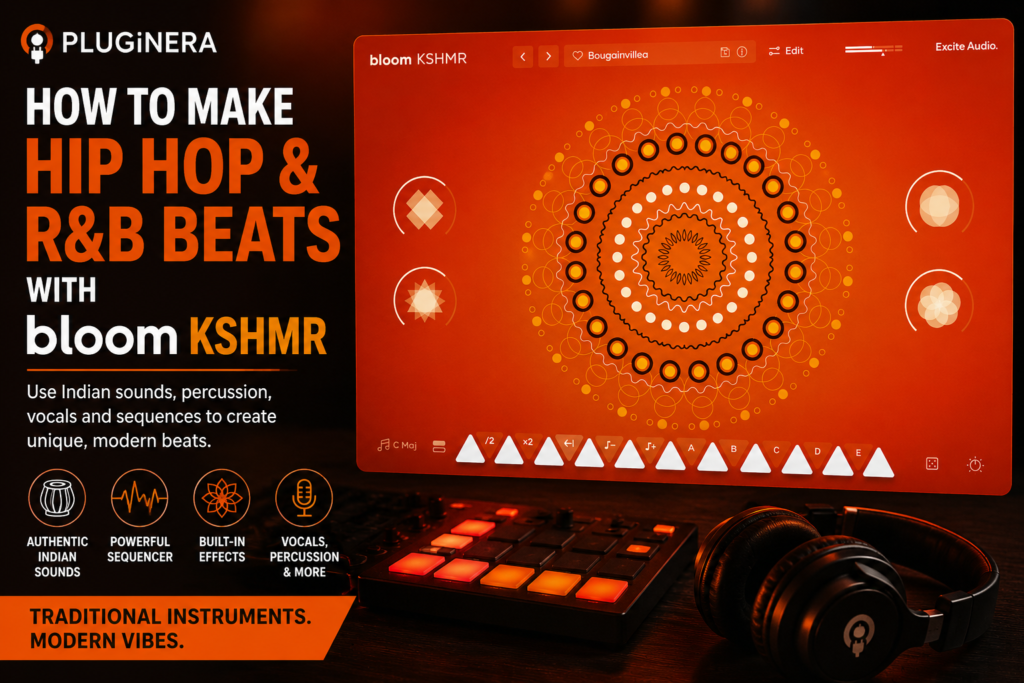
 When you’re making Hip Hop and R&B regularly, one of the biggest challenges isn’t finding more sounds.
It’s finding sounds that make your beats feel different.
You can only start so many beats with the same piano, electric piano, bell, guitar, or analog synth before your productions begin traveling down familiar roads.
That’s where Excite Audio Bloom KSHMR gets interesting.
Bloom KSHMR gives producers a collection of Indian and South Asian-inspired instruments, percussion, vocals, phrases, and textures wrapped inside a modern sample-based instrument. Instead of trying to make traditional music, however, we’re going to take those sounds and place them inside a completely different environment.
Think:
Tablas + 808s.
Sitar-style plucks + Trap drums.
Flutes + atmospheric R&B chords.
Vocal textures + dark pads.
That’s where Bloom KSHMR can become a powerful creative tool for modern Hip Hop and R&B production.
In this guide, we’ll walk through how to build a complete beat with Bloom KSHMR while keeping the production modern, spacious, and ready for a vocalist.
Why Bloom KSHMR Works for Hip Hop & R&B
Bloom KSHMR isn’t a conventional Hip Hop instrument.
That’s precisely why it’s useful.
Hip Hop production has always been about taking sounds from different sources and putting them into new contexts. A sound doesn’t necessarily need to originate from Hip Hop to work in a Hip Hop record.
What matters is what you do with it.
Bloom KSHMR gives you access to sounds such as:
- Tabla and hand percussion
- Sitar-inspired instruments
- Plucked strings
- Flutes
- Vocal performances
- Rhythmic phrases
- Atmospheric textures
- Percussion ensembles
Instead of using these sounds exactly as they come, we’re going to reshape them around modern Hip Hop and R&B production techniques.
That means changing pitches, simplifying melodies, layering sounds, filtering frequencies, adding effects, and combining Bloom with modern drums and bass.
Step 1: Choose Your Direction Before Browsing Sounds
Before opening presets, decide what kind of beat you’re making.
This is important because Bloom KSHMR can send you in a lot of different directions.
For a modern R&B beat, you might start around:
70–95 BPM
For a Trap or melodic Hip Hop beat, you could work around:
120–150 BPM
You can also use half-time or double-time interpretations depending on how you like to program drums.
For this example, let’s imagine we’re creating a dark, melodic Trap Soul/R&B beat around 140 BPM.
We want something atmospheric enough for an R&B singer but hard enough to support 808s and Trap drums.
Now we have a target.
Step 2: Start With One Bloom KSHMR Sound
Don’t immediately start stacking five Bloom sounds.
Find one sound that inspires the beat.
Browse the presets and listen specifically for:
- Plucks
- Sitar-style instruments
- Flutes
- Vocal textures
- Short phrases
- Atmospheric sounds
You’re looking for something capable of becoming the musical identity of the beat.
When you find an interesting preset, stop browsing.
That’s important.
One of the easiest ways to kill an idea is spending another 30 minutes looking for something “better.”
Start creating.
Step 3: Build a Simple Melody
You don’t need a complicated melody.
In fact, simpler melodies often work better for modern Hip Hop and R&B because they leave space for the vocalist.
Try starting with a four-bar phrase.
You might use only three or four notes.
For example, if you’re working in E minor, you could experiment with notes from:
E – F# – G – A – B – C – D
Instead of playing constant notes, leave gaps.
Something like:
Note → space → short phrase → space → response
That silence is important.
It gives your drums room to breathe and creates pockets where a vocalist can eventually perform.
Step 4: Make the Bloom Sound Darker
This is where we start pulling Bloom KSHMR away from its original context and into modern Hip Hop.
If your selected sound feels too bright or traditional, manipulate it.
Try:
- Pitching it down
- Reducing high frequencies
- Increasing reverb
- Lengthening the release
- Adjusting the sample start
- Reversing the sound
- Changing the playback behavior
- Adding saturation
- Adding delay
Pitching sounds down can be especially effective.
A bright plucked instrument can become dramatically darker when dropped an octave and processed with reverb.
Suddenly it feels less like a traditional instrument and more like something you’d hear underneath a modern Trap Soul record.
Step 5: Add R&B Chords Underneath Bloom
Now let’s give the melody some harmonic context.
You don’t necessarily need Bloom KSHMR to handle everything.
In fact, some of the best results will come from combining Bloom with instruments you already use.
Load your favorite:
- Rhodes
- Electric piano
- Analog pad
- Warm synth
- Soft piano
Then create a simple chord progression underneath your Bloom melody.
For example, in E minor:
Em9 – Cmaj7 – Am7 – Bm7
Those extended chords immediately push the production toward R&B.
Keep the voicings relatively spacious.
You don’t want the chords competing with your Bloom melody.
The Bloom sound should provide the distinctive character while the chords establish the emotional foundation.
Step 6: Use Bloom KSHMR Percussion as a Layer
This might be my favorite way to use Bloom KSHMR.
Instead of replacing your normal Hip Hop drums, use Bloom’s percussion around them.
Start with your regular drum foundation:
Kick
Snare/Clap
Hi-Hat
Then introduce a tabla or hand-percussion pattern underneath.
Keep it relatively quiet.
The percussion shouldn’t necessarily sound like the main drum groove.
It should create movement.
This can instantly make a basic drum pattern feel more detailed.
Step 7: Use the Sequencer to Create Rhythmic Movement
Bloom KSHMR’s sequencer becomes particularly useful when working with percussion.
Instead of manually programming every variation, experiment with Bloom’s sequencing controls.
Adjust things such as:
- Sequence length
- Step rate
- Velocity
- Swing
- Probability
- Attack
- Release
Probability is especially interesting for Hip Hop.
If every percussion hit happens every time the pattern repeats, the loop can quickly become predictable.
Probability allows certain hits to appear only occasionally.
That creates subtle variation.
Your listener may not consciously notice what’s changing, but the beat feels less repetitive.
Step 8: Add Your Main Hip Hop Drums
Now bring in the drums that define the genre.
Start with the snare or clap.
For Trap-oriented production, place it where you normally would within your half-time groove.
Then add your kick.
Don’t overcomplicate it.
If Bloom’s percussion is already providing rhythmic movement, your kick pattern can remain relatively sparse.
Next, add hi-hats.
Start simple.
Then introduce occasional:
- Rolls
- Triplets
- Velocity changes
- Open hats
- Stutters
The goal isn’t to fill every available space.
Let Bloom handle some of the rhythmic complexity.
Step 9: Add the 808
Now we need the low end.
Choose an 808 that complements the mood of the Bloom melody.
Tune it to the key of your beat.
Then start by following the root notes of your chord progression.
Using our earlier example:
E → C → A → B
From there, experiment with:
- Octave jumps
- Slides
- Passing notes
- Rhythmic pauses
- Shorter 808 notes
Don’t make the 808 unnecessarily complicated.
If the Bloom percussion is busy, the 808 may work better with a simpler pattern.
The contrast between detailed percussion and a heavy, minimal 808 can sound incredible.
Step 10: Add a Second Bloom Texture
Now that the foundation exists, we can return to Bloom.
This time we’re not looking for another main melody.
We’re looking for ear candy.
Try finding:
- A flute phrase
- Vocal texture
- Atmospheric sound
- Percussion fill
- Short melodic phrase
Use it sparingly.
Maybe it appears only at the end of every eight bars.
Maybe it plays during the intro.
Maybe it appears only during the chorus.
This prevents the production from becoming overcrowded while still allowing Bloom KSHMR to provide additional character.
Step 11: Turn Bloom Vocals Into Atmospheric Textures
Vocal textures can work beautifully in R&B.
But you don’t necessarily need to use them exactly as they come.
Try taking a vocal sample and:
- Pitching it down.
- Reversing it.
- Adding a long reverb.
- Adding delay.
- Filtering the high frequencies.
- Lowering it significantly in the mix.
Now the vocal becomes an atmosphere rather than an obvious sample.
Place it behind your chords.
This can make the entire production feel wider and more immersive without adding another conventional instrument.
Step 12: Resample Bloom KSHMR
One of the best ways to make preset-based instruments sound more original is resampling.
Record your Bloom melody or phrase into audio.
Now manipulate the audio instead of the original instrument.
You can:
- Chop it
- Reverse sections
- Pitch individual pieces
- Time-stretch it
- Rearrange the rhythm
- Add effects
- Bounce it again
- Chop it again
This is where Bloom can become a source of completely new samples.
You aren’t simply using Bloom KSHMR anymore.
You’re sampling Bloom KSHMR.
That mindset opens up far more creative possibilities.
Step 13: Create a Darker R&B Version
Let’s say you don’t want a hard Trap beat.
Bloom can work just as well for slower R&B.
Try something around:
75–90 BPM
Start with warm extended chords.
For example:
Bm9 – Gmaj7 – Em9 – F#m7
Add a very simple Bloom flute or plucked melody.
Then add:
- Soft kick
- Rimshot or clap
- Loose hi-hats
- Sub bass
- Atmospheric vocal texture
Use plenty of space.
For this type of production, Bloom shouldn’t dominate the record.
It should create an emotional texture around the singer.
Step 14: Don’t Overuse the Exotic Elements
This is important.
You don’t need every element in the beat to come from Bloom KSHMR.
If you use:
- Sitar
- Tabla
- Flute
- Vocals
- Percussion
- Multiple melodic phrases
all at the same time, the production can quickly lose focus.
Instead, choose one or two elements that give the beat its identity.
For example:
Bloom pluck + Bloom percussion
Then let everything else come from your normal production toolkit.
Or:
Bloom flute + Bloom vocal texture
Combined with Rhodes, 808s, and modern drums.
The contrast is what makes the sound interesting.
Step 15: Use Effects to Push Bloom Into a Modern Context
Effects can completely change how Bloom KSHMR sits inside a Hip Hop or R&B production.
Reverb
Use longer reverbs on flutes, vocals, and plucked instruments when you want an atmospheric sound.
But watch the low frequencies.
Filtering the reverb return can prevent the mix from becoming muddy.
Delay
Try quarter-note, eighth-note, or dotted delays on short melodic sounds.
This can transform a simple one-note phrase into something much more interesting.
Saturation
A little saturation can make acoustic samples feel more aggressive and contemporary.
Filtering
Low-pass filtering is one of the easiest ways to make a Bloom sound darker.
Automate the filter during transitions for additional movement.
Step 16: Arrange the Beat Into a Full Song
Now we need to turn the loop into a record.
This is where a lot of producers get stuck.
Instead of constantly adding new sounds, arrange the sounds you already have.
Try this structure:
Intro — 8 Bars
Bloom melody + atmosphere.
No drums.
Maybe filter the melody.
Chorus — 8 Bars
Full drums + 808 + Bloom melody + percussion.
Verse — 16 Bars
Remove one or two elements.
Maybe remove the Bloom percussion and simplify the melody.
Pre-Chorus — 8 Bars
Remove the 808.
Bring in the vocal texture.
Automate reverb or filtering.
Chorus — 8 Bars
Bring everything back.
Verse 2 — 16 Bars
Introduce subtle percussion variation or a different Bloom phrase.
Outro — 8 Bars
Return to the original Bloom melody and atmosphere.
Now your four-bar idea has become a complete arrangement.
Step 17: Create Transitions With Bloom
Bloom KSHMR can also help create transitions.
Instead of reaching for another riser sample, try manipulating sounds already inside the beat.
Take your Bloom melody and:
Reverse it before the chorus.
Or automate the reverb until the sound washes into the next section.
You could also remove the low frequencies during the final bar before the hook.
Then bring the full beat back.
Small changes like these create momentum without requiring dozens of additional tracks.
Step 18: Leave Space for the Artist
This is especially important for R&B.
A beat can sound amazing by itself and still be terrible for a vocalist.
Don’t fill every frequency and every rhythmic pocket.
Ask yourself:
Where does the singer go?
If the Bloom melody is constantly playing complicated phrases, simplify it.
If the percussion is too busy, remove some hits.
If your chords occupy too much space, simplify the voicing.
Production isn’t about proving how many sounds you can fit into a beat.
It’s about creating the right environment for the record.
Example Bloom KSHMR Hip Hop/R&B Beat Recipe
Here’s a simple formula you can try immediately:
Tempo: 138 BPM
Key: E Minor
Chords: Em9 – Cmaj7 – Am7 – Bm7
Main Melody: Bloom KSHMR plucked instrument
Texture: Bloom vocal or flute
Percussion: Bloom tabla/hand percussion
Drums: Trap kick + clap + hi-hats
Bass: Deep tuned 808
Additional Instrument: Warm Rhodes or analog pad
Effects: Reverb + delay + saturation + filtering
That gives you a complete foundation without requiring dozens of tracks.
Three Bloom KSHMR Beat Ideas to Try
1. Dark Trap Soul
Start with a pitched-down Bloom pluck.
Add minor seventh or ninth chords underneath.
Layer atmospheric vocals.
Finish with sparse Trap drums and a sliding 808.
Think dark, spacious, emotional production.
2. Alternative R&B
Start with Rhodes chords.
Add a soft Bloom flute as the response melody.
Use Bloom percussion very quietly underneath the drums.
Add sub bass instead of an aggressive 808.
Keep everything spacious.
3. Experimental Hip Hop
Start with Bloom percussion instead of chords.
Build an unusual rhythmic pattern.
Resample it.
Chop the resulting audio.
Add a distorted bass and hard drums.
Then introduce a heavily processed Bloom vocal as ear candy.
This approach can take the plugin somewhere completely different from its factory presets.
The Secret Is Contrast
The best way to use Bloom KSHMR for Hip Hop and R&B isn’t necessarily to build an entire production with Bloom.
It’s to combine its distinctive sounds with familiar modern production elements.
Traditional percussion + 808s.
Organic plucks + synthetic pads.
Flutes + Trap drums.
Vocal textures + Rhodes chords.
That contrast is what makes the production interesting.
Bloom provides the unexpected element.
Your existing production tools provide the familiar foundation.
Final Thoughts
Bloom KSHMR can be much more than a specialized world-instrument plugin.
For Hip Hop and R&B producers, it can become a source of melodies, percussion, textures, vocal layers, samples, and inspiration.
The key is not treating the sounds as finished products.
Manipulate them.
Pitch them.
Chop them.
Layer them.
Sequence them.
Resample them.
Then combine them with the drums, 808s, chords, and production techniques that define your sound.
You don’t need Bloom KSHMR on every beat.
But when you find yourself opening the same synths, playing the same melodies, and reaching for the same sounds, Bloom can give you a completely different place to start.
And sometimes that’s exactly what you need to make your next beat stand out.