 Minimal Audio Current 2.0 Review: Is This Modern Synth Worth It?
Modern producers have no shortage of powerful software synthesizers. Serum, Pigments, Phase Plant, Vital, and other heavyweight instruments can handle everything from simple presets to incredibly complex sound design.
So where does Minimal Audio Current 2.0 fit into the picture?
Current 2.0 takes a slightly different approach. Instead of focusing entirely on one synthesis method, Minimal Audio combines wavetable synthesis, granular synthesis, sampling, additive synthesis, modulation, MIDI processing, and effects inside one instrument.
The result is a synth designed to move easily between preset browsing and serious sound design.
For producers making Hip Hop, R&B, Trap, Trap Soul, Pop, EDM, cinematic music, and experimental electronic music, that versatility makes Current 2.0 particularly interesting.
But with so many capable synthesizers already available, is Current 2.0 actually worth adding to your plugin collection?
In this Minimal Audio Current 2.0 review, we’ll look at its sound engines, workflow, modulation system, effects, presets, strengths, weaknesses, and the types of producers who will get the most from it.
What Is Minimal Audio Current 2.0?
Current 2.0 is a software synthesizer and sound-design platform developed by Minimal Audio.
Rather than being strictly a wavetable synthesizer, Current combines several synthesis and sampling technologies within a single interface.
Its five primary sound sources include:
- Two wavetable oscillators
- A granular engine
- An additive sub oscillator
- A time-stretching sampler
The synth also includes two multimode filters, FM capabilities, extensive modulation, MIDI effects, an effects rack, and Minimal Audio’s integrated Stream sound platform.
This means you can create everything from relatively straightforward basses and leads to evolving textures constructed from several different synthesis techniques.
Current is compatible with major DAWs, making it suitable for producers working in environments such as Ableton Live, FL Studio, Logic Pro, and Pro Tools.
Current 2.0’s Five Sound Engines
The biggest attraction of Current is its multi-engine architecture.
Instead of forcing you to build every sound from the same oscillator type, you can combine several different sound-generation techniques within one patch.
Wavetable Oscillators
Current includes two wavetable oscillators that provide the foundation for many of its traditional synth sounds.
Wavetable synthesis is particularly useful for creating:
- Synth leads
- Pads
- Plucks
- Bass sounds
- Keys
- Bells
- Atmospheric textures
You can start with relatively simple waveforms or use more complex wavetables to create sounds that evolve as you modulate their parameters.
For modern Hip Hop and R&B production, this can be especially useful for creating melodic sounds that feel less static than traditional subtractive synth patches.
Granular Engine
The granular engine is where Current becomes much more interesting for producers who enjoy creating atmospheric sounds.
Granular synthesis breaks audio into extremely small pieces—or grains—and rearranges or manipulates them to create entirely new textures.
That makes it excellent for creating:
- Ambient pads
- Experimental melodies
- Textured keys
- Soundscapes
- Vocal-like textures
- Background layers
- Transitions
For genres such as Trap Soul and alternative R&B, these kinds of sounds can be incredibly useful.
Instead of filling an arrangement with several instruments, you could create one evolving granular texture that provides movement throughout the track.
Additive Sub Oscillator
Minimal Audio also includes a dedicated additive sub oscillator.
That might not sound as exciting as the granular or wavetable engines, but it’s an important addition.
A dedicated sub engine makes it easier to establish a solid low-frequency foundation underneath more complicated patches.
This can be particularly useful when creating:
- Synth basses
- 808-style bass patches
- Reese-style basses
- Layered bass sounds
- Heavy electronic basses
Rather than trying to squeeze the low end out of a complicated wavetable patch, you can use the sub oscillator to provide a cleaner foundation.
For Hip Hop and Trap producers, that’s a welcome feature.
Time-Stretching Sampler
Current also includes a sampler capable of time-stretching audio.
This significantly expands the instrument beyond traditional synthesis.
Samples can become starting points for entirely new sounds rather than simply being played back conventionally.
Combine the sampler with Current’s modulation, filtering, effects, and other engines and you can turn relatively simple source material into something dramatically different.
That’s particularly valuable for producers who enjoy manipulating samples but don’t necessarily want every sound in their production to feel obviously sample-based.
Layering Engines Is Where Current Gets Powerful
Individually, none of these synthesis methods are revolutionary.
The real power comes from having them available together.
For example, you could create a patch using:
Wavetable oscillator → main melodic character
Granular engine → atmospheric texture
Sampler → organic layer
Sub oscillator → low-frequency weight
You can then process and modulate those elements as part of one instrument.
That opens up an enormous amount of sound-design territory without requiring several different plugins.
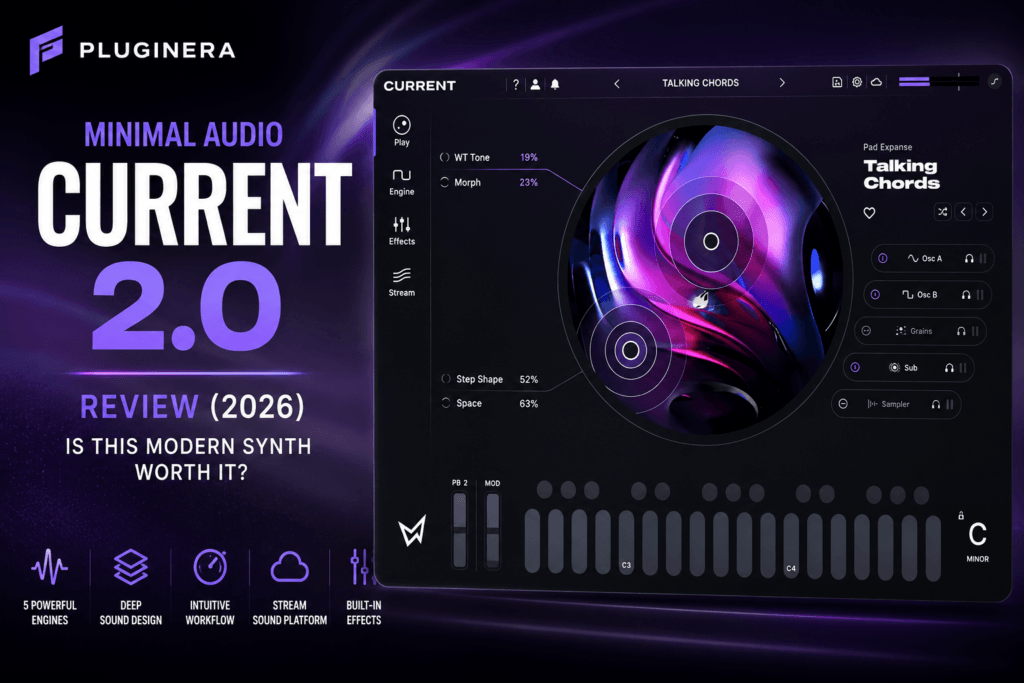
The New Play View
One of Current 2.0’s important additions is its Play View.
Complex synthesizers sometimes suffer from a major problem: they’re incredibly powerful but aren’t particularly enjoyable when you just want to find a sound and start making music.
Play View attempts to solve that.
Instead of immediately presenting every synthesis parameter, it gives you a more streamlined way to interact with presets.
At the center is an XY control system connected to four macros.
Moving around the XY interface can manipulate multiple characteristics of the patch, allowing you to quickly change its personality without diving deep into the synthesis engine.
This is especially useful for producers who primarily work with presets.
You can find something close to what you want and then quickly make it your own.
If you want more control, you can jump directly into the individual sound engines.
It’s a clever compromise between accessibility and depth.
Modulation and Sound Design
A modern synth needs a strong modulation system, and Current provides plenty of possibilities.
Modulation allows parameters to change automatically over time.
Instead of having a filter remain in one position, for example, you could use modulation to make it slowly open and close throughout the sound.
That movement is essential for creating evolving patches.
Current’s modulation capabilities can be used to create everything from subtle movement to highly rhythmic sound design.
This becomes particularly powerful when combined with its multiple engines.
You might modulate:
- Wavetable position
- Filter cutoff
- Pitch
- Effects
- Granular parameters
- Sample playback characteristics
- Volume
- Stereo movement
Once several modulation sources begin interacting, relatively simple patches can become surprisingly complex.
Filters and FM
Current includes two multimode filters along with a flexible FM system.
Filters allow you to sculpt the frequency content of your sounds, while FM introduces another layer of harmonic complexity.
You don’t necessarily need to understand advanced FM synthesis to benefit from it.
Even subtle amounts can introduce additional harmonics that make basses, bells, leads, and keys more interesting.
For experienced sound designers, however, combining FM with wavetable and granular synthesis opens up significantly deeper possibilities.
Built-In Effects
Current isn’t just a synthesis environment.
Minimal Audio also gives you an integrated effects section for shaping sounds without immediately reaching for additional plugins.
This is important because effects are often an enormous part of modern synth patch design.
A relatively simple oscillator can become dramatically different after adding distortion, modulation, delay, reverb, or other processing.
Having effects integrated into Current means patches can be designed as complete sounds rather than raw synth tones that still require several inserts in your DAW.
For producers who like working quickly, this can significantly improve workflow.
Stream Sound Platform
Another major component of Current is Stream, Minimal Audio’s cloud-connected sound platform.
Stream provides access to presets, samples, and wavetables directly through Current.
The advantage is convenience.
Instead of constantly leaving your DAW to browse folders or download additional content, you can explore sounds from inside the instrument.
Minimal Audio also uses Stream to expand the available sound library over time.
For preset-focused producers, this could potentially become one of Current’s strongest features.
What Does Current 2.0 Sound Like?
Current 2.0 definitely leans toward a modern, polished, and highly produced sound.
It’s particularly comfortable creating:
- Atmospheric pads
- Modern synth keys
- Plucks
- Digital bells
- Textures
- Heavy basses
- Leads
- Experimental sounds
- Cinematic atmospheres
- Electronic sound design
That makes Current especially attractive for modern production.
However, it doesn’t mean you can’t make warmer or simpler sounds.
The architecture is flexible enough to create relatively straightforward patches as well.
Current simply shines when you start combining its engines and modulation system to create sounds with movement and texture.
Current 2.0 for Hip Hop and Trap
Although Current might initially look like a synth aimed primarily at electronic producers, there’s plenty here for Hip Hop and Trap production.
You could use Current for:
- Dark melodic plucks
- Atmospheric pads
- Bells
- Leads
- 808-style basses
- Counter melodies
- Textured keys
- Ambient layers
The granular engine is particularly useful for darker Hip Hop production because it can create strange textures that sit quietly behind the primary melody.
Instead of adding another conventional instrument, you can introduce an evolving layer that gives the beat atmosphere.
Current 2.0 for R&B and Trap Soul
Current might be even more interesting for modern R&B and Trap Soul.
These genres frequently rely on atmospheric production where texture is just as important as melody.
Current can handle:
- Dreamy pads
- Soft keys
- Ambient textures
- Detuned synths
- Warm basses
- Evolving chords
- Experimental leads
- Vocal-style textures
The XY macros can also make presets more expressive.
For example, you could automate the macros throughout an arrangement so that a pad gradually becomes brighter or more spacious during the chorus.
Small changes like this can help an arrangement evolve without adding unnecessary instruments.
Current 2.0 for EDM and Electronic Music
Electronic producers are arguably Current’s most obvious audience.
Its combination of wavetable synthesis, granular processing, FM, modulation, and effects makes it capable of extremely aggressive and complicated sounds.
Bass music producers in particular can take advantage of the ability to create highly animated patches.
But Current isn’t limited to aggressive sound design.
It can also produce lush pads, melodic sequences, cinematic textures, and polished leads.
Is Current 2.0 Beginner Friendly?
Surprisingly, yes—with an important caveat.
Current is a deep synthesizer.
If you open the complete synthesis engine without understanding oscillators, filters, envelopes, LFOs, or modulation, there’s a lot to learn.
However, you don’t need to understand everything immediately.
The Play View and preset workflow allow newer producers to use Current almost like a simpler preset instrument.
You can:
- Find a preset.
- Play your melody or chords.
- Adjust the macros.
- Manipulate the XY controls.
- Start producing.
As your synthesis knowledge improves, you can gradually move deeper into the engine.
That makes Current surprisingly scalable.
Beginners can use presets while advanced producers can build complicated patches from scratch.
Current 2.0 Workflow
Despite the amount of technology packed inside Current, the interface tries to keep the different parts organized.
You don’t have to stare at every parameter simultaneously.
You can move between the streamlined Play View and the deeper synthesis sections depending on what you’re trying to accomplish.
That’s important.
One of the biggest problems with “do everything” synthesizers is that sound design can start feeling more like programming than making music.
Current doesn’t completely eliminate that complexity, but its workflow does a good job of keeping it manageable.
Current 2.0 Pros
Multiple Synthesis Engines
Having wavetable, granular, additive, and sample-based sound generation inside one instrument gives Current enormous sonic range.
Excellent for Modern Sound Design
If you like evolving textures, experimental sounds, animated pads, or aggressive basses, Current offers plenty of depth.
Strong Preset Workflow
Play View makes it possible to use sophisticated patches without understanding every parameter behind them.
Deep Modulation
Advanced producers can create sounds that constantly evolve rather than remaining static.
Integrated Sound Ecosystem
Stream makes discovering additional presets, samples, and wavetables much more convenient.
Useful Across Multiple Genres
Current can comfortably work in Hip Hop, R&B, Trap, Pop, EDM, cinematic music, and experimental production.
Current 2.0 Cons
It Can Be Overkill
If you primarily want straightforward analog-style synth sounds, you may not need everything Current offers.
Learning the Entire Synth Takes Time
Preset browsing is easy, but mastering every engine, modulation option, and routing possibility will take considerably longer.
Lots of Competition
Current exists in an extremely competitive category.
Synths like Serum, Pigments, Phase Plant, and Vital already provide extensive sound-design capabilities.
That means producers who already own several flagship synthesizers should think about whether Current’s particular workflow and combination of engines adds something meaningful to their setup.
Current 2.0 vs Traditional Synth Plugins
Current’s biggest advantage isn’t necessarily that it replaces every other synth.
It’s that it brings several different workflows together.
A traditional virtual analog synth might give you oscillators, filters, envelopes, and effects.
Current gives you those concepts alongside granular processing, sampling, wavetable synthesis, FM, modulation, MIDI tools, and an expandable sound platform.
That makes it less like a recreation of a traditional hardware synthesizer and more like a modern sound-design workstation.
And that’s probably the best way to think about Current 2.0.
Who Should Buy Current 2.0?
Current is particularly well suited for:
Modern Hip Hop producers who want distinctive melodic sounds and textures.
R&B and Trap Soul producers looking for atmospheric pads, keys, textures, and evolving sounds.
Electronic producers who want deep modulation and aggressive sound-design possibilities.
Sound designers who enjoy combining multiple synthesis techniques.
Preset users who want high-quality sounds that can quickly be customized.
Producers who want one versatile synth capable of covering a wide range of sonic territory.
Who Might Want to Skip It?
Current might not be necessary if you already have several deep modern synthesizers and rarely explore their advanced features.
It also might not be the best first choice if you’re specifically looking for authentic vintage analog emulations.
If your goal is classic Prophet, Juno, Jupiter, or Minimoog-style synthesis, dedicated analog-modeling plugins may provide a more immediate experience.
Current’s identity is much more modern and forward-looking.
Is Minimal Audio Current 2.0 Worth It in 2026?
For producers who value modern sound design, Current 2.0 is absolutely worth considering.
The biggest reason isn’t any individual feature.
It’s the combination.
You get multiple synthesis engines, sampling, granular processing, filters, FM, modulation, MIDI processing, effects, preset exploration, and Minimal Audio’s Stream ecosystem inside a single instrument.
That gives Current enough flexibility to function as anything from a quick preset machine to a serious sound-design environment.
For Hip Hop and R&B producers specifically, the granular engine and extensive modulation possibilities are particularly compelling because they make it easy to create atmospheric sounds that can give productions their own identity.
Current isn’t necessarily going to replace every synth you own.
But it doesn’t need to.
Its strength is providing a different way of combining synthesis, samples, modulation, and effects into finished sounds.
Final Verdict
Minimal Audio Current 2.0 is one of the more ambitious modern synthesizers available to producers who want both immediate presets and deep sound-design capabilities.
The five-engine architecture gives it tremendous versatility, while Play View makes that complexity much easier to approach.
Current is especially impressive when creating evolving pads, textured melodies, experimental keys, aggressive basses, atmospheric layers, and other sounds that benefit from movement.
Pluginera Rating: 9/10
Best for: Hip Hop, R&B, Trap Soul, EDM, Pop, cinematic production, experimental music, and advanced sound design.
Biggest strength: Combining several powerful synthesis and sampling methods into one streamlined environment.
Potential downside: Producers who already own multiple flagship synths may find some overlap.
Bottom Line
If you want a synth that goes beyond traditional subtractive synthesis and encourages experimentation, Current 2.0 deserves a serious look.
It works equally well when you want to quickly grab an inspiring preset or spend an hour designing a sound nobody else has.
And for modern producers looking for textures, movement, atmosphere, and distinctive melodic sounds, that’s exactly where Current 2.0 shines.
Check the latest price and availability for Minimal Audio Current 2.0 at Plugin Boutique.