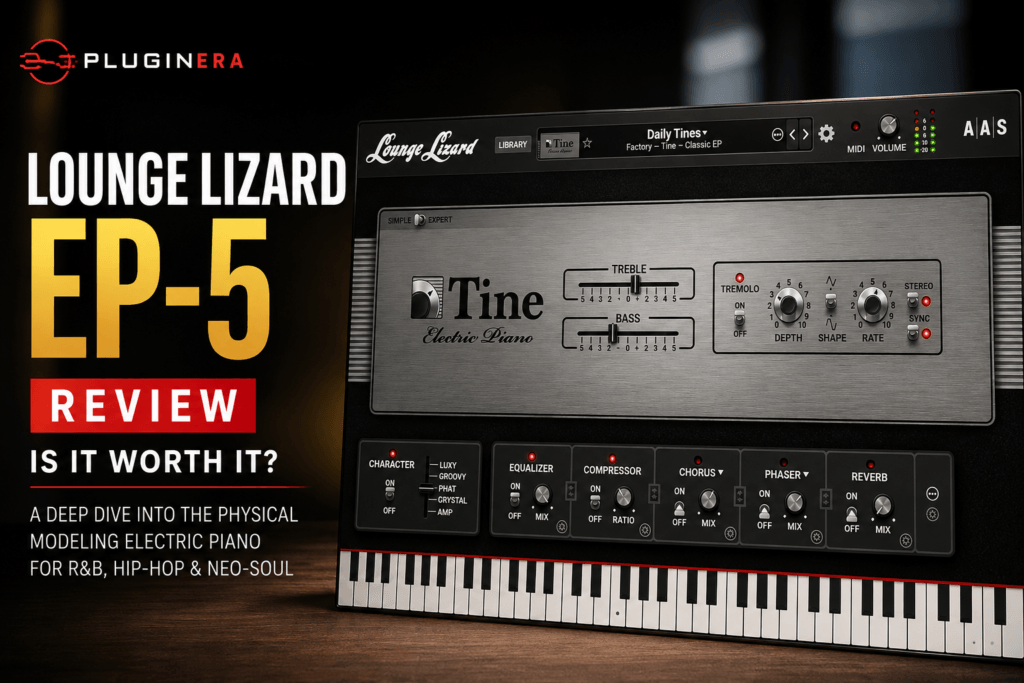
 Electric piano sounds have been a cornerstone of R&B, Neo-Soul, Hip-Hop, Jazz, Funk, and Pop for decades. From warm Rhodes-inspired chords to gritty reed-style keys, there’s something about an electric piano that can instantly make a production feel more soulful.
That’s exactly the territory Applied Acoustics Systems Lounge Lizard EP-5 is designed to cover.
Instead of relying on a huge collection of recorded samples, Lounge Lizard EP-5 uses physical modeling to recreate the behavior of classic electric pianos. That approach gives producers much more control over the instrument itself, allowing you to shape the hammer, tine or reed, pickup, damper, effects, and other characteristics of the sound.
But with so many electric piano plugins available today, is Lounge Lizard EP-5 actually worth adding to your collection?
In this Lounge Lizard EP-5 review, we’ll look at its sound, workflow, physical-modeling engine, effects, presets, strengths, weaknesses, and — most importantly — how useful it is for modern music production.
What Is Lounge Lizard EP-5?
Lounge Lizard EP-5 is a physically modeled electric piano virtual instrument from Applied Acoustics Systems (AAS).
Its biggest difference from many electric piano libraries is what’s happening behind the scenes.
Rather than triggering recordings of a real electric piano every time you press a key, Lounge Lizard mathematically models the components and behavior of an electric piano.
That means the plugin can generate the sound dynamically.
This approach gives you control over characteristics that would normally be baked into samples.
You can shape elements such as:
- Hammer behavior
- Tine and reed characteristics
- Pickup response
- Damper behavior
- Tone and resonance
- Tremolo
- Effects
- Performance response
For producers, this makes Lounge Lizard EP-5 feel less like loading an electric piano sample library and more like actually designing your own electric piano.
Lounge Lizard EP-5 Sound Quality
Sound quality is where Lounge Lizard EP-5 really earns its reputation.
The plugin can produce everything from soft, mellow electric piano tones to bright, aggressive keys that cut through a dense arrangement.
You can create sounds reminiscent of classic tine-based electric pianos as well as the more aggressive character associated with reed-based instruments.
But the important thing is that Lounge Lizard doesn’t have to sound exactly like a vintage keyboard.
Because it’s modeled rather than sampled, you can push the instrument into sounds that sit somewhere between traditional electric piano and modern sound design.
For genres like:
R&B
Neo-Soul
Trap Soul
Hip-Hop
Jazz
Lo-Fi
Pop
Funk
that flexibility can be extremely useful.
A soft EP patch can sit underneath an R&B vocal, while a brighter patch could become the main melodic instrument in a Hip-Hop beat.
Tine and Reed Electric Piano Engines
One of the most useful aspects of Lounge Lizard EP-5 is its ability to explore different electric piano characters.
Tine Sounds
Tine-style electric pianos generally give you the warm, rounded, bell-like sound many producers associate with classic Rhodes-style keyboards.
These sounds work beautifully for:
- R&B chords
- Neo-Soul progressions
- Jazz voicings
- Trap Soul melodies
- Lo-Fi beats
- Ballads
Lower the brightness and play some extended chords — minor 7ths, major 7ths, 9ths and 11ths — and Lounge Lizard can immediately produce that late-night R&B atmosphere.
Reed Sounds
Reed-style electric piano tones can be more aggressive and midrange-heavy.
They can work especially well for:
- Funk
- Soul
- Vintage Hip-Hop
- Alternative R&B
- Rock
- Retro-inspired productions
Instead of needing separate instruments for these sounds, Lounge Lizard lets you explore both territories within one plugin.
Physical Modeling Is the Secret Weapon
This is arguably the biggest reason to choose Lounge Lizard EP-5 over a traditional sampled electric piano.
With a sample library, much of the character has already been recorded.
You can usually adjust EQ, effects, velocity response and a few other parameters, but the underlying instrument remains relatively fixed.
Lounge Lizard gives you deeper control.
For example, adjusting the hammer characteristics can change how aggressively the virtual mechanism interacts with the instrument.
Pickup adjustments can change how the generated vibrations are captured.
Tine or reed parameters can alter the fundamental character of the sound.
These controls matter because two producers could start with the same patch and end up with dramatically different electric pianos.
That’s particularly valuable if you’re trying to develop your own sonic identity.
Presets and Workflow
You don’t have to understand physical modeling to use Lounge Lizard EP-5.
That’s important.
The plugin includes a substantial preset library that gives you plenty of starting points.
Instead of immediately diving into detailed modeling controls, you can load a preset, start playing and adjust the sound only when necessary.
That’s probably how most beatmakers will use EP-5.
Load → play → tweak → produce.
Once you find a sound that’s close to what you want, the deeper controls become useful.
Maybe the patch is slightly too bright.
Maybe you want a softer attack.
Maybe you want more mechanical character.
Maybe the pickup response needs to feel different.
Instead of endlessly browsing presets hoping to find the perfect variation, you can modify the instrument you already have.
Built-In Effects
Electric piano sounds are heavily influenced by effects.
A dry electric piano can sound surprisingly plain.
Add the right processing and suddenly it becomes something completely different.
Lounge Lizard EP-5 includes an integrated effects section that lets you shape the sound without immediately reaching for third-party plugins.
Depending on the sound you’re creating, effects can help add:
- Width
- Movement
- Space
- Warmth
- Saturation
- Ambience
- Rhythmic character
For R&B production, subtle modulation combined with reverb can turn a basic EP patch into a wide atmospheric layer.
For Lo-Fi Hip-Hop, darker processing and additional character can create something that feels worn and nostalgic.
And for Funk or vintage Soul, rhythmic modulation can help the electric piano become part of the groove.
Making R&B With Lounge Lizard EP-5
This may be one of the plugin’s strongest applications.
Electric piano and R&B are practically inseparable.
Start with a warm tine-based patch and try a progression using chords such as:
Bm9 → Em9 → A13 → Dmaj9
Play the chords softly and use wider voicings rather than stacking every note close together.
Then soften the electric piano tone slightly and introduce some subtle modulation.
Add reverb.
Now filter or EQ the sound so it leaves enough space for the vocal.
You can quickly create the type of lush keyboard bed that works underneath modern R&B production.
Lounge Lizard also responds well to velocity, so the way you perform the chords becomes part of the sound.
Don’t quantize everything perfectly.
Let some notes arrive slightly differently.
Vary your velocities.
Those small differences can make an EP performance feel much more musical.
Lounge Lizard EP-5 for Trap Soul
Trap Soul requires a slightly different approach.
Instead of big, bright electric piano chords, try making the sound darker.
Start with a warm EP patch.
Reduce some brightness.
Add reverb.
Then play sparse minor 7th or minor 9th chords.
For example:
Em9 → Cmaj7 → Am9 → B7
Keep the arrangement minimal.
Let the electric piano establish the emotional atmosphere while your 808, drums, vocals and textures occupy the rest of the mix.
You can also bounce the EP performance to audio and manipulate it further.
Try:
- Pitching it down
- Reversing sections
- Filtering it
- Chopping chords
- Adding tape effects
- Adding delay
- Resampling it
At that point Lounge Lizard becomes more than an electric piano plugin.
It becomes a sample-generation instrument.
Lounge Lizard EP-5 for Hip-Hop
Electric piano has been used throughout Hip-Hop history, and Lounge Lizard works extremely well when you want that soulful keyboard foundation without digging through samples.
Try recording an eight-bar electric piano progression.
Bounce it to audio.
Then chop your own performance like a sample.
Now you can rearrange those chops around the drums.
This creates an interesting hybrid workflow:
Play it like a musician.
Process it like a producer.
Chop it like a sampler.
Because you created the original keyboard performance yourself, you also have complete control over the harmony before you begin sampling.
Expressive Performance and MPE
Another advantage of a physically modeled instrument is responsiveness.
Lounge Lizard EP-5 can respond dynamically to your playing rather than simply switching between static recordings.
EP-5 also supports MPE, opening additional possibilities when paired with compatible controllers.
For keyboard players, this makes the instrument especially appealing.
Velocity becomes extremely important.
Play softly and you can get smooth, intimate tones.
Hit the keys harder and the sound becomes more aggressive.
That makes Lounge Lizard particularly enjoyable for producers who actually like playing their parts rather than drawing every MIDI note into the piano roll.
CPU and Storage Advantages
Physical modeling has another practical advantage:
You don’t need an enormous sample library to create the instrument.
High-end sampled keyboards can require gigabytes of storage because multiple notes, velocity layers, articulations and variations must be recorded.
A modeled instrument generates its sound differently.
That can make Lounge Lizard attractive for producers working on laptops or systems where storage space matters.
It also makes browsing and loading instruments feel more immediate compared with some massive sample-based libraries.
What I Like About Lounge Lizard EP-5
There are several things that make Lounge Lizard EP-5 stand out.
The Sound Is Highly Customizable
You’re not limited to whatever was captured during a sampling session.
You can actually shape the behavior of the instrument.
Excellent for R&B and Neo-Soul
If your productions regularly involve soulful chords, Lounge Lizard could easily become one of your primary keyboard instruments.
Physical Modeling Encourages Experimentation
Small parameter changes can create entirely new variations of familiar electric piano sounds.
Great for Keyboard Players
The dynamic response makes playing the instrument feel rewarding.
Fast Workflow
You can load a preset and immediately start creating without building a sound from scratch.
No Massive Sample Library
You get a deep electric piano instrument without dedicating huge amounts of storage to samples.
What Could Be Better?
No plugin is perfect.
And whether Lounge Lizard EP-5 makes sense depends heavily on what you’re looking for.
Physical Modeling Has Its Own Character
If your only goal is an absolutely specific recreation of one particular vintage electric piano recorded through a particular signal chain, you may prefer a deeply sampled instrument.
Physical modeling can sound incredibly convincing, but it also has its own sonic personality.
Deep Editing May Be More Than Some Producers Need
If you simply want to load an EP preset and never touch another control, some of Lounge Lizard’s deeper features may be unnecessary.
But you certainly don’t have to use them.
It’s Specialized
Lounge Lizard isn’t trying to be a giant workstation with strings, brass, synths, drums and hundreds of other instrument categories.
It’s focused primarily on electric piano territory.
That’s either a limitation or a strength depending on what you need.
Lounge Lizard EP-5 vs Sampled Electric Pianos
The biggest decision isn’t necessarily Lounge Lizard versus another particular plugin.
It’s:
Physical modeling vs. sampling.
Choose a sampled electric piano if you want the sound of a particular instrument captured during a particular recording session.
Choose Lounge Lizard if you want an instrument you can manipulate more deeply.
For producers, I find the second approach especially interesting.
You can create an EP that fits the beat rather than forcing the beat to fit the EP.
Need less attack?
Change it.
Need a darker tone?
Change it.
Need a more aggressive pickup character?
Change it.
That’s the beauty of physical modeling.
Who Should Buy Lounge Lizard EP-5?
Lounge Lizard EP-5 makes the most sense for:
- R&B producers
- Neo-Soul producers
- Hip-Hop producers
- Trap Soul producers
- Lo-Fi producers
- Jazz musicians
- Funk producers
- Keyboard players
- Producers who enjoy sound design
- Producers who want electric piano sounds without huge sample libraries
If electric piano is something you use once every six months, you probably don’t need a dedicated instrument this deep.
But if Rhodes-style and reed-style keyboards regularly appear in your productions, Lounge Lizard becomes much easier to justify.
Is Lounge Lizard EP-5 Worth It?
Yes — especially for producers who regularly use electric piano sounds.
What makes Lounge Lizard EP-5 compelling isn’t simply that it can produce convincing vintage-inspired electric pianos.
There are plenty of plugins capable of doing that.
Its biggest advantage is control.
The physical-modeling approach lets you shape the instrument at a deeper level than a typical sample library while still providing presets for producers who want to start creating immediately.
For R&B, Neo-Soul, Hip-Hop and Trap Soul producers in particular, that combination makes a lot of sense.
You can load a warm EP patch and immediately start writing chords, or dive into the modeling controls and create something that’s uniquely yours.
Final Verdict
Lounge Lizard EP-5 is one of the more interesting electric piano plugins for producers who want both authenticity and flexibility.
Its physical-modeling engine gives it a different workflow from traditional sampled electric pianos, while the preset library makes it approachable even if you have no interest in learning the technical side of physical modeling.
For R&B and Neo-Soul, it’s an obvious fit.
For Hip-Hop and Trap Soul, it can become an excellent source for dark chords, soulful progressions and original samples.
And for keyboard players, the expressive response makes it feel much more like an instrument than simply another preset browser.
Pluginera Rating: 9/10
Sound Quality: 9/10
Electric Piano Variety: 9/10
Customization: 9.5/10
Ease of Use: 9/10
Value for Producers: 9/10
Bottom Line
If electric piano is an important part of your sound, Lounge Lizard EP-5 deserves serious consideration.
And if you make R&B, Neo-Soul, Hip-Hop or Trap Soul, this is exactly the kind of instrument that could quietly end up appearing in beat after beat.
Disclosure: This article may contain affiliate links. If you purchase through one of these links, Pluginera may earn a commission at no additional cost to you.