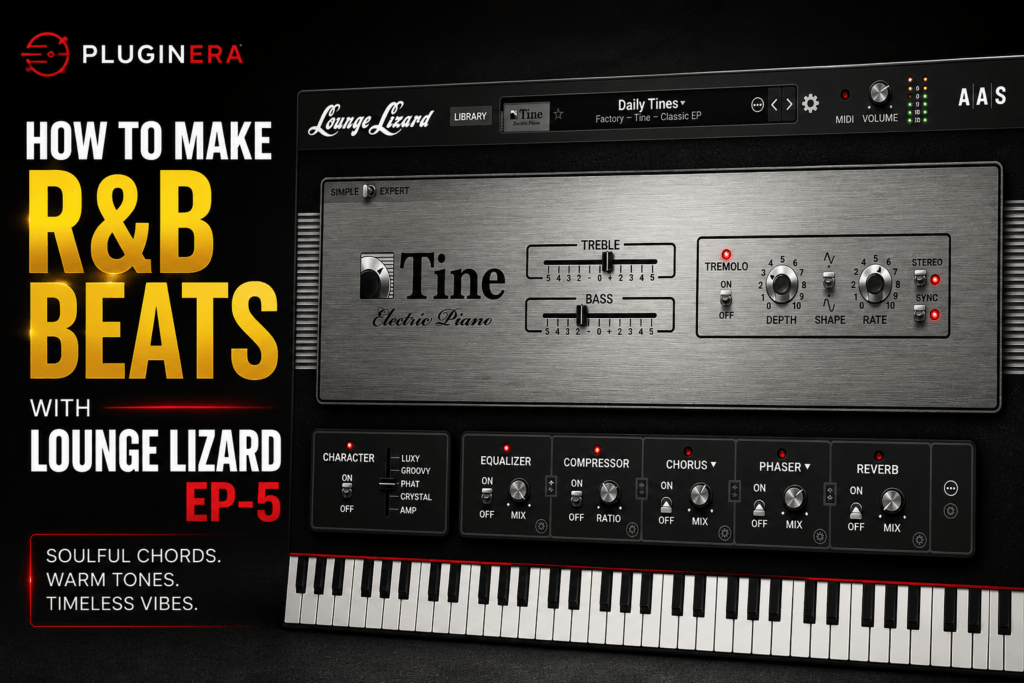
 Electric piano and R&B were practically made for each other.
From the warm chords of classic ’70s soul to ’90s R&B, Neo-Soul, Trap Soul, and modern alternative R&B, the electric piano remains one of the easiest ways to give a production warmth, emotion, and sophistication.
That makes AAS Lounge Lizard EP-5 particularly interesting for R&B producers.
Unlike many electric piano plugins that rely primarily on samples, Lounge Lizard EP-5 uses physical modeling to generate its sounds. That means you aren’t simply choosing between different recordings of electric pianos — you can actually shape how the virtual instrument behaves.
And for R&B production, that flexibility can be extremely powerful.
In this guide, we’ll walk through how to make R&B beats with Lounge Lizard EP-5, from choosing your initial electric piano sound and creating soulful chord progressions to adding drums, bass, melodies, effects, and arranging everything into a finished beat.
Why Lounge Lizard EP-5 Works So Well for R&B
The electric piano occupies an interesting space in an R&B mix.
It’s harmonically rich enough to carry an entire song but soft enough to leave room for vocals.
That’s exactly what we want.
Lounge Lizard EP-5 gives you access to both tine- and reed-inspired electric piano sounds, along with controls that let you change the character of the instrument.
For modern R&B, you can use it for:
- Warm Rhodes-inspired chords
- Neo-Soul progressions
- Dark Trap Soul keys
- Jazzy chord voicings
- Soft melodic riffs
- Atmospheric background layers
- Vintage R&B textures
- Chopped electric piano samples
Instead of treating Lounge Lizard as simply another preset instrument, we’re going to use it as the harmonic foundation of the beat.
Step 1: Choose the Right Electric Piano Sound
Start by opening Lounge Lizard EP-5 and browsing the presets.
Don’t overthink this stage.
You’re looking for something that immediately gives you the general emotion you want.
For contemporary R&B, I usually recommend starting with a warm tine-style electric piano.
Look for something that feels:
Warm.
Soft.
Smooth.
Slightly dark.
Dynamic.
You don’t necessarily want the brightest EP in the library.
Remember that vocals, hi-hats, snares, percussion, and other melodic elements will eventually occupy the upper frequencies.
Starting with a slightly darker electric piano leaves room for everything else.
Tine vs. Reed for R&B
Lounge Lizard EP-5 gives you different electric piano personalities.
Tine
Tine sounds are probably where most R&B producers will spend the majority of their time.
They’re excellent for:
- Smooth R&B
- Neo-Soul
- Trap Soul
- Slow jams
- Jazzy Hip-Hop
- Alternative R&B
You get that familiar bell-like attack followed by a warm body.
Reed
Reed-style sounds tend to have more bite and midrange character.
These can work beautifully for:
- Vintage Soul
- Funk-inspired R&B
- Retro productions
- Alternative R&B
- Sample-inspired Hip-Hop
Don’t automatically assume that R&B means tine.
Sometimes a reed-based sound can give your production exactly the personality it needs.
Step 2: Create Your R&B Chord Progression
Now we need harmony.
This is where Lounge Lizard really begins to shine.
Instead of starting with basic major and minor triads, experiment with 7th and 9th chords.
These extensions immediately give your progression more R&B character.
Let’s build an example in E minor.
Try:
Em9 → Cmaj9 → Am9 → B7
The notes could be:
Em9: E – G – B – D – F#
Cmaj9: C – E – G – B – D
Am9: A – C – E – G – B
B7: B – D# – F# – A
Play that slowly on a warm Lounge Lizard patch.
Immediately, we’re in R&B territory.
Don’t Play Every Note
Here’s where things get more interesting.
You don’t always need five notes in every chord.
The bass is probably going to establish the root note later.
That means your keyboard part can concentrate on the notes that define the harmony.
Instead of:
E – G – B – D – F#
you might play:
G – B – D – F#
and let the bass handle E.
This creates more room in the lower frequencies.
It also gives the chords a more sophisticated sound.
Step 3: Improve the Voicings
Chord selection matters.
Voicing matters even more.
If every chord jumps around the keyboard in root position, your progression can sound stiff.
Instead, look for common notes between your chords.
Try keeping some notes in place while moving others by the smallest possible distance.
For example, rather than playing every chord from its root, use inversions and spread the notes across multiple octaves.
Your left hand might play one or two supporting notes while your right hand handles the colorful extensions.
This produces smoother voice leading.
And smooth voice leading is one of the easiest ways to make R&B harmony sound more polished.
Use Open Voicings
Don’t cram every note into one octave.
Spread things out.
You might play:
Left hand: E + B
and:
Right hand: G + D + F#
for an Em9 sound.
That gives the electric piano room to breathe.
It also creates space in the center of the arrangement for the vocal.
Step 4: Humanize the Performance
This part is incredibly important.
Don’t make the electric piano performance too perfect.
R&B benefits from feel.
If every note starts at exactly the same millisecond with exactly the same velocity, the performance can start sounding programmed.
Instead, vary your velocities.
Let some notes hit slightly before others.
Play certain chord tones harder than others.
Try emphasizing the top note of the chord.
Lounge Lizard’s physical-modeling approach responds particularly well to performance dynamics.
Play softly and the instrument can sound intimate.
Play harder and you can bring out more attack and bite.
Use that.
Producer Tip
Record the progression instead of drawing it.
Even if your keyboard skills aren’t perfect, record several passes.
Keep the best performance.
Then correct only the mistakes that are distracting.
Don’t automatically quantize everything to 100%.
A little imperfection can actually make the beat feel better.
Step 5: Shape Lounge Lizard EP-5 for R&B
Now that we have our progression, we can customize the electric piano.
This is one of the biggest advantages of Lounge Lizard.
Instead of searching through another 100 presets, modify the sound you already like.
Darken the Tone
If your electric piano feels too bright, reduce some of the upper-frequency character.
You’re looking for warmth rather than dullness.
The attack should still be audible, but it shouldn’t dominate the production.
For darker contemporary R&B, you can push this further.
For Neo-Soul, you may want slightly more definition.
Adjust the Attack
Pay attention to how the virtual hammer interacts with the instrument.
A harder attack can make the electric piano more rhythmic.
A softer attack can push it deeper into the background.
For a slow R&B beat, I’d generally start softer.
For something more upbeat or funky, let the attack come through.
Experiment With the Pickup
Pickup characteristics can dramatically influence the personality of an electric piano.
Small adjustments can change how bright, aggressive, or intimate the sound feels.
This is one area where physical modeling becomes especially useful.
Don’t worry about finding some theoretically “correct” setting.
Adjust it while the entire beat is playing.
Mix the instrument into the song — not in isolation.
Step 6: Add Tremolo and Movement
Electric piano doesn’t have to sit completely still.
A little movement can make the sound much more interesting.
Lounge Lizard includes tremolo controls that can add subtle rhythmic movement to the instrument.
The key word is:
Subtle.
For smooth R&B, you don’t necessarily want the volume swinging dramatically from side to side.
Start with a low depth.
Then slowly increase it until you can feel the movement.
Once you clearly hear the effect, consider backing it down slightly.
That’s often the sweet spot.
Step 7: Add Reverb
Now let’s create some space.
R&B electric piano usually benefits from reverb, but there’s a common mistake here:
Too much reverb can push your chords miles away from the listener.
Start small.
Use enough reverb to create depth around the instrument without destroying its definition.
For intimate R&B, try a shorter, warmer space.
For atmospheric Trap Soul or alternative R&B, experiment with longer reverb tails.
You can also use Lounge Lizard’s built-in processing as your starting point and then add your favorite external reverb later.
Step 8: Add a Simple R&B Drum Groove
Now we need rhythm.
Don’t immediately create a complicated drum pattern.
Let the chords establish the emotion first.
For a modern R&B beat, try somewhere around:
70–90 BPM
You can also work at double-time tempos such as 140–180 BPM while maintaining the same half-time feel.
Start with:
Kick
Snare or clap
Closed hi-hat
Percussion
Keep the groove simple.
Start With the Snare
Place your primary snare or clap where the backbeat feels natural.
Then add the kick around it.
The kick doesn’t need to hit constantly.
A few strategically placed kicks can create much more groove than filling every empty space.
Add Hi-Hats
Start with straight eighth or sixteenth notes.
Then remove notes.
Add velocity changes.
Introduce a few rolls or subdivisions if they complement the groove.
Modern R&B hats often borrow from Trap, but they usually don’t need to be as aggressive.
The electric piano should still feel like part of the rhythm section.
Step 9: Add the Bass
Now listen to your chord progression again.
Your bass doesn’t need to copy every root note exactly.
Start there, but experiment.
For our progression:
Em9 → Cmaj9 → Am9 → B7
the obvious bass movement is:
E → C → A → B
That works.
But you can create more movement with passing notes.
For example:
E → D → C → B → A → B
Now the bass becomes melodic.
808 or Bass Guitar?
Both can work.
For contemporary Trap Soul:
808.
For Neo-Soul or traditional R&B:
Electric bass.
For alternative R&B:
Either.
You can even layer a very soft sub underneath an electric bass if the arrangement needs additional low-end weight.
Just make sure the bass and Lounge Lizard aren’t fighting.
This is another reason I like removing unnecessary low notes from the keyboard voicings.
Step 10: Add a Counter Melody
At this point, we have:
Electric piano
Drums
Bass
That’s already enough to make a record.
Don’t ruin it by adding seven more instruments.
Instead, try adding one counter melody.
You could use:
- Soft synth lead
- Bell
- Guitar
- Pluck
- Vocal texture
- Synth pad
- Another Lounge Lizard patch
Keep the melody simple.
Sometimes three notes are enough.
Step 11: Layer Lounge Lizard With Itself
Here’s another interesting technique.
Duplicate your Lounge Lizard track.
Keep the main electric piano relatively centered.
On the duplicate, choose a brighter or more atmospheric sound.
Then play only selected notes from the original progression.
For example, play just the highest note of each chord.
Add more reverb.
Lower the volume.
Pan or widen the layer.
Now your electric piano has an atmospheric extension without requiring an entirely different instrument.
Step 12: Turn Lounge Lizard Into a Sample
This is one of my favorite ways to use electric piano plugins for Hip-Hop and R&B.
Record an eight-bar Lounge Lizard performance.
Then bounce it to audio.
Now forget that you played it.
Pretend you found the recording on an old record.
Chop it.
Try slicing it into:
Chord 1
Chord 2
Chord 3
Chord 4
Then rearrange them.
Pitch the entire sample down.
Reverse one chord.
Filter another section.
Add delay.
Stretch the audio.
Resample it again.
Suddenly Lounge Lizard doesn’t sound like a virtual instrument anymore.
It sounds like your own original sample.
Step 13: Create Variation Every 4–8 Bars
Now we need to avoid the classic producer trap:
The eight-bar loop.
Once the loop sounds good, immediately create variations.
For example:
Bars 1–8
Main electric piano progression.
Bars 9–16
Remove the top notes from some chords.
Bars 17–24
Bring the full progression back with an additional melody.
Bars 25–32
Remove the drums and let Lounge Lizard breathe.
You don’t necessarily need new chords.
You need new information.
That could simply mean removing something.
Step 14: Arrange the Beat Around a Vocal
This is crucial for R&B.
The beat isn’t supposed to show everything you can do.
It’s supposed to create space for the artist.
A simple structure could be:
Intro — 8 bars
Electric piano + texture
Verse — 16 bars
Electric piano + drums + bass
Pre-Chorus — 8 bars
Simplified drums + atmospheric EP layer
Chorus — 8 bars
Full drums + bass + EP + counter melody
Verse 2 — 16 bars
Variation of first verse
Bridge — 8 bars
Different Lounge Lizard voicing or processed EP
Final Chorus — 16 bars
Full arrangement
Outro — 8 bars
Electric piano alone
Notice something important.
Lounge Lizard can remain present throughout almost the entire song.
The arrangement changes around it.
Step 15: Mix the Electric Piano
Once the arrangement is finished, it’s time to make Lounge Lizard sit properly in the mix.
Don’t automatically start cutting frequencies because someone told you every electric piano needs a particular EQ curve.
Listen first.
High-Pass Only When Necessary
If your chord voicings contain unnecessary low-frequency energy, a high-pass filter can clean things up.
But don’t automatically remove all of the warmth.
Electric piano naturally occupies the low-midrange.
That’s part of its character.
The goal is to prevent conflicts with the bass and kick — not turn the EP into a thin keyboard.
Watch the Low-Mids
If the arrangement feels muddy, investigate the area where your electric piano, bass, vocals, pads, and other instruments overlap.
Small EQ moves can sometimes create plenty of separation.
Again:
Don’t EQ in solo.
Listen to the entire production.
Compression
Electric piano usually doesn’t require aggressive compression.
If the performance has too much dynamic variation, use gentle compression to control it.
But don’t flatten the instrument.
The velocity response is part of what makes Lounge Lizard expressive.
Create Vocal Space
Once vocals enter the production, you may need additional EQ adjustments.
The electric piano and lead vocal can occupy similar midrange frequencies.
A subtle reduction in the EP around the vocal’s most important frequencies can help.
Dynamic EQ or sidechain-controlled processing can also work if you want the electric piano to move slightly out of the way whenever the singer performs.
Example Lounge Lizard R&B Beat Recipe
If you want a simple starting template, try this:
Tempo: 78 BPM
Key: E Minor
Chord Progression:
Em9 → Cmaj9 → Am9 → B7
Main Instrument:
Warm Lounge Lizard tine electric piano
Drums:
Soft kick + rim/snare + closed hats + subtle percussion
Bass:
Warm sub bass or electric bass
Counter Melody:
Soft synth or guitar
Effects:
Light tremolo + warm reverb + subtle delay
Arrangement:
8-bar intro → 16-bar verse → 8-bar chorus → 16-bar verse → 8-bar bridge → 16-bar final chorus
That’s enough to build an entire R&B record.
Don’t Overproduce It
This may be the biggest takeaway from the entire tutorial.
When you have a beautiful electric piano progression, you already have a lot of musical information.
You don’t necessarily need:
Five synths.
Three pads.
Four counter melodies.
Constant percussion.
Multiple chord layers.
Let the electric piano do its job.
A great Lounge Lizard progression, strong bassline, tasteful drum groove, and one memorable melodic idea can be more than enough.
Especially when you’re producing for a vocalist.
Final Thoughts
Lounge Lizard EP-5 isn’t just useful because it gives you convincing electric piano sounds.
Its biggest strength for R&B producers is how easily you can shape those sounds around the production.
You can create something warm and vintage for Neo-Soul, dark and spacious for Trap Soul, clean and polished for contemporary R&B, or heavily process the instrument until it becomes something completely different.
And because Lounge Lizard uses physical modeling, the instrument responds to the way you actually play it.
That encourages something that’s easy to forget when making beats:
Performance matters.
Experiment with velocity.
Experiment with voicings.
Leave imperfections.
Create movement.
Give the chords space.
Then build the beat around the emotion those chords create.
For R&B production, Lounge Lizard EP-5 can easily become more than another electric piano plugin.
It can become one of the instruments you reach for whenever a beat needs soul, warmth, and emotion.
Disclosure: This article may contain affiliate links. If you purchase through one of these links, Pluginera may earn a commission at no additional cost to you.