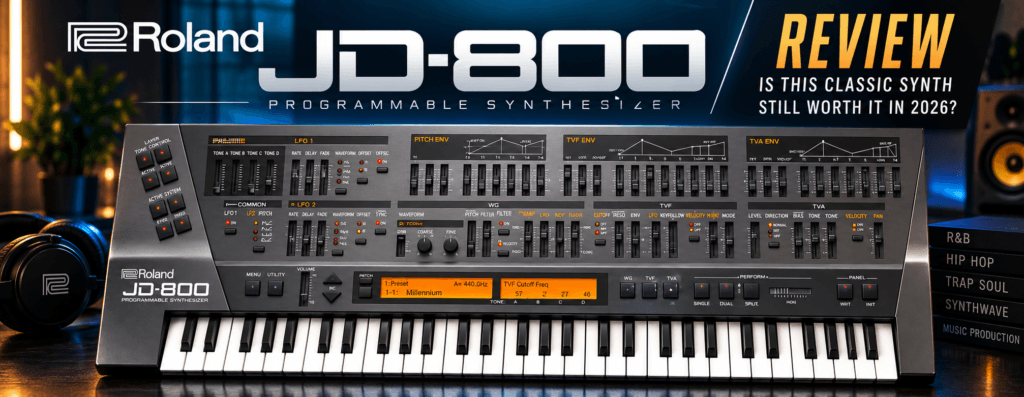
 Roland JD-800 VST Review: Is This Classic Synth Still Worth It in 2026?
The Roland JD-800 is one of those synthesizers that immediately sounds like an era.
Originally released in 1991, the JD-800 arrived when digital synthesizers and preset-driven workstations were dominating the market. Instead of hiding sound-design controls behind menus, Roland covered the JD-800 with sliders and controls that encouraged musicians to actually shape their sounds.
More than three decades later, Roland has recreated the JD-800 as a software synthesizer, bringing its bright digital pads, atmospheric textures, aggressive leads, bells, keys, and unmistakable early-’90s character into modern DAWs.
But vintage character alone doesn’t necessarily make a plugin worth buying.
In this Roland JD-800 vst review, we’ll look at how the software version works, what it sounds like, its presets and effects, and whether the JD-800 is still worth adding to your collection in 2026.
What Is the Roland JD-800?
The Roland JD-800 Software Synthesizer is an official software recreation of Roland’s original JD-800 hardware synthesizer.
Roland hasn’t simply created a sample library based on the original instrument. The software uses the original JD-800 waveform data combined with Roland’s modeling technology to recreate the behavior and sound of the hardware.
That’s important because the JD-800’s identity goes far beyond its PCM waveforms.
The original instrument combined digital waveforms with subtractive synthesis controls, envelopes, modulation, filters, layering, and a powerful effects section.
The software version recreates that architecture while adapting the experience for a modern computer-based production environment.
It supports:
- VST3
- AU
- AAX
- Apple silicon
- Windows and macOS
The interface is also resizable, which makes working with the JD-800’s large collection of controls much easier than squeezing a vintage hardware interface onto a computer screen.
A Quick History of the JD-800
Roland introduced the original JD-800 in 1991.
At the time, digital synthesizers had become increasingly focused on presets and menu-driven editing. Roland took a different approach.
The JD-800 placed a huge number of synthesis controls directly on its front panel.
Instead of scrolling endlessly through menus, musicians could reach for a slider and start manipulating the sound.
Underneath the interface was a digital synthesis engine built around PCM waveforms, filters, envelopes, modulation, effects, and extensive layering.
The original JD-800 offered 24-voice polyphony and allowed up to four Tones to be combined into a single Patch.
That four-layer architecture remains one of the most important aspects of the instrument.
A producer could combine something like:
- A soft pad
- A bell-like attack
- A digital texture
- A bright atmospheric layer
into a single evolving patch.
That ability helped give the JD-800 its massive, polished sound.
Roland JD-800 Sound
This is ultimately why you buy the JD-800.
It has character.
The JD-800 isn’t trying to sound like a modern analog synth, and that’s exactly what makes it interesting.
Its sound can be:
Bright.
Glassy.
Wide.
Digital.
Atmospheric.
Dreamy.
Aggressive.
And sometimes wonderfully cheesy in that unmistakable early-’90s way.
That character makes the JD-800 particularly useful when you want sounds that don’t feel like another modern wavetable or virtual analog synthesizer.
Pads
Pads are easily one of my favorite applications for the JD-800.
Its four-layer architecture allows you to create enormous textures without stacking several different plugin instances.
You can combine slower evolving waveforms with brighter layers and then use chorus, delay, and reverb to create huge atmospheric sounds.
For R&B, Trap Soul, Ambient, Synthwave, Pop, and cinematic production, there’s plenty to work with.
Keys and Digital Textures
The JD-800 also excels at distinctly digital keyboard sounds.
Think:
- Glassy keys
- Digital EP-style patches
- Bells
- Plucks
- Atmospheric keys
- Hybrid piano textures
- Dreamy layered sounds
These can work especially well underneath vocals because they provide harmonic information without necessarily occupying the same space as a large acoustic piano.
Leads
The JD-800 can also become surprisingly aggressive.
Its filters, envelopes, modulation, and effects allow its PCM waveforms to be transformed into cutting leads and synth lines.
Add distortion, chorus, delay, or phaser and the instrument can move considerably beyond its cleaner factory-preset personality.
The Four-Tone Architecture
One of the biggest reasons the JD-800 remains interesting today is its architecture.
A Patch can contain four Tones.
Think of each Tone almost like having another synthesizer layer inside the same patch.
Each layer can have its own waveform and synthesis settings.
That means you aren’t limited to making a sound from a single oscillator source.
You might create an R&B pad using:
Tone A: Warm sustained foundation
Tone B: Bright digital shimmer
Tone C: Bell-like transient
Tone D: Slowly evolving atmospheric texture
Balance those four components correctly and you can create sounds that feel much more complex than any individual waveform.
This is where the JD-800 becomes much more than a nostalgia machine.
Once you stop browsing presets and start treating its layers as building blocks, it’s an extremely capable sound-design instrument.
Waveforms and Synthesis
The JD-800 software includes 108 waves based on the original architecture.
Each Tone gives you access to familiar synthesis controls including waveform selection, pitch controls, filtering, amplification, envelopes, and modulation.
The basic signal flow is easy to understand if you’ve worked with subtractive synthesizers before.
You essentially start with a waveform and shape it using filters, envelopes, modulation, and effects.
The difference is that you can repeat that process across four separate layers.
This creates an enormous number of potential combinations.
Filters
The JD-800’s Time Variant Filter, or TVF, plays an important role in shaping its sound.
Instead of simply accepting the character of the PCM waveform, you can use filtering and envelopes to completely reshape it.
For example, a bright digital waveform can be filtered down into a darker R&B texture.
You could then use another Tone to introduce some high-frequency shimmer.
That’s one of the techniques that makes layered synthesizers so powerful.
You don’t need one waveform to accomplish everything.
Each layer can have a specific job.
Modulation
Each layer also gives you modulation options including LFOs.
Modulation becomes particularly useful when creating evolving pads.
Instead of having every layer remain static, you can introduce subtle movement to parameters such as pitch or filtering.
Small amounts of movement across several layers can create a sound that feels alive without becoming obviously modulated.
This is especially effective for atmospheric Hip Hop and R&B production.
The JD-800 Effects Section
The effects section is another major part of the JD-800 sound.
Roland recreated the instrument’s multistage effects system while giving the software version a more convenient expanded view.
You get seven primary effects:
- Distortion/Overdrive
- Enhancer
- Spectrum Equalizer
- Phaser
- Chorus
- Triple-Tap Delay
- Reverb
There’s also a master EQ.
Even better, effects can be reordered using drag and drop, allowing you to experiment with different signal flows.
This matters more than it might initially seem.
Putting distortion before chorus, for example, can produce a completely different result than processing an already-chorused sound with distortion.
The combination of layering and effects is a huge part of what makes the JD-800 sound so large.
Chorus
If you’re chasing lush ’90s digital textures, start here.
The chorus can add width and movement to pads, keys, and atmospheric sounds.
Delay
The triple-tap delay is excellent for leads, plucks, bells, and ambient textures.
It can turn relatively simple sounds into rhythmic elements that interact with the rest of your production.
Reverb
Reverb is practically essential when exploring the JD-800’s atmospheric side.
Pads and digital textures can quickly become huge once they’re placed into a larger virtual space.
Just be careful.
The combination of layered patches, chorus, delay, and reverb can produce an enormous amount of sonic information.
Sometimes reducing the effects actually makes the JD-800 sit better inside a modern mix.
Roland JD-800 Presets
The plugin includes 128 presets out of the box.
That consists of:
- 64 presets from the original JD-800 hardware
- 64 newer presets designed for the software version
I like this approach.
The original patches allow you to experience the instrument closer to how musicians encountered it in the early ’90s.
The newer presets demonstrate how the architecture can still work in contemporary production.
And because this is a synthesizer rather than just a sample library, any preset can become a starting point.
Find something close to what you want and start modifying it.
Change the waveform.
Disable a Tone.
Adjust the filter.
Change the envelope.
Reduce the reverb.
Add modulation.
Suddenly that factory patch becomes something completely different.
Is Roland JD-800 Good for Hip Hop?
Absolutely, although I wouldn’t necessarily use it as the only synthesizer in a Hip Hop production setup.
Where the JD-800 shines is texture.
For Hip Hop, I would reach for it when I need:
- Dark pads
- Eerie digital textures
- Bells
- Ambient keys
- Experimental leads
- Background layers
- Intro textures
- Sample-like digital sounds
One interesting approach is to create a chord progression with the JD-800, bounce it to audio, and then treat that recording like a sample.
Pitch it.
Chop it.
Reverse sections.
Filter it.
Add saturation.
That gives you the character of the JD-800 without necessarily making your production sound intentionally retro.
Is Roland JD-800 Good for R&B?
I actually think R&B is one of the best modern applications for this plugin.
The JD-800’s strength with pads, digital keys, atmospheric textures, bells, and layered sounds fits naturally into modern R&B.
You can build a simple extended chord progression and let the sound design create the atmosphere.
Try playing:
- Minor 7th chords
- Major 7th chords
- Minor 9th chords
- Major 9th chords
- Add9 voicings
- Suspended chords
with one of the softer JD-800 patches.
Then remove unnecessary low frequencies and add a small amount of delay.
You can quickly create a foundation for Trap Soul, alternative R&B, or atmospheric R&B.
Using the JD-800 in Modern Production
One mistake would be assuming that buying a vintage digital synthesizer means your music needs to sound vintage.
It doesn’t.
The JD-800 becomes much more interesting when you combine its character with modern production techniques.
For example:
JD-800 pad + modern 808
creates an interesting contrast between lush digital harmony and contemporary low end.
JD-800 bell + Trap drums
can give you a melodic foundation without reaching for the same modern presets everyone else uses.
JD-800 texture + vocal chops
can work beautifully in atmospheric R&B.
You can also resample the JD-800 into something like an MPC and completely transform the source material.
That’s where these older synthesizer architectures can become secret weapons.
Interface and Workflow
Roland has retained the unmistakable control-heavy appearance of the original instrument.
There’s a lot on the screen.
For complete beginners, the JD-800 can initially look intimidating because you’re confronted with many parameters simultaneously.
But I actually prefer this approach to synthesizers that bury everything inside tabs.
Once you understand the basic sections, the interface starts making sense.
You can visually move through the synthesis process rather than constantly opening different menus.
And because the software interface is resizable, it’s considerably easier to work with on modern displays.
CPU Performance
Despite recreating a fairly sophisticated synthesizer architecture, Roland says the JD-800 is optimized to allow multiple instances with increased polyphony compared with the original hardware.
That’s useful because you might want separate JD-800 instances for pads, keys, leads, and textures rather than constantly bouncing everything to audio.
Of course, actual performance will depend on your computer, DAW, buffer settings, and project size.
What I Like About the Roland JD-800
There are several things that make this plugin stand out.
The Sound Has Personality
The biggest advantage is simply that the JD-800 doesn’t sound like everything else.
There is an unmistakably digital quality to it.
That’s useful when your plugin collection already contains multiple analog emulations and wavetable synthesizers.
Four-Layer Sound Design
The ability to combine four independent Tones gives you enormous sound-design potential.
This is especially powerful for pads and evolving textures.
Excellent Built-In Effects
The effects aren’t merely extras.
They’re part of the instrument’s identity.
Chorus, delay, phaser, reverb, distortion, and the other processing options dramatically expand what you can create.
Original Presets Are Included
Having the 64 original hardware presets is a nice touch.
You’re not simply getting a synth inspired by the JD-800.
You’re getting direct access to an important part of the instrument’s history.
Modern Plugin Compatibility
VST3, AU, AAX, Apple silicon support, expanded polyphony, and a resizable interface make the instrument far easier to incorporate into a modern studio than maintaining vintage hardware.
What Could Be Better?
The JD-800 isn’t perfect.
The Interface Can Feel Busy
Having so many controls available is part of the JD-800 experience, but beginners may need some time before the layout becomes comfortable.
Its Character Isn’t for Everyone
If you’re looking exclusively for warm vintage analog sounds, this probably shouldn’t be your first synthesizer.
The JD-800 has a distinctly polished digital personality.
That’s either its greatest strength or the reason you won’t need it.
You May Already Own Similar Roland Sounds
If you’re heavily invested in Roland Cloud or ZENOLOGY, consider how much additional value the dedicated JD-800 plugin adds to your existing setup.
The dedicated instrument is particularly attractive if you want the complete JD-800-style interface and workflow rather than simply access to Roland-inspired sounds.
Roland JD-800 Pros and Cons
Pros
- Official Roland recreation
- Original waveform data
- Distinctive ’90s digital character
- Four-Tone layered architecture
- Excellent pads and textures
- Great for R&B and atmospheric Hip Hop
- 128 included presets
- Seven built-in effects
- Drag-and-drop effect routing
- Resizable interface
- VST3, AU, and AAX
- Native Apple silicon support
- Expanded polyphony compared with the hardware
Cons
- Large interface can initially feel overwhelming
- Digital character won’t appeal to everyone
- Not necessarily an essential purchase for producers already deeply invested in overlapping Roland Cloud instruments
- Preset-heavy users may eventually want additional sound banks
Who Should Buy the Roland JD-800?
I would strongly consider the JD-800 if you produce:
- R&B
- Trap Soul
- Hip Hop
- Synthwave
- Ambient
- Electronic music
- Pop
- Cinematic music
- ’80s- and ’90s-inspired productions
It’s also worth considering if you already own plenty of modern synths and want something with a noticeably different personality.
Sometimes adding another massive synthesizer to your collection doesn’t actually expand your sonic palette.
Adding something with a specific character does.
That’s where the JD-800 makes sense.
Who Should Skip It?
You can probably skip the JD-800 if you primarily need realistic acoustic instruments or you’re looking for your first general-purpose synthesizer.
Likewise, if you don’t enjoy the polished character of early digital synthesis, buying the JD-800 simply because it’s a classic probably won’t change your mind.
Listen to it first.
Its personality becomes obvious pretty quickly.
Roland JD-800 vs Modern Synth Plugins
The JD-800 isn’t really trying to compete with something like a modern wavetable powerhouse.
Modern synthesizers may offer deeper modulation systems, enormous wavetable collections, advanced sequencing, granular synthesis, and other features that didn’t exist when the JD-800 architecture was created.
But that’s missing the point.
You buy the JD-800 because you want the JD-800.
Its limitations are partly responsible for its identity.
Instead of asking whether it can outperform every modern synthesizer technically, I’d ask a different question:
Does it give you sounds that inspire you to make different music?
For me, that’s much more important.
Is Roland JD-800 Worth It in 2026?
Yes — for the right producer.
The Roland JD-800 isn’t an essential synthesizer for everyone, but that’s actually part of its appeal.
It provides a very specific flavor.
Its combination of original PCM waveforms, four-layer architecture, extensive sound-shaping controls, and distinctive effects produces textures that can immediately pull you away from generic modern presets.
And despite its vintage heritage, it doesn’t have to make your music sound dated.
Used creatively, the JD-800 can become an excellent source for modern R&B pads, Trap Soul textures, Hip Hop samples, digital keys, ambient layers, and experimental sound design.
Final Verdict
Pluginera Rating: 9/10
Its biggest strengths are its four-layer architecture, unmistakable digital character, excellent effects, original factory sounds, and enormous potential for atmospheric sound design.
If you make R&B, Hip Hop, Trap Soul, Synthwave, Ambient, or electronic music and your plugin collection is starting to sound a little too familiar, the JD-800 can provide a genuinely different source of inspiration.
It’s not about replacing your favorite modern synthesizer.
It’s about adding another color to your palette.
And more than three decades after the original hardware appeared, the JD-800 remains a very interesting color indeed.