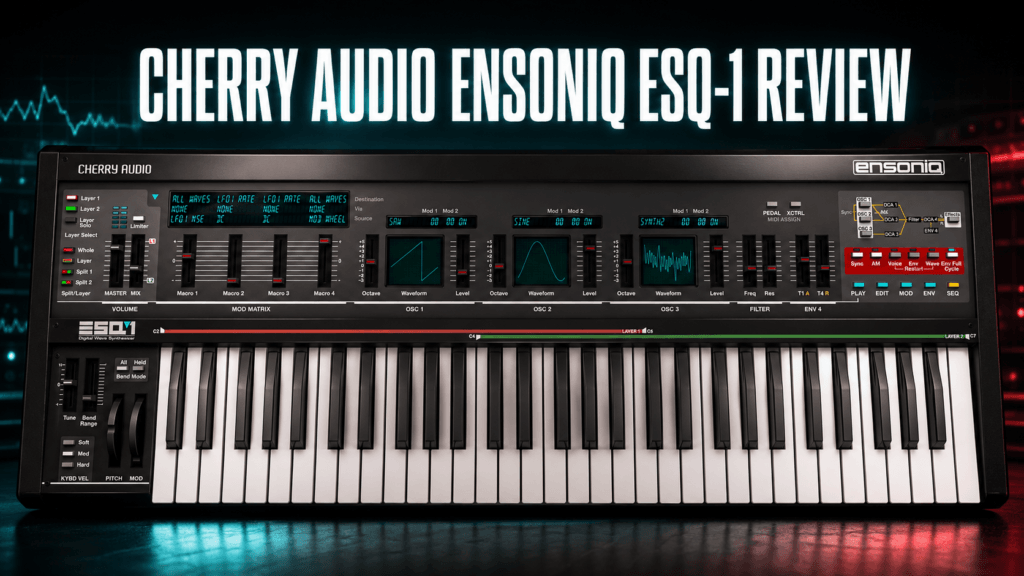
 Cherry Audio Ensoniq ESQ-1 Review: Vintage Hybrid Sound Reborn
The original Ensoniq ESQ-1 arrived in 1986, when synthesizers were rapidly transitioning from analog circuitry to digital sound generation. Instead of choosing one approach, Ensoniq combined digital oscillators with an analog filter to create an instrument capable of producing warm pads, metallic bells, gritty basses, evolving textures, and unmistakably digital keyboard sounds.
Now, Cherry Audio has recreated that distinctive hybrid character with the officially licensed Ensoniq ESQ-1 virtual synthesizer.
Cherry Audio’s version features the original 32 digital waveforms, modeled analog filtering, three oscillators per voice, dual-layer sound design, modern modulation, built-in sequencing, MPE support, and more than 400 presets.
But is Cherry Audio Ensoniq ESQ-1 merely a nostalgic recreation, or can it become a useful instrument for modern producers?
In this Cherry Audio Ensoniq ESQ-1 review, we’ll examine its sound, workflow, features, presets, strengths, and limitations to determine whether it deserves a place in your plugin collection.
This article contains affiliate links. If you purchase through one of these links, Pluginera may earn a commission at no additional cost to you.
What Is Cherry Audio Ensoniq ESQ-1?
Cherry Audio Ensoniq ESQ-1 is a software recreation of the classic Ensoniq ESQ-1 hybrid synthesizer released in 1986.
The original hardware used three digital oscillators per voice and routed them through a resonant Curtis analog filter. This gave the ESQ-1 more harmonic variety than a traditional analog synthesizer while retaining the warmth and movement associated with analog filtering.
Cherry Audio preserves that fundamental architecture while expanding it for contemporary production.
The plugin includes the original 32 ESQ-1 waveforms, officially licensed from Creative Technology, the current owner of the Ensoniq intellectual property. Cherry Audio also modeled the behavior of the original CEM3379 analog filter.
Additional modern features include:
- Two independent synthesis layers
- Up to 32 voices of polyphony per layer
- Keyboard splits and stacked sounds
- Expanded filter modes
- Three LFOs per layer
- Four multistage envelopes per layer
- A flexible modulation matrix
- Independent arpeggiators and sequencers
- MPE and polyphonic-aftertouch support
- Three customizable effects chains
- ESQ-1 SysEx patch compatibility
- More than 400 presets
The result is an instrument that respects the original ESQ-1 while offering a much faster and more flexible production workflow.
How Does Cherry Audio Ensoniq ESQ-1 Sound?
The Ensoniq ESQ-1 has a character that sits somewhere between a traditional analog polysynth and a modern digital instrument.
Its oscillators can sound bright, hollow, glassy, metallic, gritty, vocal, or intentionally lo-fi. These digital tones are then shaped by the modeled analog filter, helping soften the harder frequencies and add warmth.
This combination allows the plugin to produce a wide variety of sounds, including:
- Warm vintage pads
- Digital bells and mallets
- Punchy synth basses
- Retro brass and strings
- Glassy keyboard sounds
- Metallic percussion
- Lo-fi leads
- Rhythmic sequences
- Cinematic atmospheres
- Evolving soundscapes
The ESQ-1 does not sound as polished or pristine as many modern wavetable synthesizers. That is part of its appeal.
Its waveforms have texture, grit, and personality. Even relatively simple patches can sound as though they were sampled from an older record or pulled from a forgotten piece of studio hardware.
For producers who want every sound to be perfectly clean, that personality may not always be desirable. However, for musicians looking for a synthesizer that immediately adds color to a production, the ESQ-1 can be highly inspiring.
Three Digital Oscillators per Voice
Each ESQ-1 voice begins with three digital oscillators.
Having three oscillators provides more flexibility than a basic single- or dual-oscillator synth. You can combine different waveforms, tune them to separate octaves, detune them for width, or use intervals to create harmonically complex sounds.
The plugin contains the original 32 ESQ-1 waveforms organized into four categories:
- Basic and Noise
- Samples
- Additive and Formant
- Band Limited
Some of these waveforms resemble familiar analog shapes, while others produce more unusual digital textures.
Combining a conventional waveform with a metallic or formant-based waveform is one of the easiest ways to create the hybrid character associated with the ESQ-1. One oscillator can provide the body of the sound while another adds a sharper attack or more complex upper harmonics.
Oscillator sync is available for creating aggressive and harmonically rich tones. Amplitude modulation can generate metallic, bell-like, and experimental timbres.
These options make the ESQ-1 particularly useful for creating plucks, bells, percussion, basses, and unusual keyboard patches.
Modeled Curtis Analog Filter
One of the most important parts of the ESQ-1 sound is its filter.
Cherry Audio modeled the Curtis CEM3379 resonant low-pass filter found in the original hardware. The classic four-pole low-pass mode has a 24 dB-per-octave slope and helps smooth the harder digital waveforms.
This filter is one reason the instrument sounds different from simply loading vintage digital waves into a modern wavetable synth.
Digital oscillators can sometimes sound thin or overly sharp on their own. Passing them through the modeled analog filter adds warmth, movement, and a more musical response.
Cherry Audio also expands the filter section with:
- Two-pole low-pass
- High-pass
- Band-pass
The additional modes increase the instrument’s usefulness in contemporary mixes.
The high-pass filter can remove low-frequency buildup from pads and atmospheric sounds. The band-pass option can produce thinner, focused textures that leave more space for vocals, drums, and bass.
Increasing the resonance works especially well for plucks, filter sweeps, sequenced patterns, and animated synth leads.
Dual-Layer Sound Design
One of the biggest improvements over the original ESQ-1 is Cherry Audio’s dual-layer architecture.
The plugin contains two independent synthesis layers, each with its own oscillators, filter, envelopes, modulation, sequencer, arpeggiator, and effects.
You can stack the layers to create larger sounds or divide them across the keyboard using split mode.
For example, you could combine:
- A soft pad with a bright bell attack
- A warm analog-style layer with a gritty digital texture
- A synth bass in the lower register with keys in the upper register
- A sustained pad with a rhythmic sequence
- Two contrasting sounds spread across the stereo field
Each layer supports up to 32 voices of polyphony, allowing the ESQ-1 to produce wide chords and detailed stacked patches.
The layering system is especially valuable for producers because it allows complete composite sounds to be created inside a single plugin instance.
However, some layered presets can occupy a large amount of space in a mix. A patch may sound impressive when auditioned alone but become overpowering once drums, vocals, bass, and other instruments are added.
In those cases, reducing the layer volume, shortening the release, filtering the sound, or disabling unnecessary effects can help the patch fit more naturally into the arrangement.
Modulation and Multistage Envelopes
Cherry Audio Ensoniq ESQ-1 provides extensive modulation without turning the instrument into an overly complicated modular environment.
Each layer includes three LFOs and four independent multistage envelopes.
Unlike a conventional ADSR envelope, each ESQ-1 envelope contains four levels and four rates. This makes it possible to create more complex shapes and sounds that continue evolving after the initial attack.
The multistage envelopes are useful for:
- Slowly changing pads
- Complex filter movement
- Unusual pluck envelopes
- Sounds that transform while notes are held
- Rhythmic volume changes
- Evolving cinematic textures
Cherry Audio visualizes the envelopes with movable handles, making them much easier to understand than they would be on the original hardware’s small display.
The four-slot modulation matrix provides an additional way to connect modulation sources with destinations. Assignments can be created with a straightforward click-to-assign workflow.
Potential modulation sources include velocity, aftertouch, LFOs, envelopes, macros, and MPE controls. Destinations include synthesis parameters, effects, arpeggiator settings, and sequencer controls.
The four matrix slots should be sufficient for most musical patches, although advanced sound designers may occasionally wish for additional slots.
Arpeggiator and Polyphonic Step Sequencer
The ESQ-1 includes an independent arpeggiator and polyphonic step sequencer for each layer.
The arpeggiator offers four pattern modes:
- Arp
- Leap
- Order
- Random
Swing, chance, feel, and humanization controls can introduce variation and prevent patterns from sounding excessively mechanical.
The 16 x 4 polyphonic step sequencer can control both notes and modulation. It is syncable to your project tempo, transposable, and equipped with four assignable macro-motion lanes.
Because each synthesis layer has its own pattern tools, you can create sounds that combine two related rhythmic ideas.
One layer might play a short plucked sequence while the other produces a slower-moving pad. Alternatively, one layer could remain sustained while the sequencer subtly changes its filter, oscillator balance, or effects.
These tools are excellent for generating new musical ideas.
You can hold a chord, browse different patterns, adjust the swing and probability, and record the results into your DAW. Even when you do not use the sequencer to generate notes, its modulation lanes can add movement to otherwise static patches.
Preset Library
Cherry Audio Ensoniq ESQ-1 includes more than 400 professionally designed presets across 15 categories.
The collection also contains the 40 original ESQ-1 factory patches.
Including the original sounds is important because it allows producers to experience the instrument’s authentic 1980s character. However, the newer presets are more likely to demonstrate the full capabilities of Cherry Audio’s expanded architecture.
Modern presets take advantage of features such as:
- Dual-layer sound design
- Expanded modulation
- Polyphonic sequencing
- Arpeggiation
- Multiple effects chains
- MPE and aftertouch
The preset library covers basses, leads, pads, keys, strings, brass, sequences, sound effects, and other useful categories.
Many sounds are immediately playable, while others are designed to demonstrate the instrument’s deeper programming possibilities.
Preset browsing also makes the ESQ-1 approachable for producers who do not want to build every patch from scratch. Once you find a suitable starting point, you can quickly adjust the filter, envelopes, layer balance, effects, or modulation to make the sound fit your production.
Built-In Effects
Cherry Audio includes 20 studio-quality effects that can be arranged across three customizable effect chains.
Each synthesis layer has its own effects chain, and a third global chain processes the combined sound.
Available effects include:
- BBD Flanger
- Compressor
- Digital Delay
- Digital Reverb
- Distortion and EQ
- Dual Delay
- Dual Ensemble
- Dual Phaser
- Envelope Filter
- Flanger and Chorus
- Galactic Reverb
- Lo-Fi
- Lushverb
- Ring Modulator
- Seven-Band EQ
- Spring Reverb
- Tape Echo
The effects are an important part of the overall ESQ-1 experience.
Chorus and ensemble effects help create wide vintage pads and keyboard sounds. Delays and reverbs can turn short digital plucks into large atmospheric textures. Distortion and lo-fi processing can push the plugin toward darker hip-hop and experimental production.
Independent layer effects are particularly useful.
You could add delay to a bright upper layer while keeping the lower layer dry and centered. You could also apply lo-fi processing to one layer while preserving the clarity of the other.
Dedicated third-party effects may still provide more detailed mixing control, but the ESQ-1’s internal effects are more than capable of creating finished and inspiring patches.
Is the Interface Easy to Use?
The original Ensoniq ESQ-1 was powerful, but programming it required navigating a small display, soft buttons, and a data slider.
Cherry Audio makes the synthesis engine considerably easier to understand by dividing the interface into five main sections:
- Play
- Edit
- Modulation
- Envelopes
- Sequencer
This organization allows more controls to remain visible and reduces the amount of menu navigation required.
The interface is resizable and includes Cherry Audio’s Focus feature, which enlarges a selected section for more precise editing.
There is still a learning curve.
The dual layers, multistage envelopes, modulation assignments, sequencers, and effects create a fairly deep instrument. Producers who are accustomed to simple preset players may initially find the interface busy.
After spending some time with the layout, however, the workflow becomes logical. The most important controls are clearly organized, and producers can make basic changes without understanding every part of the instrument.
MPE and Performance Features
Cherry Audio expands the ESQ-1 with several modern performance options.
The plugin supports:
- Velocity
- Channel aftertouch
- Polyphonic aftertouch
- MIDI Polyphonic Expression
- Portamento
- Glissando
- Mono legato
- Mono retrigger
- Unison
- Polyphonic playing
With a compatible controller, MPE allows parameters such as pitch, timbre, or modulation to respond independently for each note.
This can make pads, leads, and cinematic sounds much more expressive.
Even without an MPE controller, velocity and aftertouch assignments can add significant movement to a patch. A sound might become brighter when played harder or introduce vibrato as additional pressure is applied.
The performance options make the ESQ-1 useful for keyboard players as well as producers entering notes through a DAW piano roll.
SysEx Compatibility with the Original Hardware
One of the most distinctive features is the plugin’s compatibility with original ESQ-1 patches.
Cherry Audio Ensoniq ESQ-1 can import individual patches and patch banks from SysEx files. Patches can be dragged directly into the software or transferred from connected hardware through MIDI.
The plugin can also export compatible SysEx files for use with an original ESQ-1.
This gives vintage-hardware owners a practical way to:
- Archive old patches
- Edit sounds through a visual interface
- Use hardware patches inside a DAW
- Transfer compatible patches back to the keyboard
- Preserve custom sound libraries
Most modern producers will not need this feature, but it demonstrates the depth of Cherry Audio’s commitment to the original instrument.
Making Hip-Hop and R&B with Ensoniq ESQ-1
Although the ESQ-1 is an obvious choice for synthwave and ’80s-inspired music, it can also be extremely useful in hip-hop, R&B, and trap soul.
Its digital waveforms provide textures that can sound darker and less predictable than conventional analog presets.
For trap soul, try selecting a bell or digital keyboard patch and reducing the filter cutoff. Shorten the release, add a small amount of chorus, and use a dark reverb to create a moody melodic sound.
For R&B, layer a warm pad with a brighter digital attack. Lower the second layer until it provides just enough definition for the chords to remain clear.
For hip-hop, use the more unusual waveforms to create a short phrase, record it as audio, and then resample or pitch it. The ESQ-1’s vintage texture can make the result feel as though it came from an older recording.
Its basses can also work underneath modern drums. Instead of replacing an 808, a narrow ESQ-1 bass can be layered quietly to add midrange definition.
The key is to use the instrument’s personality without allowing large presets to dominate the mix.
Cherry Audio Ensoniq ESQ-1 Pros and Cons
Pros
- Distinctive hybrid digital and analog character
- Original 32 ESQ-1 waveforms
- Modeled Curtis analog filter
- Three oscillators per voice
- Powerful dual-layer architecture
- More than 400 presets
- Includes the original 40 factory patches
- Flexible multistage envelopes
- Independent arpeggiators and sequencers
- Strong selection of built-in effects
- MPE and polyphonic-aftertouch support
- SysEx compatibility with original hardware
- Resizable interface
- Reasonable regular price
Cons
- Interface may initially feel busy
- Multistage envelopes require some learning
- Large layered presets can overwhelm a mix
- Four modulation-matrix slots may feel limited to advanced sound designers
- Its gritty vintage character will not suit every production
Who Is Cherry Audio Ensoniq ESQ-1 For?
Cherry Audio Ensoniq ESQ-1 is an excellent choice for:
- Synthwave and retro-pop producers
- Producers creating ’80s-inspired R&B
- Hip-hop and trap soul producers seeking unusual textures
- Film and game composers
- Sound designers who enjoy hybrid synthesis
- Keyboard players using aftertouch or MPE
- Original ESQ-1 owners
- Producers who want vintage character without maintaining old hardware
It may not be the best choice for producers who only need realistic acoustic instruments or extremely clean, modern wavetable sounds.
The ESQ-1’s greatest strength is its distinctive personality. It makes the most sense for musicians who want that personality to influence their productions.
Price and System Requirements
At the time of writing, Cherry Audio Ensoniq ESQ-1 is listed at $69, although prices and promotions can change.
Cherry Audio also offers a free 30-day demo, allowing producers to explore the instrument before purchasing.
macOS Requirements
- macOS 10.13 or later
- 64-bit Intel or Apple Silicon processor
- Quad-core 3.4 GHz or Apple Silicon CPU recommended
- 8 GB RAM recommended
- Approximately 173 MB of storage
Windows Requirements
- Windows 7 or later, including Windows 11
- 64-bit operating system
- Quad-core 3.4 GHz processor recommended
- 8 GB RAM recommended
- Approximately 173 MB of storage
Always verify current compatibility information before purchasing, especially after a major operating-system or DAW update.
Is Cherry Audio Ensoniq ESQ-1 Worth It?
Yes, Cherry Audio Ensoniq ESQ-1 is worth considering if you want a characterful hybrid synthesizer that combines vintage digital textures with analog-style warmth.
The original waveforms and modeled filter give it an authentic connection to the hardware, while the dual-layer architecture, modulation system, pattern tools, effects, and expressive performance features make it practical for modern production.
It also offers a strong value at its regular $69 price.
The preset library provides immediate inspiration, while the deeper programming options give sound designers enough flexibility to create original patches.
The biggest question is whether its specific character matches your music.
If you prefer extremely polished and pristine sounds, the ESQ-1 may not become your primary synthesizer. If you enjoy gritty digital bells, hazy pads, unusual keys, evolving sequences, and vintage hybrid tones, it could become one of the most distinctive instruments in your collection.
Frequently Asked Questions
Is Cherry Audio Ensoniq ESQ-1 officially licensed?
Yes. Cherry Audio partnered with Creative Technology, the owner of the Ensoniq intellectual property, to license the original 32 ESQ-1 waveforms.
Is the Ensoniq ESQ-1 analog or digital?
It uses a hybrid architecture. Its oscillators are digital, while the original hardware used an analog Curtis filter. Cherry Audio recreates this combination using the original waveforms and a modeled filter.
How many presets are included?
Cherry Audio states that the plugin includes more than 400 presets across 15 categories, including the original 40 hardware factory patches.
Can it import patches from the original ESQ-1?
Yes. The plugin supports ESQ-1 SysEx patch and bank imports. It can also export compatible SysEx files for the original hardware.
Does it support Apple Silicon?
Yes. Cherry Audio Ensoniq ESQ-1 supports compatible 64-bit Intel and Apple Silicon Mac computers.
What genres is the ESQ-1 best for?
It is particularly well suited to synthwave, ’80s R&B, retro pop, hip-hop, trap soul, cinematic music, ambient music, electro, and experimental electronic production.
Can I try it before buying?
Yes. Cherry Audio offers a free 30-day demo. The demo periodically produces white noise but otherwise allows you to explore the instrument before purchasing.
Final Verdict
Cherry Audio Ensoniq ESQ-1 successfully preserves the identity of the original synthesizer while expanding it into a much more capable modern instrument.
Its officially licensed waveforms, modeled analog filter, multistage envelopes, and SysEx compatibility maintain a meaningful connection to the hardware. Meanwhile, the dual-layer engine, modern modulation, MPE, sequencing tools, scalable interface, and built-in effects make that sound easier to use in today’s DAWs.
The ESQ-1 is not simply another virtual analog synthesizer. Its combination of digital grit, analog warmth, and vintage atmosphere gives it a recognizable personality.
Whether you are creating an ’80s R&B groove, a dark trap soul melody, a retro-futuristic synth track, or an evolving cinematic texture, the instrument offers plenty of inspiration.
If you want a synthesizer that bridges the gap between vintage digital character and analog warmth, Cherry Audio Ensoniq ESQ-1 deserves a serious listen.
Pluginera Rating: 9/10