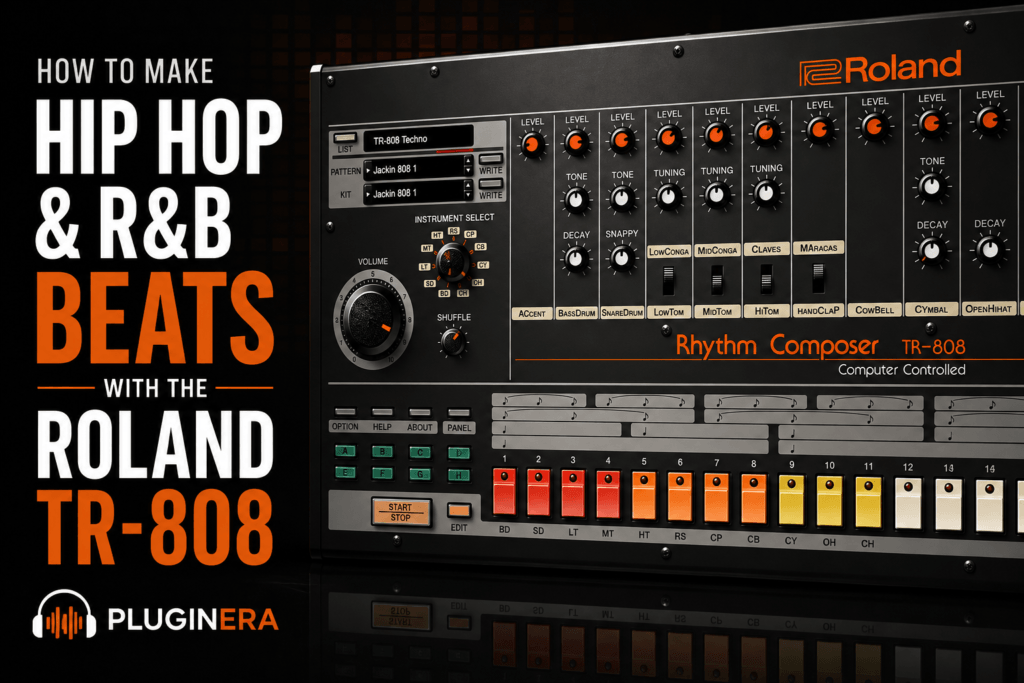
 How to Make Hip Hop & R&B Beats with the Roland TR-808
Few drum machines have had a bigger impact on hip hop and R&B than the Roland TR-808.
Its booming bass drum, snappy snare, unmistakable clap, metallic hi-hats, and quirky percussion sounds helped define entire eras of music. Decades after the original hardware appeared, producers are still building records around sounds that trace directly back to the 808.
But you don’t need vintage hardware to bring that sound into your productions.
The Roland TR-808 Software Rhythm Composer recreates the legendary drum machine inside your DAW using Roland’s Analog Circuit Behavior modeling technology while adding modern features such as tuning, decay controls, overdrive, sub-steps, pattern variations, and drag-and-drop MIDI and audio.
More importantly, you don’t have to make an old-school beat to use it.
With the right programming and processing, the Roland TR-808 can work beautifully for modern hip hop, R&B, Trap Soul, alternative R&B, boom bap, and contemporary trap-influenced production.
In this guide, we’ll walk through how to make Hip Hop & R&B beats with the Roland TR-808, from choosing your tempo and programming the kick to creating hi-hat grooves, adding swing, tuning the 808, and turning a simple pattern into a complete arrangement.
1. Start With the Right Tempo
Before programming anything, decide what kind of beat you’re trying to create.
There isn’t one correct BPM for hip hop or R&B, but your tempo will dramatically affect how you approach the TR-808.
Here are some useful starting ranges:
Modern R&B
Try approximately:
70–95 BPM
This range gives you plenty of space for lush chords, vocals, bass, and atmospheric production.
Trap Soul
Try:
60–85 BPM
Slower tempos can create the dark, spacious feeling associated with Trap Soul and contemporary R&B.
Traditional Hip Hop
Try:
80–100 BPM
This works particularly well if you’re combining the TR-808 with samples, chopped melodies, electric piano, or boom-bap-inspired production.
Modern Trap-Influenced Hip Hop
Try:
120–150 BPM
Remember that these faster tempos are often programmed with a half-time feel.
A 140 BPM trap beat can therefore feel closer to a 70 BPM groove.
Don’t obsess over the exact number.
Choose a tempo that gives your drums enough room to breathe.
2. Build a Simple Kick and Snare Foundation
One of the easiest mistakes to make with an 808 drum machine is programming too much too quickly.
Start simple.
Create a basic pattern using only:
- Bass drum
- Snare
- Closed hi-hat
Ignore everything else for the moment.
For a modern R&B groove, place your main snare or clap on beats 2 and 4.
Then build the kick pattern around it.
A basic pattern could feel something like:
Kick — Snare — Kick — Snare
But don’t place kicks everywhere.
Space is incredibly important in R&B.
Try placing your first kick directly on beat one, then experiment with additional kicks before or after the snare.
Listen for the groove rather than trying to fill every empty step.
3. Shape the TR-808 Bass Drum
Now we get to the star of the show.
The Roland plugin gives you control over characteristics such as tone, tuning, and decay, allowing the bass drum to serve different roles depending on your production.
For a Punchy Hip-Hop Kick
Keep the decay relatively short.
You want the kick to hit and get out of the way.
This works especially well when you already have a separate bass instrument.
Think:
Kick + bass guitar/synth bass
rather than using the kick itself as the bass.
For Modern R&B and Trap Soul
Increase the decay.
The kick will begin to develop a longer low-frequency tail.
This can create the sustained 808-style low end heard throughout contemporary hip hop and R&B.
At that point, your bass drum can effectively become part of the bassline.
That’s where tuning becomes especially important.
4. Tune the 808 to Your Song
If you’re using a long 808 kick, don’t ignore its pitch.
A sustained 808 becomes a musical element.
That means it should generally complement the key of your song.
For example, imagine you’re producing an R&B beat in:
F minor
You could tune your main 808 around F.
Then experiment with notes from the F minor scale:
- F
- G
- Ab
- Bb
- C
- Db
- Eb
You don’t necessarily need a complicated bassline.
A simple pattern centered around the root note can work extremely well.
For example:
F → F → Ab → C
Or:
F → Eb → Db → C
The important thing is listening to how the 808 interacts with your chords.
If the low end feels dissonant or muddy, check the pitch before reaching for an EQ.
Sometimes what sounds like a mixing problem is actually an arrangement problem.
5. Add the Classic TR-808 Snare
The TR-808 snare has a synthetic character that immediately stands out.
For modern productions, you have two main options.
Use It Alone
This works especially well for:
- Minimal R&B
- Retro R&B
- Synthwave-influenced R&B
- Alternative hip hop
- Old-school hip hop
Letting the original snare stand by itself gives the production unmistakable 808 character.
Layer It
For contemporary hip hop and R&B, try layering the TR-808 snare underneath a modern snare sample.
The modern sample can provide the transient and punch.
The 808 snare provides character.
You can then blend them until the combination feels right.
Don’t automatically make both layers equally loud.
Often the TR-808 works best as the quieter layer.
6. Add the Hand Clap
The TR-808 clap is another legendary sound.
Try layering it with the snare on beats 2 and 4.
For R&B, you can also use the clap without the snare during certain sections.
For example:
Verse: Clap
Pre-Chorus: Snare + clap
Chorus: Layered snare + clap
That’s a simple arrangement trick, but it makes the drums feel like they’re evolving as the song progresses.
You can also add reverb to the clap for more space.
Keep the reverb controlled, though.
Too much can push the clap backward in the mix.
7. Program Your Closed Hi-Hats
Once the kick and snare groove feels good, add closed hi-hats.
Start with something simple.
Try straight eighth notes.
If you’re working at a faster trap tempo, you can experiment with a steady pattern that creates the familiar rolling pulse of modern hip hop.
But don’t stop there.
Velocity and timing variations can make a huge difference.
The Roland TR-808 provides tools such as soft hits, sub-steps, and shuffle, which can help your patterns feel less robotic.
8. Use Sub-Steps for Modern Hi-Hat Rolls
This is where Roland’s software version becomes especially useful for contemporary producers.
The original TR-808 wasn’t designed around today’s trap hi-hat programming.
The software version gives you sub-steps, allowing you to create faster subdivisions within your patterns.
Use these to create:
- Double-time hats
- Short rolls
- Triplet-style fills
- Percussion bursts
- Transition effects
The key word is short.
Don’t put a hi-hat roll every two seconds simply because you can.
One carefully placed roll before a snare or at the end of an eight-bar section can have much more impact.
9. Add Swing
Perfectly quantized drums aren’t always what you want.
Hip hop and R&B often benefit from subtle rhythmic imperfections.
The TR-808’s shuffle controls can help push the beat away from a rigid grid.
Start with a small amount.
Listen to the relationship between:
- Kick
- Snare
- Hi-hat
- Percussion
You want the groove to feel relaxed without sounding sloppy.
One particularly useful feature of Roland’s software TR-808 is the ability to work with shuffle on individual instruments.
That means your kick doesn’t necessarily have to swing exactly like your hi-hat.
Try keeping the kick and snare relatively stable while allowing the hats or percussion to lean further into the groove.
For R&B especially, that subtle difference can make the rhythm feel much more human.
10. Introduce the Open Hi-Hat
Open hats are excellent for creating movement.
Try placing an open hi-hat:
- Before a snare
- Before the chorus
- At the end of four bars
- Between kick hits
- At the beginning of a transition
Don’t use it constantly.
An open hat tends to attract attention.
That makes it more effective when it’s treated like punctuation rather than a constant rhythmic element.
For a smooth R&B groove, you might only need one or two open hats every few bars.
11. Use the Rim Shot for R&B Percussion
The rim shot is one of the TR-808’s most useful sounds for R&B.
It can create subtle rhythmic movement without making the drums feel overly busy.
Try placing rim shots in the spaces between your main snare hits.
You can also process them with:
- Reverb
- Delay
- Filtering
- Saturation
A filtered rim shot with a little delay can sit beautifully behind an electric piano or atmospheric synth progression.
Keep it quieter than the main drums.
The goal is texture.
12. Don’t Be Afraid of the Cowbell
The TR-808 cowbell is instantly recognizable.
That also means it can easily dominate a production.
Use it carefully.
For a retro-inspired hip-hop beat, you can make it a major part of the rhythm.
For modern R&B, try using it as an occasional accent.
You can also process it heavily.
Try:
- Filtering
- Reverb
- Delay
- Saturation
- Pitch manipulation
Once processed, it doesn’t necessarily have to scream “1980s drum machine.”
It can simply become another interesting percussion texture.
13. Add Toms and Congas
Don’t overlook the TR-808 toms and congas.
They’re excellent for fills.
Instead of creating another hi-hat roll every time you need a transition, try programming a short tom fill.
For example:
Low Tom → Mid Tom → High Tom
Or reverse it:
High Tom → Mid Tom → Low Tom
You can also alternate between toms and congas.
This is particularly useful when creating retro R&B, funk-influenced hip hop, or experimental beats.
Keep these fills occasional.
If they happen constantly, they stop feeling like transitions.
14. Use Overdrive to Add Modern Aggression
A clean 808 can sound beautiful.
But sometimes you need more attitude.
The Roland TR-808 lets you overdrive its modeled circuitry.
This can add:
- Harmonics
- Grit
- Aggression
- Perceived loudness
- Additional midrange presence
That last point is important.
Extremely deep 808 bass can disappear on smaller speakers.
Adding harmonic content can make the low end easier to perceive even when the listener isn’t using a subwoofer.
Start with subtle overdrive.
You don’t necessarily want obvious distortion.
Increase it until the 808 begins cutting through the mix, then decide whether you need more.
15. Layer the TR-808 with Modern Drum Samples
Using an authentic TR-808 doesn’t mean every drum in your beat has to come from the TR-808.
In fact, layering it with modern samples can produce excellent results.
Try:
Kick
TR-808 low end + modern kick transient
Snare
TR-808 snare + modern snare
Clap
Keep the TR-808 clap as a character layer.
Hi-Hats
Combine TR-808 hats with modern trap hats or percussion.
Percussion
Mix TR-808 rim shots, cowbells, toms, and congas with contemporary percussion samples.
This gives you the best of both worlds:
Classic character + modern impact.
16. Build Multiple Pattern Variations
Don’t create one drum loop and repeat it for three minutes.
The Roland TR-808 gives you eight pattern variations, labeled A through H.
Use them.
You could build:
Pattern A — Intro
Minimal percussion.
Pattern B — Verse
Kick, snare, and basic hats.
Pattern C — Verse Variation
Add additional kick or percussion hits.
Pattern D — Pre-Chorus
Introduce open hats or additional claps.
Pattern E — Chorus
Full drum pattern.
Pattern F — Chorus Variation
Add faster hats or stronger kick movement.
Pattern G — Breakdown
Remove the kick and simplify the rhythm.
Pattern H — Fill
Toms, percussion, or rapid hats leading into another section.
Now your TR-808 isn’t merely generating sounds.
It’s helping you build an arrangement.
17. Use Drum Subtraction to Create Transitions
Adding sounds isn’t the only way to create movement.
Removing sounds can be even more effective.
Suppose your chorus contains:
- Kick
- Snare
- Clap
- Closed hat
- Open hat
- Rim shot
- Percussion
When the verse begins, remove several elements.
Maybe the verse only uses:
- Kick
- Clap
- Closed hat
The listener immediately feels the difference.
Then gradually introduce additional elements as the song approaches the chorus.
This is one of the easiest ways to turn a loop into an actual beat.
18. Drag Your MIDI Into the DAW
Once you have a pattern you like, Roland lets you drag MIDI from the TR-808 into your DAW.
This opens up additional possibilities.
You can edit:
- Note placement
- Velocity
- Pattern length
- Timing
- Arrangement
You can also duplicate sections and make small changes directly in your DAW.
19. Drag Audio Into Your DAW
You can also drag audio from the TR-808.
This is useful when you’re ready to commit.
Working with audio allows you to:
- Chop drums
- Reverse hits
- Create stutters
- Apply fades
- Resample patterns
- Stretch sections
- Process individual clips
You could even create a complete TR-808 pattern, bounce it to audio, chop it up, and treat it like a sampled drum break.
That can produce interesting results for experimental hip hop.
20. Route the Drums to Separate Mixer Channels
For more control, route the individual TR-808 sounds to separate channels inside your DAW.
Your mixer might look something like:
TR-808 Kick
TR-808 Snare
TR-808 Clap
TR-808 Closed Hat
TR-808 Open Hat
TR-808 Percussion
Now you can process each sound independently.
This is especially important for modern mixing.
21. Process the Kick Carefully
The 808 kick occupies valuable low-frequency space.
Avoid automatically boosting massive amounts of bass.
Instead, listen.
If the kick already has enough sub energy, you may need very little EQ.
You can experiment with:
- Gentle saturation
- Soft clipping
- Compression
- EQ
- Transient shaping
If you’re using a long 808 alongside another bass instrument, make sure they’re not fighting each other.
Sometimes the best solution is simply choosing one primary source of deep low end.
22. Give the Snare and Clap Some Space
R&B drums often benefit from ambience.
Try sending your snare or clap to a short reverb.
Keep the dry signal present.
You’re trying to create dimension without washing out the groove.
You can also use pre-delay to separate the initial drum transient from the reverb.
For more atmospheric R&B, experiment with longer reverbs on selected clap hits rather than applying the same huge reverb throughout the entire song.
23. Keep the Hi-Hats Controlled
Hi-hats can quickly become harsh.
If necessary, use gentle EQ to tame unpleasant high frequencies.
You can also adjust their level.
One of the easiest mistakes in modern beat production is making hi-hats too loud.
They should provide rhythmic energy without distracting from:
- Vocals
- Chords
- Melody
- Snare
- Kick
When in doubt, pull them down slightly and listen again.
24. Create a Drum Bus
Once your individual sounds are balanced, route them into a drum bus.
You can use subtle processing such as:
- Bus compression
- Saturation
- Tape-style processing
- EQ
- Soft clipping
Keep it controlled.
The goal isn’t necessarily to crush the drums.
You’re trying to make the individual TR-808 elements feel like they belong together.
25. Build the Music Around the Drums
Once the groove works, start adding musical elements.
For R&B, try:
- Rhodes-style electric piano
- Warm synth pads
- Analog-style synths
- Soft plucks
- Electric guitar
- Atmospheric textures
- Vocal chops
For hip hop, try:
- Samples
- Piano
- Soul chords
- Synth bass
- Strings
- Brass
- Keys
- Chopped vocals
Leave room for the drums.
If your TR-808 kick has a long decay, don’t automatically add another massive sub-bass patch underneath it.
Think of the arrangement as a frequency puzzle.
Every element needs somewhere to live.
Example R&B TR-808 Beat Recipe
Here’s a simple starting point.
Tempo: 78 BPM
Key: F minor
Chords
Try:
Fm9 → Dbmaj7 → Abmaj7 → Ebadd9
Use a warm Rhodes or electric piano.
Drums
Kick: Sparse, long decay
Snare: Beats 2 and 4
Clap: Layered quietly with the snare
Closed Hat: Eighth-note foundation with subtle swing
Open Hat: Occasional transitions
Rim Shot: Sparse syncopated accents
808
Tune the long kick around F and experiment with:
F → Eb → Db → C
Keep the bassline simple.
Additional Texture
Add:
- Atmospheric pad
- Reverse vocal texture
- Soft lead
- Reverb-heavy guitar
You now have the foundation for a spacious modern R&B or Trap Soul beat built around the TR-808.
Example Hip-Hop TR-808 Beat Recipe
Try another approach.
Tempo: 92 BPM
Sample or Chords
Start with a soulful chord progression or chopped sample.
Kick
Use a shorter TR-808 kick.
Snare
Layer the TR-808 snare with a punchier modern snare.
Hi-Hats
Program eighth notes and add subtle shuffle.
Percussion
Add occasional rim shots, congas, or cowbells.
Bass
Use a separate bass instrument rather than relying on a long 808 kick.
This creates a more traditional hip-hop foundation while retaining the unmistakable character of the TR-808.
Common Roland TR-808 Beat-Making Mistakes
Using Too Many Sounds
You don’t need every TR-808 instrument in every pattern.
Choose sounds intentionally.
Making Every Pattern Identical
Create variations.
Even one extra kick or missing hi-hat can help differentiate sections.
Ignoring 808 Tuning
If you’re using long bass-drum decay, pay attention to pitch.
Overusing Hi-Hat Rolls
A roll is more effective when it isn’t happening constantly.
Making the Low End Too Loud
More sub doesn’t automatically mean a harder beat.
Balance matters.
Overprocessing the TR-808
The character of the instrument is part of the reason you’re using it.
Don’t process every trace of that character away.
Forgetting About Space
This is especially important for R&B.
The silence between drum hits is part of the groove.
Is the Roland TR-808 Good for Modern Hip Hop & R&B?
Absolutely.
The Roland TR-808 may be based on a drum machine from the early 1980s, but its sound is anything but irrelevant.
The trick is understanding how to combine its classic character with modern production techniques.
You can use the TR-808 exactly as it is for retro-inspired production.
Or you can combine it with:
- Modern samples
- Saturation
- Contemporary hi-hat programming
- Layered drums
- Modern effects
- DAW editing
- Current R&B chord progressions
- Trap-inspired arrangements
That flexibility is what makes the software version so useful.
Final Thoughts
Learning how to make Hip Hop & R&B beats with the Roland TR-808 isn’t about recreating the 1980s.
It’s about understanding why these sounds have survived for more than four decades.
The 808 kick provides incredible low-end weight.
The snare and clap have unmistakable character.
The hi-hats provide rhythmic energy.
And sounds like the rim shot, cowbell, toms, and congas give you a palette of percussion that can instantly add personality to a beat.
Roland’s software version makes those sounds even more useful by adding tuning, decay controls, overdrive, shuffle, sub-steps, multiple pattern variations, and drag-and-drop integration with your DAW.
Start simple.
Build the kick and snare groove first.
Add hats.
Introduce percussion selectively.
Tune your low end.
Then use pattern variations and subtraction to turn that groove into a complete arrangement.
You don’t need 50 drum sounds to make a great beat.
Sometimes you just need the right few sounds programmed with intention.
And more than 40 years after its introduction, the TR-808 remains one of the best places to start.
Check the latest Roland TR-808 price and availability at Plugin Boutique.
Disclosure: This article may contain affiliate links. If you purchase through one of our links, Pluginera may earn a commission at no additional cost to you.