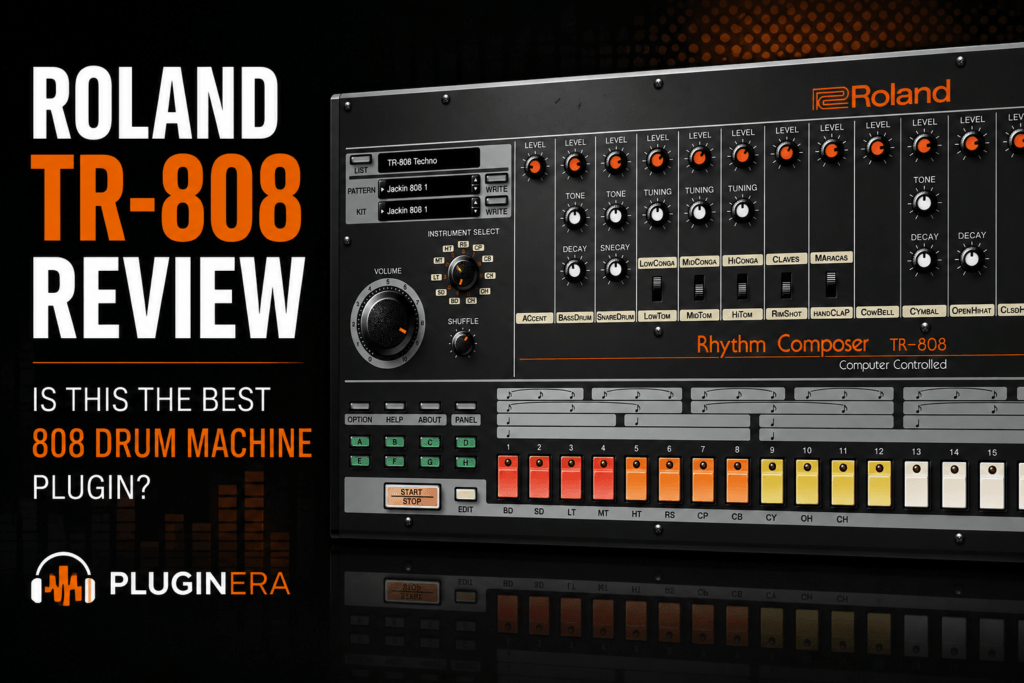
 Roland TR-808 Review: Is This the Best 808 Drum Machine Plugin?
Few drum machines have influenced modern music as much as the Roland TR-808.
Hip hop, R&B, trap, pop, electronic music, and countless subgenres have all been shaped by its booming bass drum, crisp handclaps, metallic cowbell, snappy snare, and instantly recognizable hi-hats.
The problem is that buying an original hardware TR-808 isn’t exactly practical for most producers.
That’s where the Roland TR-808 Software Rhythm Composer comes in.
Rather than simply giving you another collection of 808 samples, Roland recreated its legendary drum machine as a plugin using the company’s Analog Circuit Behavior (ACB) modeling technology.
Even better, Roland didn’t stop at recreating the original hardware. The software version adds features like an expanded sequencer, tuning controls, overdrive, pattern variations, drag-and-drop MIDI and audio, and deeper groove controls that make the classic 808 much easier to integrate into a modern DAW workflow.
But with thousands of 808 samples and drum plugins already available, is Roland’s official TR-808 plugin actually worth buying?
In this Roland TR-808 review, we’ll look at its sound, workflow, features, strengths, weaknesses, and whether it deserves a place in your production setup in 2026.
What Is the Roland TR-808 Software Rhythm Composer?
The Roland TR-808 Software Rhythm Composer is Roland’s official software recreation of the original TR-808 Rhythm Composer.
The original hardware appeared in the early 1980s and generated its drum sounds through analog synthesis rather than playing recorded drum samples.
That distinction is important.
When producers talk about an “808” today, they’re often referring specifically to a long, pitched sub-bass sound derived from the TR-808 bass drum.
But the original machine was an entire drum machine.
It included sounds such as:
- Bass drum
- Snare drum
- Low, mid, and high toms
- Congas
- Rim shot
- Claves
- Hand clap
- Maracas
- Cowbell
- Cymbal
- Open hi-hat
- Closed hi-hat
Roland’s plugin recreates this complete instrument inside your DAW.
Instead of relying exclusively on static recordings of the hardware, Roland uses ACB modeling to reproduce the behavior of the original analog circuitry.
The result is essentially Roland’s attempt to put an authentic TR-808 directly inside your computer while giving producers considerably more control than the vintage hardware offered.
Roland TR-808 at a Glance
The biggest features include:
- Official Roland TR-808 emulation
- Analog Circuit Behavior modeling
- Classic TR-REC style sequencing
- 11 instrument parts
- 16-step sequencing
- Eight variations per pattern
- Individual drum tuning controls
- Adjustable decay
- Internal overdrive
- Flams
- Sub-steps
- Soft hits
- Per-instrument shuffle
- Per-instrument last-step controls
- Drag-and-drop MIDI
- Drag-and-drop audio
- Individual gain and pan controls
- Multiple outputs
- TR-8S and TR-08 hardware integration
- VST3, AU, and AAX support
It’s therefore more than a virtual copy of vintage hardware.
Roland has taken the fundamental TR-808 concept and adapted it for modern production.
The Sound: Does It Actually Sound Like an 808?
This is arguably the most important part of the review.
And the Roland TR-808’s biggest advantage is simple:
Roland made the original machine.
The plugin uses Roland’s proprietary Analog Circuit Behavior technology to model the circuitry responsible for the original TR-808 sound.
That gives the plugin a different philosophy from simply loading a folder containing hundreds of recorded 808 samples.
You get the familiar character of the machine while retaining the ability to manipulate the individual drum sounds.
The Bass Drum
Naturally, the bass drum is the star.
The classic 808 kick has a deep, rounded low end capable of working as either a traditional kick or an almost bass-like element.
Inside the plugin, you can adjust parameters including tuning and decay, giving you much more flexibility than you might expect from a vintage drum machine recreation.
Shorten the decay and you can create a tighter kick.
Lengthen it and the sound begins moving toward the sustained 808 bass tones associated with modern hip hop and trap.
Tuning also becomes especially useful when incorporating the kick into melodic productions.
Instead of searching through sample folders hoping to find an 808 that matches your track, you can shape the sound directly inside the plugin.
The Snare and Clap
The TR-808 snare isn’t designed to sound like a realistic acoustic snare.
That’s exactly why it works.
It has the synthetic snap that became part of the identity of early hip hop and electronic music.
The hand clap is equally recognizable.
Layer it with the snare and you can quickly create classic 808 backbeats. Use it alongside modern samples and it becomes an excellent texture layer for contemporary hip hop and R&B drums.
Hi-Hats and Cymbals
The metallic hi-hats are another major part of the 808 sound.
They can work especially well for:
- Hip hop
- R&B
- Trap
- Trap Soul
- Electro
- House
- Pop
- Synthwave
- Retro-inspired production
The software sequencer’s sub-step controls make them significantly more flexible for contemporary production.
You’re not limited to basic old-school patterns.
You can create faster subdivisions and detailed rhythmic sequences without abandoning the character of the original machine.
Don’t Forget the Cowbell
Yes, it’s that cowbell.
The TR-808 cowbell might be one of the most recognizable percussion sounds ever created.
It can immediately push a production toward an old-school hip-hop or electro aesthetic, but it can also be used much more subtly.
And because the plugin allows additional sound manipulation, you’re not necessarily stuck with one rigid interpretation of the sound.
ACB Modeling vs. 808 Samples
This is one of the biggest reasons to consider the Roland TR-808.
You can find thousands of free 808 samples online.
So why pay for a plugin?
Because samples and modeled drum machines provide different workflows.
A sample is essentially a snapshot.
You load the sound and manipulate that recording.
The Roland TR-808 instead models the instrument responsible for generating the sound.
That gives you a more interactive experience.
You can adjust the characteristics of the drum sounds while working with a workflow designed around the actual TR-808.
For producers who only need an occasional 808 kick, a sample library may be perfectly adequate.
But if you regularly build drums around the 808 sound, having the complete instrument available inside your DAW can be much more useful.
The Expanded TR-808 Sequencer
One of my favorite things about Roland’s approach is that it doesn’t force you to choose between vintage authenticity and modern convenience.
The classic TR-REC step sequencing workflow is still here.
But Roland expands it with dedicated lanes for the different drum instruments.
That makes building patterns much faster visually.
You can quickly see where your:
- Kicks
- Snares
- Claps
- Hats
- Percussion
are landing.
For producers accustomed to piano rolls and modern drum sequencers, this expanded interface makes the 808 workflow easier to understand without completely abandoning what made the hardware special.
Eight Pattern Variations
Each pattern can contain eight variations labeled A through H.
This is extremely useful for creating arrangements.
Instead of programming one four-bar drum loop and letting it repeat throughout your entire beat, you can create variations.
For example:
Variation A: Main verse groove
Variation B: Verse groove with additional hi-hats
Variation C: Chorus pattern
Variation D: Chorus fill
Variation E: Breakdown
Variation F: Percussion-heavy section
Variation G: Transition
Variation H: Ending fill
Suddenly the plugin becomes more than a drum sound generator.
It becomes a beat-arrangement tool.
And for hip-hop and R&B producers, that’s valuable because small drum variations can make a repetitive instrumental feel significantly more dynamic.
Flams, Sub-Steps, and Soft Hits
Roland has also added sequencing features that go beyond the capabilities of the original hardware.
Flams
Flams allow closely spaced hits that can make snares and percussion feel more expressive.
Sub-Steps
Sub-steps let you divide steps into smaller rhythmic values.
This becomes especially useful for modern hi-hat programming.
You can create:
- Hat rolls
- Percussion rolls
- Ratcheting effects
- Fast fills
without leaving the TR-808 sequencer.
Soft Hits
Soft hits give you another level of dynamics.
That can help avoid the mechanical feeling that sometimes comes from programming every drum hit at exactly the same intensity.
Per-Instrument Shuffle
Another surprisingly powerful feature is per-instrument shuffle.
Rather than applying the exact same swing setting to the entire drum pattern, different instruments can have different timing behavior.
You could keep the kick relatively straight while adding more swing to the hats or percussion.
That can dramatically change the feel of a groove.
For R&B and laid-back hip hop especially, subtle timing differences can be the difference between drums that sound programmed and drums that actually groove.
Per-Instrument Last Step
Roland also lets individual instruments use their own last-step settings.
This opens the door to polyrhythmic and evolving patterns.
For example, your main kick and snare pattern might follow the traditional 16-step structure while a percussion sound cycles through a shorter sequence.
As the patterns overlap, the relationship between the instruments continually changes.
You don’t necessarily need this feature for everyday hip-hop production, but experimental producers can get surprisingly creative with it.
Internal Overdrive
The original TR-808 is famous for relatively clean analog drum sounds.
Modern production often calls for something more aggressive.
Roland therefore lets you overdrive the modeled internal circuitry.
This is a great addition.
Instead of immediately reaching for an external saturation plugin, you can introduce additional grit and harmonic character directly from the TR-808.
Push it lightly for warmth.
Push it harder for more aggressive drums.
For modern hip hop, trap, and electronic production, this dramatically expands the plugin’s sonic range.
Drag-and-Drop MIDI and Audio
This might be one of the most useful modern workflow features.
Once you’ve created a pattern, you can drag MIDI or audio directly from the TR-808 into your DAW.
That’s huge.
You can build your groove using the TR-808’s sequencer and then transfer it into your main project.
Dragging MIDI gives you additional editing flexibility.
Dragging audio allows you to commit to the sound and continue arranging.
It effectively lets you use the TR-808 as a self-contained groovebox without trapping your patterns inside the plugin.
Individual Outputs
Producers who like detailed mixing will appreciate the ability to route drum instruments separately.
Instead of processing the entire 808 kit through one channel, you can treat individual elements differently.
For example:
Kick
- EQ
- Saturation
- Compression
- Clipping
Snare
- EQ
- Reverb
- Transient shaping
Hi-Hats
- High-pass filtering
- Stereo processing
- Saturation
Clap
- Reverb
- Delay
- Width
This becomes particularly useful when combining the vintage TR-808 sound with a modern mix.
You can keep the character of the drum machine while processing every element according to the needs of your track.
Roland TR-808 for Hip Hop
Hip-hop producers are probably among the most obvious candidates for this plugin.
The TR-808 is embedded in the history of the genre.
But you aren’t limited to making retro beats.
You can use the plugin for:
- Boom bap
- Trap
- Trap Soul
- Southern hip hop
- Alternative hip hop
- Lo-fi hip hop
- Experimental hip hop
One interesting approach is combining the TR-808 with modern drum samples.
Use Roland’s 808 kick as the low-end foundation, then layer a modern kick transient over it.
Layer the snare with a contemporary snare.
Use the authentic hats underneath modern percussion.
That gives you some of the character of the classic drum machine without forcing the entire production into a vintage aesthetic.
Roland TR-808 for R&B
The TR-808 can be equally useful for R&B.
For modern R&B and Trap Soul, try using:
- Long 808 kicks
- Sparse snares
- Soft claps
- Swinging hi-hats
- Minimal percussion
The key is often restraint.
You don’t need every sound playing simultaneously.
A carefully tuned 808 kick, snare, closed hat, and occasional percussion hit can provide enough rhythmic foundation for chords, vocals, bass, and atmospheric textures to breathe.
This is an area we’ll explore much further in our How to Make Hip Hop & R&B Beats with the Roland TR-808 guide.
TR-808 Hardware Integration
Roland has another advantage for producers who own its hardware.
The software TR-808 integrates with the Roland TR-8S Rhythm Performer and Roland TR-08.
Compatible hardware can provide hands-on control of the plugin, and TR-8S patterns can be transferred between the hardware and software environment.
This obviously won’t matter to everyone.
But if you’re already invested in Roland’s ecosystem, the integration makes the software considerably more appealing.
What I Like About the Roland TR-808
There is a lot to like here.
1. It’s Roland’s Official Recreation
There are countless 808-inspired products available, but this one comes directly from the company responsible for the original instrument.
2. ACB Modeling
The modeled approach gives you the experience of manipulating an instrument rather than simply browsing static samples.
3. Modern Sound Controls
Tuning, decay, gain, pan, and overdrive make the 808 much easier to adapt to contemporary productions.
4. Excellent Sequencer
The expanded step sequencer maintains the classic workflow while making programming easier.
5. Eight Variations
Being able to create multiple versions of a pattern encourages better arrangement.
6. Drag-and-Drop
Moving MIDI and audio into your DAW is extremely convenient.
7. Great for Hip Hop and R&B
Few drum machines have a stronger connection to these genres.
What Could Be Better?
No plugin is perfect.
Roland Cloud Installation and Authentication
The plugin operates through Roland’s software ecosystem, and an internet connection is required for authentication.
Some producers will have no problem with this.
Others may prefer plugins with simpler standalone installers and authorization systems.
It’s More Specialized Than a Modern Drum Workstation
The TR-808 isn’t trying to give you thousands of acoustic kits, cinematic percussion libraries, or endless sample browsing.
It’s an 808.
That’s the appeal.
But if you want one drum plugin to cover virtually every possible style, there are broader options available.
You May Already Have Plenty of 808 Samples
If you already own a massive collection of high-quality 808 samples and prefer programming everything directly inside your DAW, you may not need this plugin.
The value comes from wanting the instrument, sound-shaping capabilities, and sequencing workflow, rather than simply wanting another 808 kick.
Roland TR-808 Pros and Cons
Pros
- Official Roland TR-808 recreation
- Authentic ACB circuit modeling
- Legendary 808 drum sounds
- Excellent bass drum
- Adjustable tuning and decay
- Internal overdrive
- Expanded step sequencer
- Eight pattern variations
- Flams, sub-steps, and soft hits
- Individual shuffle controls
- Individual last-step controls
- Drag-and-drop MIDI and audio
- Individual drum routing
- Excellent for hip hop, R&B, trap, and electronic music
- TR-8S and TR-08 integration
Cons
- Roland Cloud authentication won’t appeal to everyone
- More specialized than an all-purpose drum workstation
- Producers with extensive 808 sample collections may find some overlap
- Overkill if you only need an occasional 808 kick
System Requirements
The Roland TR-808 supports modern plugin formats including:
- VST3
- AU
- AAX
Roland currently lists Windows 10 64-bit or later and macOS 11 or later among the supported operating-system requirements.
The plugin requires approximately 400 MB of storage, at least 2 GB of RAM, and an internet connection for authentication.
As always, check the latest compatibility information before purchasing, particularly if you’re running a newly released operating system or DAW version.
Who Should Buy the Roland TR-808?
I’d recommend considering the TR-808 if you’re a:
- Hip-hop producer
- R&B producer
- Trap producer
- Trap Soul producer
- Pop producer
- Electronic producer
- Synthwave producer
- Vintage drum-machine enthusiast
- Roland hardware owner
- Producer who wants more control than static 808 samples provide
It’s particularly compelling if the 808 sound is a regular part of your production style.
Who Should Skip It?
You may want to skip it if you:
- Rarely use electronic drums
- Only need an occasional 808 bass sample
- Already have an 808 sample workflow you love
- Want a massive multi-kit drum workstation
- Prefer avoiding software ecosystems that require online authentication
In those situations, a good collection of 808 samples might already provide everything you need.
Is the Roland TR-808 Worth It in 2026?
The Roland TR-808 isn’t valuable simply because it gives you access to an 808 kick.
You can find those everywhere.
Its real appeal is giving you an officially modeled TR-808 instrument with the sound, controls, sequencing philosophy, and character of the original machine while adding conveniences designed for modern DAW production.
The expanded sequencer is excellent.
The ability to tune and shape individual sounds makes the instrument considerably more versatile.
Sub-steps and flams help bridge the gap between vintage and contemporary drum programming.
And drag-and-drop MIDI and audio make it easy to incorporate the plugin into practically any production workflow.
For producers making hip hop, R&B, trap, or electronic music, that’s a compelling combination.
Final Verdict
The Roland TR-808 Software Rhythm Composer succeeds because Roland didn’t simply recreate an old drum machine and stop there.
It preserves the identity of the TR-808 while removing many of the limitations that would make vintage hardware inconvenient inside a modern studio.
You get the classic kick, snare, clap, hats, cowbell, percussion, and cymbal sounds alongside deeper editing, an expanded sequencer, pattern variations, overdrive, flexible groove controls, and DAW integration.
Pluginera Rating: 9.2/10
Sound: 9.5/10
Features: 9/10
Workflow: 9/10
Versatility: 8.5/10
Value: 9/10
Bottom Line
If you’re looking for random 808 samples, you don’t need the Roland TR-808.
If you want an authentic, customizable TR-808 living inside your DAW, this is one of the most compelling ways to get it.
For hip-hop and R&B producers in particular, the combination of history, sound, sequencing, and modern workflow makes the Roland TR-808 much more than a nostalgia plugin.
Check the latest Roland TR-808 price and availability at Plugin Boutique.
Disclosure: This article may contain affiliate links. If you purchase through one of our links, Pluginera may earn a commission at no additional cost to you.