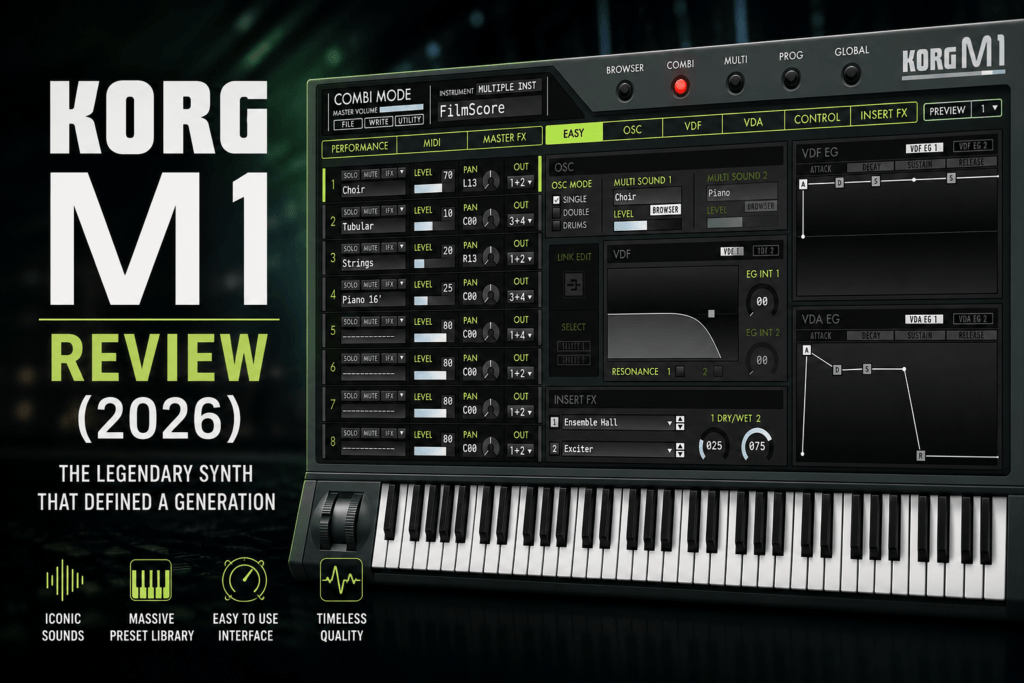
 KORG M1 Review: Is This Legendary Synth Plugin Still Worth Buying?
The KORG M1 isn’t just another virtual instrument—it’s one of the most iconic synthesizers ever created. Originally released in 1988, the hardware M1 became the best-selling synthesizer of its era, shaping the sound of pop, R&B, house, hip-hop, gospel, and film scores for decades.
Today, the software version included in the KORG Collection faithfully recreates the original instrument while adding modern workflow improvements, making it easier than ever for today’s producers to access its legendary sounds.
But with countless modern synths like Serum, Omnisphere, Nexus, and Pigments available, does the KORG M1 still deserve a place in your plugin library?
After spending time exploring its sounds and capabilities, here’s why this classic continues to earn its legendary reputation.
What Is the KORG M1?
The KORG M1 is a virtual recreation of KORG’s groundbreaking workstation synthesizer. Unlike many modern synths that focus heavily on sound design, the M1 is built around an extensive collection of professionally crafted presets that are instantly playable.
The software version includes:
- The original M1 factory sounds
- Every official expansion card
- More than 3,300 presets
- Modern preset browsing
- High-resolution interface
- DAW integration
- Enhanced polyphony
Rather than trying to reinvent the instrument, KORG has preserved the sound that made the original a global success while making it much more convenient to use inside today’s production environments.
Key Features
Over 3,300 Classic Sounds
One of the biggest reasons producers continue using the M1 is its massive sound library.
You’ll find:
- Pianos
- Electric pianos
- Organs
- Strings
- Choirs
- Pads
- Basses
- Bells
- Synth leads
- Brass
- Sound effects
- World instruments
Many of these sounds became staples of hit records throughout the late ’80s and ’90s.
The Legendary M1 Piano
If you’ve listened to classic house music, gospel, or R&B, you’ve almost certainly heard the famous M1 Piano.
Its bright, punchy character became one of the defining keyboard sounds of an entire generation.
Even today, producers continue reaching for it because it cuts through dense mixes incredibly well.
Iconic Organ Sounds
The M1’s organ presets remain favorites among gospel musicians, R&B producers, and pop composers.
Layered with modern synths, they still sound surprisingly fresh.
Classic Pads
Few synthesizers create lush atmospheric textures quite like the M1.
Its evolving pads remain perfect for:
- R&B intros
- Trap melodies
- Ambient music
- Pop productions
- Film scoring
They instantly create depth without overwhelming a mix.
Fast Workflow
Unlike many modern synthesizers that require extensive programming, the M1 emphasizes speed.
Browse.
Load a preset.
Play.
Within seconds, you can find inspiring sounds that fit your production.
For beat makers trying to stay creative, this workflow is incredibly valuable.
Sound Quality
Considering the original hardware was released nearly four decades ago, the M1 still sounds remarkably musical.
Its sounds possess a character that’s difficult to recreate using modern wavetable synthesis.
Instead of sounding overly polished or clinical, they carry a nostalgic warmth that instantly evokes classic records while blending surprisingly well with contemporary productions.
Many producers intentionally combine M1 presets with modern synths to create unique textures.
Perfect for Beat Makers
Although the M1 wasn’t originally designed specifically for hip-hop, today’s beat makers can get tremendous value from it.
It’s especially useful for:
- Trap Soul
- R&B
- Neo Soul
- Lo-fi Hip-Hop
- Boom Bap
- Gospel
- Pop
- House
- Afrobeats
The presets layer beautifully with modern sounds, helping producers create tracks that feel both vintage and contemporary.
Modern Improvements
KORG didn’t simply emulate the original hardware.
They improved it in several important ways.
Larger Polyphony
More simultaneous voices allow complex arrangements without note stealing.
Scalable Interface
The plugin looks much cleaner on today’s high-resolution monitors.
Preset Browser
Finding sounds is significantly faster than navigating the original hardware.
DAW Integration
Everything saves directly with your project.
No external hardware required.
Pros
✅ Faithful recreation of the legendary hardware
✅ Over 3,300 presets included
✅ Famous M1 Piano and Organ sounds
✅ Excellent pads and atmospheric textures
✅ Beginner-friendly workflow
✅ CPU efficient
✅ Great value inside the KORG Collection
Cons
❌ Limited deep sound design compared to modern synths
❌ Interface feels simple compared to newer instruments
❌ Some sounds show their age without layering
❌ Focuses more on presets than synthesis
KORG M1 vs Modern Synth Plugins
Modern synthesizers like Serum or Pigments offer virtually unlimited sound design possibilities.
The M1 takes a different approach.
Its strength isn’t endless modulation or complex wavetable manipulation—it’s delivering instantly recognizable, production-ready sounds that have already proven themselves on thousands of records.
Think of it as a timeless preset machine rather than an experimental sound-design playground.
For many producers, that’s exactly what makes it so valuable.
Is the KORG M1 Good for Beginners?
Absolutely.
Because the M1 relies heavily on presets, it’s incredibly approachable for producers who don’t yet feel comfortable designing sounds from scratch.
Instead of spending hours tweaking oscillators and modulation matrices, you can focus on writing melodies, chords, and complete songs.
As your skills grow, the M1 remains useful as a reliable source of inspiring sounds that can be layered with more advanced instruments.
Who Should Buy the KORG M1?
The KORG M1 is an excellent choice for:
- Beat makers
- Hip-hop producers
- R&B producers
- Pop producers
- Gospel musicians
- House producers
- Film composers
- Keyboard players
- Vintage synth enthusiasts
- Anyone building the KORG Collection
If you love classic keyboard sounds that have stood the test of time, the M1 still delivers exceptional value.
Final Verdict
The KORG M1 has earned its place in music history, and the software version proves that great sounds never go out of style. While it may not offer the advanced synthesis capabilities of today’s flagship instruments, it excels where it matters most: inspiring creativity with instantly recognizable, musical presets.
Whether you’re producing soulful R&B, hard-hitting hip-hop, nostalgic house tracks, or cinematic scores, the M1 offers timeless sounds that continue to work in modern productions. Its famous piano, lush pads, expressive organs, and enormous preset library make it a versatile addition to any producer’s toolkit.
For producers looking to add a piece of music history to their DAW, the KORG M1 remains one of the best vintage synth plugins available.
Overall Rating: ⭐⭐⭐⭐⭐ (5/5)
Bottom Line: The KORG M1 isn’t just a classic—it’s a timeless instrument. If you’re looking for authentic vintage sounds with modern convenience, it’s still one of the best synth plugins you can buy in 2026.