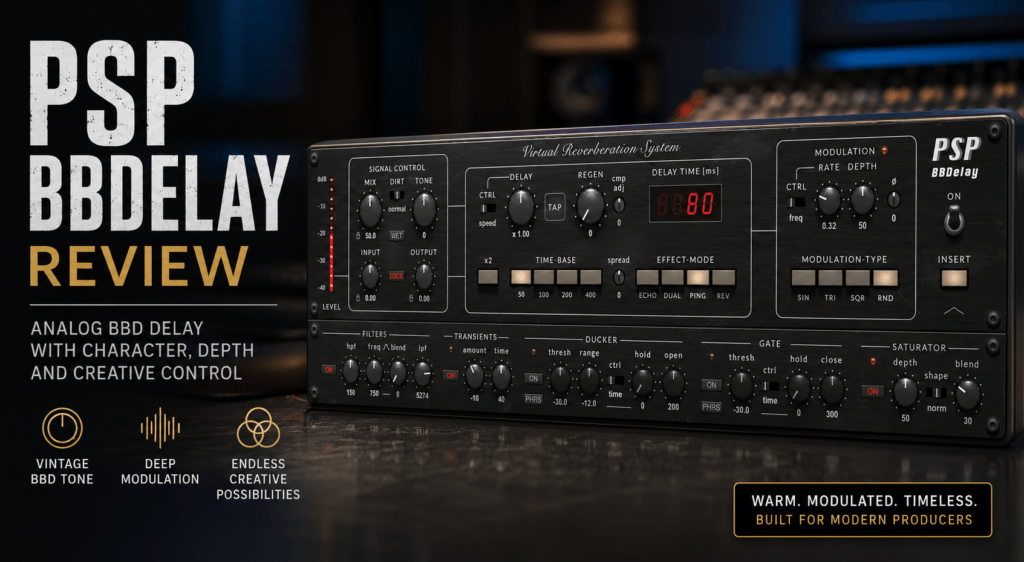
Delay plugins are everywhere, but many of them are designed to sound clean, precise, and predictable. PSP BBDelay takes the opposite approach. This analog-inspired delay and ambience processor is built to recreate the warmth, movement, instability, and character associated with classic bucket-brigade delay hardware.
Instead of simply repeating your audio, PSP BBDelay can reshape each echo with modulation, saturation, filtering, transient control, ducking, gating, and analog-style imperfections. That makes it more than a basic delay plugin. It can function as a vintage echo, stereo-widening effect, atmospheric ambience processor, rhythmic sound-design tool, or creative effect for completely transforming a sound.
But does PSP BBDelay offer enough to stand out from the many delay plugins already available? In this PSP BBDelay review, we will examine its sound, features, workflow, strengths, weaknesses, and whether it deserves a place in your music-production setup.
What Is PSP BBDelay?
PSP BBDelay is an analog-inspired delay plugin developed by PSP Audioware. Its sound is based around the character of classic bucket-brigade device, or BBD, chips.
Traditional BBD delays are known for producing repeats that become progressively darker, noisier, and less perfect as they feed back into the circuit. Those imperfections are a major part of their appeal. Instead of creating sterile digital echoes, they add warmth, motion, and texture.
PSP BBDelay models individual BBD chips, compander behavior, and analog circuit irregularities to make the repeats feel more organic. The plugin can produce traditional vintage-style echoes, but its expanded controls allow it to move far beyond the limitations of original analog hardware.
PSP BBDelay’s Sound
The main attraction of PSP BBDelay is its character.
Clean digital delays can sometimes feel disconnected from the original sound. PSP BBDelay’s repeats tend to blend into the mix more naturally because they gradually change in tone, texture, and intensity.
This can be especially useful on vocals, keyboards, guitars, synthesizers, percussion, and melodic loops. A small amount of BBDelay can add width and depth without making the source sound like it has been placed inside an obvious digital echo effect.
The plugin can also become aggressive and experimental. Increasing the dirt, saturation, modulation, feedback, and filtering can turn simple notes into unstable textures, swirling ambience, distorted echoes, and evolving soundscapes.
For hip-hop, R&B, trap soul, lo-fi, synthwave, and electronic music, that combination of warmth and movement can be extremely useful.
Delay and Ambience Modes
PSP BBDelay includes four main operating modes:
- Mono
- Dual Mono
- Ping-Pong
- Reverb
These modes allow the plugin to cover several different mixing and sound-design roles. Mono mode works well for focused echoes, while ping-pong mode creates movement across the stereo field. Dual Mono provides greater independence between the left and right channels.
The Reverb mode is especially interesting because it allows BBDelay to move beyond clearly defined repeats and create a denser ambience. This can be useful for softening synths, adding space behind vocals, or turning short musical phrases into atmospheric textures.
Flexible Delay Timing
PSP BBDelay supports delay times of up to 800 milliseconds, with a doubled mode extending the maximum time to 1,600 milliseconds.
You can adjust the timing freely or synchronize the repeats with your DAW’s tempo. The analog-style delay-speed control also allows the timing to shift smoothly rather than instantly jumping between values.
That smooth behavior is important for creative automation. Automating the delay time can produce pitch dives, warped transitions, tape-stop-like movements, and unstable effects that would be difficult to achieve with a completely rigid digital delay.
Modulation and Stereo Movement
Modulation is one of the biggest reasons to choose BBDelay over a basic stock delay.
The plugin includes four modulation waveforms with multiple synchronization options. Modulation can gently move the pitch and timing of the repeats, helping them feel wider and more alive.
PSP BBDelay also includes adjustable BBD chip spread. This can widen the stereo image by introducing variation between the modeled delay chips.
On pads, electric pianos, background vocals, guitars, and synthesizer chords, subtle chip spread can create width without relying on a separate chorus or stereo-imaging plugin. More extreme settings can produce unstable, psychedelic movement.
Analog Dirt and Saturation
BBDelay offers three analog dirt modes, each providing progressively stronger coloration. It also includes analog-style saturation with multiple response curves.
These features allow you to control how polished or degraded the echoes become. At mild settings, the saturation can help the delay sit behind the dry signal. At more aggressive settings, it can turn the feedback path into a distorted effect of its own.
This is one of the areas where PSP BBDelay feels different from a typical digital delay. The imperfections are not simply added as decoration. They are integrated into the behavior of the echoes, so the repeats can evolve each time they pass through the feedback path.
Built-In Transient Shaping
An integrated transient processor allows you to adjust the attack characteristics of each repeat.
This is a surprisingly useful feature. Delay repeats can sometimes feel too sharp, particularly on drums, plucked instruments, or percussive synthesizer patches. Softening the transient helps the repeats move behind the original sound.
Alternatively, emphasizing the transient can make the echoes more rhythmic and noticeable. This could be effective on percussion loops, hi-hats, claps, synth plucks, and sound effects.
Because the transient processing happens inside the delay effect, you can shape the echoes without changing the attack of the dry source.
Ducking and Gating
PSP BBDelay includes both a built-in ducker and an integrated gate.
Ducking reduces the level of the delay while the original signal is present. When the source becomes quieter, the repeats rise back into the mix. This is particularly useful for vocals because it helps maintain clarity while still allowing long, expressive delay tails.
The gate opens additional creative possibilities. It can tighten the delay, produce rhythmic patterns, or make ambient effects stop and start in more unusual ways.
These tools reduce the need to create complicated sidechain routing or place additional processors after the delay.
Feedback-Path Tone Shaping
BBDelay includes high-pass, low-pass, and resonant filtering inside the feedback path.
Filtering the feedback is essential for controlling how a delay develops. Rolling off high frequencies makes each repeat darker and more vintage. Removing low frequencies prevents the delay from muddying the mix.
The resonant filtering can also be pushed creatively. You can emphasize a narrow area of the frequency spectrum, causing the delay to become progressively more tonal and pronounced as it feeds back.
This makes PSP BBDelay suitable for subtle mixing duties as well as more dramatic sound-design work.
Preset Browser and Workflow
Despite its extensive processing options, PSP BBDelay includes several workflow features intended to make experimentation easier.
The preset browser supports favorites, user-default presets, A/B comparison, and Undo and Redo. These tools are valuable because BBDelay has enough controls that it can be easy to move far away from a good setting while experimenting.
A/B comparison allows you to test two different delay treatments without manually saving and recalling each version. Undo and Redo also encourage more aggressive experimentation because you can quickly return to an earlier setting.
Best Uses for PSP BBDelay
PSP BBDelay can work on almost any source, but it appears particularly well suited to:
Vocals
Use tempo-synchronized delays with ducking to create spacious vocal echoes that remain out of the way while the singer or rapper is performing.
Electric Pianos
A short, dark delay can add width and movement to Rhodes-style chords without washing them out.
Synthesizers
Modulation, chip spread, dirt, and feedback filtering can transform basic synthesizer patches into evolving textures.
Guitars
BBDelay can create vintage echoes, modulated ambience, and saturated feedback effects that complement clean or distorted guitars.
Drums and Percussion
The transient processor and gate make the plugin useful for creating rhythmic echoes and unusual percussion patterns.
Transitions and Sound Design
Automating the delay time, feedback, dirt, and filtering can create pitch dives, risers, breakdown effects, and unstable transitions.
Pros
- Warm, analog-inspired BBD character
- Highly flexible modulation controls
- Mono, Dual Mono, Ping-Pong, and Reverb modes
- Built-in ducking and gating
- Integrated transient shaping
- Adjustable analog dirt and saturation
- Useful filtering inside the feedback path
- Capable of subtle mixing and extreme sound design
- Up to 1,600 milliseconds of delay time
- Zero added latency on the dry signal
Cons
- The number of controls may feel overwhelming to beginners
- Producers wanting an extremely clean delay may prefer a simpler digital option
- iLok License Manager is required
- The vintage character may not be appropriate for every source
- The listed macOS compatibility information should be checked carefully by users running newer operating-system versions
System Requirements
On Windows, PSP BBDelay supports Windows 7 through Windows 11 and is available in VST, VST3, and AAX formats.
On Mac, the product page lists support for macOS 10.14 through macOS 13 Ventura, with Apple Silicon support. Mac formats include VST, VST3, AAX, and AU.
The latest version of iLok License Manager is required for activation on both platforms. Because the listed Mac operating systems do not include more recent macOS releases, users should confirm current compatibility with PSP Audioware before purchasing.
Is PSP BBDelay Worth It?
PSP BBDelay is worth considering for producers who want delay to contribute more than basic echoes.
Its strongest advantage is the way it combines authentic analog-inspired behavior with modern control. You can quickly create warm vintage repeats, but you can also shape the transients, duck the delay behind a vocal, gate it rhythmically, widen it with chip variation, distort the feedback, or turn it into a dense ambience.
That versatility makes BBDelay particularly valuable for producers working in R&B, hip-hop, trap soul, lo-fi, synthwave, electronic music, ambient music, and other styles where texture and movement matter.
However, producers who only need a quick, transparent tempo-synced delay may not use its deeper features. PSP BBDelay makes the most sense for people who enjoy shaping effects and treating delay as part of the sound-design process.
Final Verdict
PSP BBDelay successfully captures the warmth and instability that make classic bucket-brigade delays appealing while adding the flexibility expected from a modern plugin.
The modulation, analog dirt, saturation, transient shaping, ducking, gating, stereo spread, and feedback filtering make it much more powerful than a straightforward vintage-delay emulation. It can remain subtle enough for everyday mixing or become an aggressive creative processor when pushed.
For producers who want analog character, evolving repeats, and deep control over their delay effects, PSP BBDelay is an impressive and versatile option.
Overall Rating: 9/10
PSP BBDelay is not simply another delay plugin. It is a detailed ambience and sound-design processor capable of adding warmth, depth, movement, and personality to nearly any production.