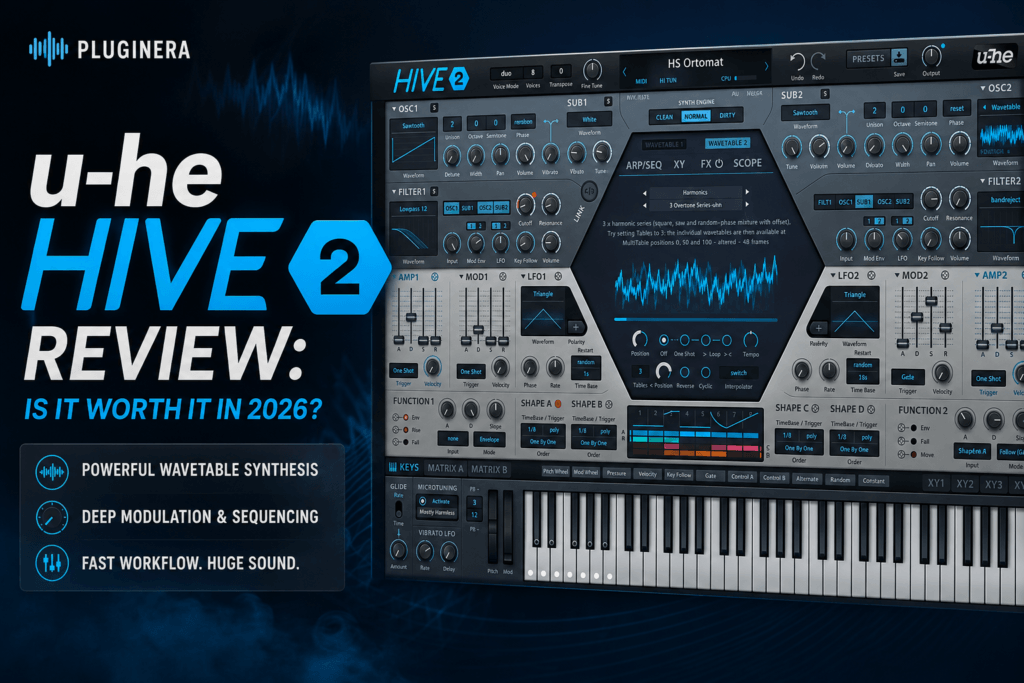
 If you’re looking for a software synthesizer that can handle everything from warm pads and atmospheric textures to aggressive basses, bright plucks, and modern leads, u-he Hive 2 deserves a serious look.
Hive 2 is a virtual synthesizer from u-he, the company behind popular instruments such as Diva and Repro. While those synths lean heavily into analog-style character, Hive 2 takes a more modern approach.
It combines traditional subtractive synthesis with wavetable capabilities, extensive modulation, sequencing, effects, and powerful unison options — all while emphasizing a fast workflow and efficient CPU performance.
That combination makes Hive 2 particularly interesting for producers working in Hip Hop, R&B, Trap, Pop, Synthwave, EDM, and other synth-heavy genres.
But with so many powerful software synths available today, is Hive 2 still worth adding to your collection?
In this u-he Hive 2 review, we’ll look at its sound, workflow, features, presets, strengths, weaknesses, and how useful it can actually be in a modern production setup.
What Is u-he Hive 2?
Hive 2 is a software synthesizer built around a streamlined dual-oscillator architecture.
At first glance, the interface is considerably less intimidating than some of the deeper wavetable and modular-style synthesizers on the market. But underneath that relatively straightforward layout is a surprisingly capable synthesis engine.
Hive 2 includes:
- Two main oscillator sections
- Wavetable capabilities
- Multiple synth engine characters
- Up to 16× unison per oscillator
- Dual multimode filters
- Extensive modulation
- Shape sequencer
- Arpeggiator and sequencer
- Built-in effects
- Large preset library
- Flexible modulation routing
The result is a synth that can work equally well when you want to quickly browse presets or spend time designing sounds from scratch.
That balance is one of Hive 2’s biggest strengths.
Hive 2’s Three Synth Engines
One of the most interesting features in Hive 2 is the ability to switch between three different synth engine characters:
Normal
This is the balanced option and a good starting point for general sound design.
Dirty
As the name suggests, Dirty can introduce a more aggressive and characterful sound. It can be particularly useful for basses, leads, distorted textures, and sounds that need additional attitude.
Clean
Clean provides a smoother and more precise character that can work particularly well for polished pads, plucks, keys, and modern electronic textures.
These aren’t simply preset categories. Changing the engine affects aspects of how Hive behaves and gives you another way to shape the overall personality of a patch.
For producers, this means you can often change the character of a sound before reaching for additional processing.
Oscillators and Wavetable Synthesis
Hive 2 gives you two primary oscillator sections capable of producing traditional waveforms as well as wavetable-based sounds.
This is where Hive becomes much more than a straightforward subtractive synth.
Wavetables allow sounds to evolve over time instead of remaining static. By modulating wavetable positions and other parameters, you can create movement that works extremely well for:
- Atmospheric pads
- Evolving textures
- Modern basses
- Synth leads
- Plucks
- Ambient sounds
- Sound effects
For Hip Hop and R&B producers, you don’t necessarily need to dive deeply into wavetable programming to benefit from it.
Even subtle movement can make a chord progression feel more alive.
For example, take a relatively simple pad patch and slowly modulate its wavetable position. Add filtering, reverb, and a little modulation, and suddenly a four-chord progression can have considerably more movement without adding additional instruments.
Massive Unison Sounds
Hive 2 can use up to 16 voices of unison per oscillator, making it capable of producing extremely wide sounds.
This is particularly useful for genres such as:
- Synthwave
- EDM
- Pop
- Trap
- R&B
- Cinematic music
But bigger isn’t always better.
For Hip Hop and R&B production, I would usually use Hive’s unison more selectively.
A slightly detuned pluck or pad can provide width without dominating the entire mix. Save the massive supersaw-style patches for moments where you actually want the synthesizer to become the centerpiece.
Having that flexibility is what matters.
Hive can go from relatively restrained sounds to enormous stereo patches very quickly.
Filters
Hive 2 includes two multimode filters that provide another major layer of sound shaping.
You can use the filters to tame bright oscillators, create darker atmospheric patches, build resonant sweeps, or dramatically reshape a wavetable sound.
For beat production, filtering is particularly valuable.
A bright preset might sound impressive when auditioned by itself but become overwhelming once drums, vocals, bass, and additional instrumentation are added.
Instead of immediately abandoning the sound, try reducing the filter cutoff.
Sometimes that is all it takes to turn an overly aggressive preset into a usable background texture.
This is especially useful when producing R&B and Trap Soul, where darker and more restrained sounds often leave more room for vocals.
Modulation Is Where Hive 2 Gets Serious
Hive 2 might look relatively straightforward, but its modulation system gives sound designers plenty of room to experiment.
You have access to envelopes, LFOs, modulation routing, and Hive’s Shape Sequencer.
The Shape Sequencer is especially interesting because it allows you to create complex modulation patterns that can add rhythmic movement to sounds.
You could use modulation to control:
- Filter cutoff
- Pitch
- Wavetable position
- Volume
- Effects
- Panning
- Oscillator parameters
This opens the door to patches that evolve and move without requiring constant automation inside your DAW.
For producers who like atmospheric Hip Hop or experimental R&B, this can become an excellent source of inspiration.
The Arpeggiator and Sequencer
Hive 2 also includes sequencing tools that can quickly turn simple chords into more complex musical ideas.
This is one area where the synth becomes particularly useful for beatmakers.
You could play a basic minor seventh chord and use Hive’s sequencing capabilities to transform it into a rhythmic melodic pattern.
That can be great for:
- Trap melodies
- R&B arpeggios
- Synthwave sequences
- Pop hooks
- Background textures
- Electronic percussion-style synth patterns
Instead of programming every note manually, you can use Hive to generate movement and then build the rest of the beat around it.
Hive 2 Presets
Not every producer wants to build every sound from scratch.
And you shouldn’t have to.
Hive 2 includes a substantial factory library covering a wide variety of sounds.
You’ll find patches suitable for:
- Bass
- Leads
- Pads
- Plucks
- Keys
- Arpeggios
- Sequences
- Effects
- Atmospheric textures
The preset browser makes Hive especially useful when you’re trying to work quickly.
For beatmakers, this is important.
Sound design can be fun, but spending 45 minutes creating a patch isn’t always the best move when you’re trying to finish a beat.
Sometimes you need to find an inspiring sound, tweak it, and keep producing.
Hive 2 works very well for that workflow.
How Does Hive 2 Sound?
Hive 2 sounds modern, polished, and extremely flexible.
It doesn’t necessarily have the same obvious vintage analog personality as something like u-he Diva or Repro.
That’s not really what Hive is trying to do.
Hive feels more like a production workhorse.
It can create clean digital sounds, huge supersaws, aggressive basses, soft pads, evolving textures, bright plucks, and plenty of experimental sounds.
That makes it easier to use across different genres.
If I’m making an ’80s-inspired R&B track, Hive could handle the pads and wide leads.
If I’m making Trap Soul, I might use it for a dark pluck or evolving atmospheric texture.
For modern Pop, Hive could easily become one of the primary synths in the entire production.
Is Hive 2 Good for Hip Hop?
Absolutely.
However, the key is choosing the right sounds.
Some Hive presets can be extremely large and polished, which may immediately make you think of EDM or electronic music.
Don’t let that fool you.
Start looking for darker pads, bells, plucks, keys, basses, and atmospheric patches and Hive quickly becomes useful for Hip Hop.
You can also take brighter presets and darken them using Hive’s filters.
For melodic Trap, Hive’s modulation and wavetable capabilities are particularly useful because they can create the subtle movement that helps a repetitive melody remain interesting.
Is Hive 2 Good for R&B and Trap Soul?
Hive 2 may be even more interesting for R&B.
Modern R&B production frequently relies on atmospheric sounds that slowly evolve behind the vocal.
That’s exactly the type of job Hive handles well.
Try combining:
Layer 1: Warm electric piano or keys
Layer 2: Dark Hive pad
Layer 3: Small Hive pluck or bell melody
Layer 4: Sub bass or 808
The Hive sounds don’t need to dominate the arrangement.
Instead, they can create atmosphere around the primary musical elements.
Add some reverb and delay and you can create extremely spacious textures.
Hive 2 for Synthwave and ’80s-Inspired Production
Hive 2 is also a strong option for Synthwave.
Its unison capabilities make it easy to create the wide saw-based sounds associated with the genre.
You can use Hive for:
- Wide pads
- Arpeggiated basses
- Synth brass
- Leads
- Pulsing sequences
- Atmospheric textures
Combine those sounds with gated drums, chorus, delay, and reverb and Hive can quickly become the centerpiece of an ’80s-inspired production.
Workflow and CPU Efficiency
One of Hive’s biggest selling points has always been efficiency.
Large synth patches can sometimes consume substantial CPU resources, especially once you begin stacking multiple instances across a project.
Hive was designed with efficiency in mind.
That makes it attractive if you like building productions with several synth layers.
Instead of constantly freezing or bouncing tracks, you may be able to keep more instances running live while continuing to tweak your sounds.
Of course, actual performance will depend on your computer, polyphony settings, unison usage, oversampling, effects, and the complexity of individual patches.
Still, efficiency remains an important part of Hive’s appeal.
Hive 2 vs. Diva
If you’re already looking at u-he synthesizers, you might be wondering whether you should choose Hive 2 or Diva.
The biggest difference is philosophy.
Diva focuses heavily on recreating the character and behavior of classic analog synthesizers.
Hive 2 is more modern and flexible, particularly when it comes to wavetable synthesis, modulation, sequencing, and large unison sounds.
Choose Diva if you primarily want vintage analog character.
Choose Hive 2 if you want a faster modern production synth capable of covering a broader range of digital and contemporary sounds.
Having both actually makes a lot of sense because they serve different roles.
Hive 2 vs. Serum
Serum is one of the obvious comparisons because both synths can handle wavetable synthesis.
Serum is extremely visual and has become something of an industry standard for modern wavetable sound design.
Hive takes a somewhat different approach.
Its interface and workflow can feel more like a traditional synthesizer while still giving you access to powerful wavetable and modulation capabilities.
For producers, the choice may come down to workflow.
If you enjoy extremely visual sound design, Serum remains difficult to beat.
If you want wavetable power inside a workflow that feels fast and relatively streamlined, Hive 2 is extremely compelling.
What I Like About Hive 2
Fast Workflow
Hive manages to offer substantial synthesis power without constantly making you feel like you’re programming a spaceship.
Excellent Sound Quality
The synth can sound polished, wide, aggressive, atmospheric, or subtle depending on the patch.
Wavetable Capabilities
Wavetables dramatically expand the types of sounds Hive can produce.
Strong Modulation
There’s enough modulation depth here to keep serious sound designers busy.
Useful Presets
You don’t need to become a synthesis expert before Hive becomes useful.
CPU-Friendly Design
Being able to run multiple synth instances can be extremely valuable when building larger arrangements.
Versatility
Hive can work across Hip Hop, R&B, Trap, Pop, EDM, Synthwave, cinematic production, and more.
What Could Be Better?
Hive 2 won’t necessarily be the perfect synth for everyone.
First, producers who only want authentic vintage analog sounds may prefer something like Diva or Repro.
Second, the amount of modulation and synthesis capability underneath the interface means there is still a learning curve if you want to fully understand Hive.
And finally, producers who already own several major wavetable synths may find some overlap.
If you already have Serum, Pigments, Phase Plant, Vital, and several other modern synthesizers, Hive 2 becomes more of a workflow and sound-character decision than a necessity.
But that doesn’t make Hive redundant.
Its combination of sound quality, efficiency, modulation, and workflow gives it a personality of its own.
Who Should Buy u-he Hive 2?
Hive 2 makes the most sense for producers who want one versatile modern synthesizer that can cover a lot of territory.
I would particularly recommend checking it out if you produce:
- Hip Hop
- Trap
- R&B
- Trap Soul
- Pop
- Synthwave
- EDM
- Electronic music
- Cinematic music
It’s also a great option if you’re interested in learning more about sound design without immediately jumping into one of the most complicated synthesizers available.
You can start with presets.
Then tweak filters.
Then experiment with envelopes.
Then explore modulation.
Then start manipulating wavetables.
Hive can essentially grow with your sound-design skills.
Is u-he Hive 2 Worth It in 2026?
Yes — Hive 2 remains a very capable synthesizer in 2026.
Its biggest advantage isn’t any single feature.
It’s the combination of features.
You get wavetable synthesis, powerful unison, flexible filtering, extensive modulation, sequencing, effects, presets, and a relatively efficient engine inside one instrument.
For producers who primarily browse presets, Hive provides plenty of immediately usable sounds.
For producers who enjoy sound design, there’s considerably more depth waiting underneath the surface.
And for Hip Hop and R&B producers specifically, Hive can be an excellent source of pads, plucks, bells, basses, atmospheric textures, leads, and evolving sounds.
You don’t have to use it to create enormous EDM patches.
Sometimes the best Hive patch is a subtle texture sitting quietly behind your chords.
That’s ultimately what makes Hive 2 valuable: it can be as simple or as deep as you need it to be.
Pluginera Verdict
Sound Quality: 9/10
Features: 9/10
Ease of Use: 8.5/10
Preset Selection: 9/10
Sound Design: 9.5/10
Value: 9/10
Overall: 9/10
If you’re looking for a modern synth that combines fast workflow with serious sound-design capabilities, u-he Hive 2 is absolutely worth considering in 2026.