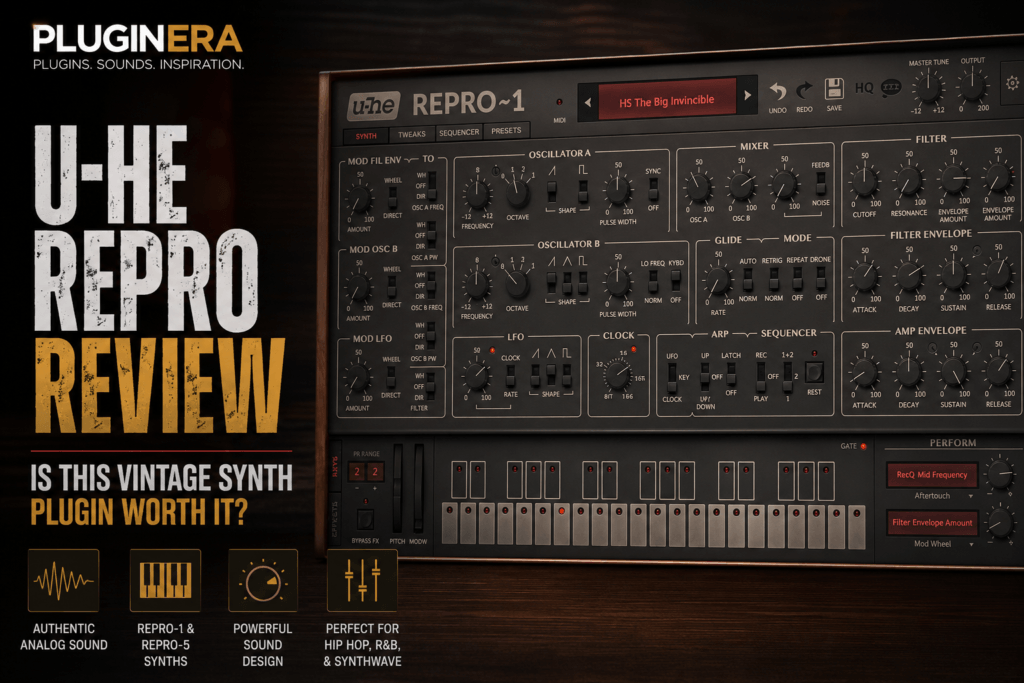
 If you love the warmth, character, and imperfections of classic analog synthesizers but don’t want to spend thousands of dollars on vintage hardware, u-he Repro is a plugin that deserves serious attention.
Repro takes inspiration from two legendary Sequential synthesizers and turns them into a software package designed to capture the sound and behavior of vintage analog gear. Instead of simply giving you another virtual analog synth with a retro-looking interface, u-he has focused heavily on recreating the individual components and character that made the original instruments special.
The result is a pair of synthesizers that can handle everything from warm R&B chords and cinematic pads to aggressive basses, leads, arpeggios, and vintage hip-hop textures.
But with so many analog-style plugins available today, is Repro still worth buying?
In this u-he Repro review, we’ll look at what you get, how Repro-1 and Repro-5 differ, how they sound, where they fit into modern music production, and whether Repro deserves a place in your plugin collection.
What Is u-he Repro?
u-he Repro is a software synthesizer package containing two separate instruments:
- Repro-1
- Repro-5
The two synths are based around different approaches to classic analog synthesis.
Repro-1 is a monophonic synthesizer designed for basses, leads, sequences, and other single-note sounds.
Repro-5 expands the concept into an 8-voice polyphonic synthesizer, making it much better suited to chords, pads, keys, and larger harmonic sounds.
Together, they give producers two distinct approaches to vintage analog synthesis inside one package.
That makes Repro more versatile than it might initially appear.
You aren’t simply getting two slightly different skins for the same synth. Repro-1 and Repro-5 encourage different styles of sound design and can play completely different roles inside a production.
Repro-1: Analog Bass, Leads, and Sequences
Repro-1 is where things get particularly interesting for producers who make hip hop, trap, electronic music, synthwave, or experimental R&B.
Because it’s monophonic, Repro-1 naturally excels at sounds such as:
- Analog bass
- Synth bass
- Leads
- Arpeggios
- Sequences
- Plucks
- Effects
- Experimental textures
Its architecture encourages you to create sounds that move.
One of the standout features is its sequencer, which can be used to create rhythmic melodic patterns without relying entirely on your DAW’s piano roll.
You can create a simple sequence, automate parameters, run it through Repro’s effects, and quickly turn a basic patch into something that feels like a sample pulled from an old record.
For hip hop production, that’s extremely useful.
Instead of searching through sample libraries for something with vintage character, you can build your own analog-inspired phrases and then resample them.
Repro-5: The Star for Chords and Pads
While Repro-1 is excellent, Repro-5 may be the bigger attraction for R&B and hip hop producers.
Its polyphonic architecture means you can actually play full chords.
And that’s where Repro begins to shine.
Load a warm Repro-5 patch and start playing minor 7th, major 7th, 9th, or suspended chords, and it can immediately produce the type of rich harmonic foundation that works beautifully in R&B.
Repro-5 is particularly good for:
- R&B chords
- Neo-soul progressions
- Vintage keys
- Analog pads
- Synthwave chords
- Pop synths
- Ambient textures
- Hip hop samples
- Cinematic layers
There’s a thickness to the sound that can make relatively simple chord progressions feel much more expensive.
You don’t necessarily need complicated sound design either.
Sometimes a basic analog patch with the filter rolled back, a little modulation, and some effects is enough to create an excellent foundation for a beat.
How Does u-he Repro Sound?
This is ultimately the most important part of any synthesizer review.
And Repro sounds excellent.
The plugin has the warmth and density you’d expect from a synth designed specifically around recreating vintage analog behavior.
Oscillators feel substantial.
Filters have character.
Bass sounds can feel heavy without needing huge processing chains.
Pads can sound warm and slightly unstable rather than perfectly digital.
And leads can cut through a mix without immediately becoming harsh.
That’s important because many software synthesizers can technically create similar sounds.
The difference is often how quickly you arrive at something inspiring.
With Repro, relatively simple patches can already have character.
The Filter Is a Major Part of the Sound
One of my favorite things about analog-style synthesizers is using the filter almost like an instrument itself.
Repro works extremely well for this.
Take a bright patch and gradually close the filter.
Suddenly the sound becomes darker and warmer.
Add some resonance and you can emphasize specific frequencies.
Introduce envelope modulation and the filter begins moving with every note.
For modern hip hop and R&B, this makes Repro particularly useful.
You can take a bright analog chord patch and filter it until it becomes a dark, moody texture sitting underneath the drums.
That can instantly create space for vocals.
Effects and Sound Shaping
Repro isn’t limited to recreating the basic architecture of vintage hardware.
u-he also provides additional processing options that allow you to push the sounds into more modern territory.
Depending on which Repro instrument you’re using, you can access effects and processing that help add:
- Saturation
- Distortion
- Modulation
- Delay
- Reverb
- Movement
- Width
- Texture
This is important because raw analog-style patches aren’t always enough for modern production.
A simple synth chord can sound good.
But add saturation, modulation, delay, and reverb and suddenly it can become the centerpiece of an entire track.
Using u-he Repro for Hip Hop
Repro is surprisingly good for hip hop.
One of the easiest techniques is to stop thinking about it as a synthesizer and start thinking about it as a sample generator.
Create a four- or eight-bar musical idea using Repro-5.
For example:
Cm9 → Abmaj7 → Fm9 → G7
Choose a warm analog patch.
Record the progression.
Add some modulation and effects.
Bounce it to audio.
Then start manipulating it.
You could:
- Pitch it down
- Reverse sections
- Chop it
- Filter it
- Add vinyl texture
- Time-stretch it
- Resample it
- Run it through additional saturation
Now you have something that feels much closer to a sampled record than a MIDI synth performance.
Put drums underneath it and you have the foundation of a completely original hip hop beat.
Using Repro for R&B and Trap Soul
This might be one of Repro’s strongest applications.
Modern R&B often benefits from sounds that are warm without being overly bright.
Repro-5 fits that role extremely well.
Try starting with a dark pad or poly synth.
Play something like:
F#m9 → Dmaj7 → Amaj9 → Eadd9
Then reduce the filter cutoff.
Slow the attack slightly.
Increase the release.
Add a little modulation.
Add reverb.
Now you have a lush harmonic bed that could work underneath an R&B vocal.
You can then use Repro-1 to create a complementary bass or lead.
This is where having both instruments becomes particularly useful.
Repro-5 handles the harmony.
Repro-1 handles the melodic or bass element.
Using Repro for Synthwave and ’80s-Inspired Production
If you’re interested in ’80s R&B, synthwave, retro pop, or vintage electronic production, Repro should feel right at home.
Repro-5 can produce the big polyphonic sounds associated with classic analog synthesizers.
Think:
- Warm pads
- Brass-like synths
- Poly synth chords
- Analog strings
- Pulsing sequences
- Retro leads
Add chorus, delay, and reverb and you can quickly create convincing retro textures.
But you don’t have to make pure synthwave.
Those same sounds can be incorporated into modern R&B or hip hop productions.
That’s often where Repro becomes even more interesting.
Presets
Not everyone wants to design patches from scratch.
Fortunately, Repro includes a substantial preset library that makes it possible to start producing immediately.
Presets can also serve as useful starting points.
Instead of loading a preset and leaving it untouched, try adjusting:
- Filter cutoff
- Envelope amount
- Attack
- Release
- Oscillator tuning
- Modulation
- Effects
A few small adjustments can make a preset feel much more appropriate for your track.
For newer producers, this is also an excellent way to learn synthesis.
Load a sound you like and start changing parameters.
Listen to what happens.
Over time, you’ll begin understanding how the different sections of the synthesizer interact.
Repro-1 vs. Repro-5
Although both synths belong to the same package, I wouldn’t think of this as choosing one over the other.
They complement each other.
Choose Repro-1 when you need:
- Bass
- Leads
- Sequences
- Arpeggios
- Monophonic synth sounds
- Experimental analog textures
Choose Repro-5 when you need:
- Chords
- Pads
- Keys
- Poly synths
- Vintage harmonic textures
- R&B progressions
In many productions, you could easily use both.
For example:
Repro-5: chords
Repro-1: bass
Repro-1: lead
Repro-5: background pad
That gives you an entire synth-based production palette from one plugin package.
CPU Usage
There is one important consideration.
Detailed analog modeling can require more processing power than simpler virtual analog synthesizers.
Depending on your computer, patch complexity, and project size, running large numbers of Repro instances may consume noticeable CPU resources.
Fortunately, modern DAWs make this relatively easy to manage.
You can always freeze tracks, bounce synth parts to audio, or resample your Repro performances once you’re happy with them.
And for beatmaking, bouncing to audio can actually improve your workflow.
Once the synth becomes audio, you’re more likely to start chopping and manipulating it creatively rather than endlessly tweaking the preset.
Repro vs. u-he Diva
If you’re already familiar with u-he, you might wonder whether you need Repro if you own Diva.
There is definitely some overlap.
Both plugins are capable of producing excellent analog-style sounds.
However, they approach the concept differently.
Diva is more like a flexible collection of analog-inspired components that allows you to combine different oscillator, filter, and envelope designs.
Repro is more focused.
It gives you a specific vintage-inspired architecture and encourages you to work within that environment.
Diva is arguably the better choice when you want maximum analog-synth versatility.
Repro is appealing when you want the character and workflow of these particular vintage-inspired instruments.
For serious synth enthusiasts, owning both isn’t unreasonable.
What I Like About u-he Repro
The biggest strength of Repro is its sound.
It doesn’t take much work to create something that feels rich and musical.
I also like that Repro-1 and Repro-5 have clearly defined roles.
Repro-1 gives you the aggressive monophonic side of analog synthesis.
Repro-5 gives you the lush polyphonic side.
Other highlights include:
- Excellent analog character
- Strong bass sounds
- Beautiful pads
- Great vintage chords
- Powerful sequencing possibilities
- Useful built-in effects
- Excellent sound-design potential
- Great for resampling
- Strong fit for hip hop and R&B
It’s the kind of synth package that rewards experimentation.
What Could Be Better?
No plugin is perfect.
The biggest potential downside is that Repro isn’t trying to be an enormous modern workstation synthesizer.
If you want thousands of glossy presets covering every modern genre imaginable, something like Nexus may provide a faster preset-browsing workflow.
If you want extremely deep wavetable synthesis, Serum or another dedicated wavetable synth may make more sense.
And if you want one synth capable of imitating a wide variety of analog architectures, Diva may be more flexible.
Repro is intentionally more focused.
That’s also part of its appeal.
Who Should Buy u-he Repro?
I would recommend Repro to producers who make:
- Hip hop
- R&B
- Trap Soul
- Neo-soul
- Synthwave
- Pop
- Electronic music
- Cinematic music
It’s particularly attractive if you enjoy vintage synthesizer sounds but don’t want to own or maintain vintage hardware.
Producers who enjoy creating their own samples should also get a lot of mileage from it.
Repro makes it incredibly easy to create something musical, bounce it to audio, and transform it into an entirely different sound.
Is u-he Repro Worth It in 2026?
Yes — particularly if analog character is an important part of your sound.
There are newer synthesizers with larger feature lists.
There are synths with more presets.
There are instruments with deeper modulation systems.
But that’s not really the point of Repro.
Repro is about character.
Repro-1 gives you an excellent tool for basses, sequences, leads, and analog experimentation.
Repro-5 gives you the polyphonic side of the equation, making it particularly useful for lush chords, pads, keys, and vintage textures.
Put them together and you have a surprisingly complete analog production toolkit.
For hip hop and R&B producers, I’d especially recommend experimenting with Repro as a source for original samples rather than simply treating it as another preset synth.
Build a progression.
Add movement.
Bounce it.
Chop it.
Pitch it.
Resample it.
That’s where Repro can become much more than a vintage synth emulation.
Pluginera Verdict
Sound Quality: 9.5/10
Ease of Use: 8.5/10
Presets: 9/10
Sound Design: 9/10
Hip Hop & R&B Usefulness: 9.5/10
Value: 9/10
Overall: 9.2/10
u-he Repro remains an excellent choice for producers looking for authentic analog character inside their DAW. Its combination of Repro-1 and Repro-5 gives you both monophonic and polyphonic synthesis, making the package useful for everything from deep bass and leads to lush R&B chords and cinematic pads.
If your productions could use more warmth, movement, and vintage character, Repro is absolutely worth considering.