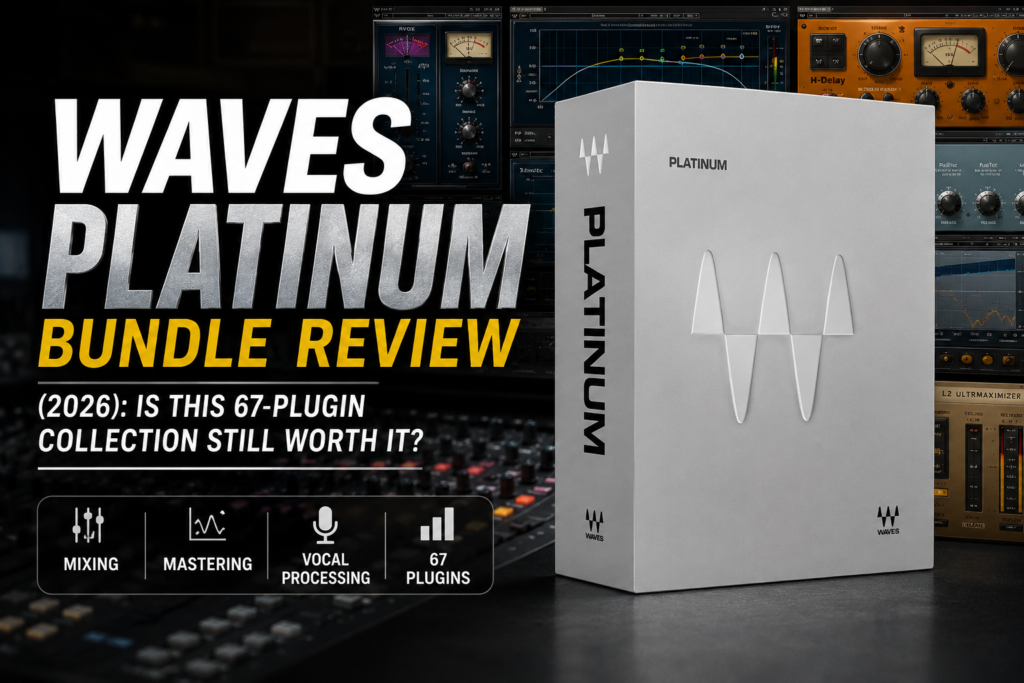
 Waves Platinum Bundle Review: Is This 67-Plugin Collection Still Worth It?
Building a serious collection of mixing and mastering plugins can get expensive quickly. You need EQs, compressors, reverbs, delays, vocal processors, stereo tools, mastering limiters, analyzers, saturation, and plenty of other utilities.
The Waves Platinum Bundle attempts to solve that problem by putting 67 plugins into one collection designed to handle everything from everyday mixing to final mastering.
Platinum includes everything found in Waves Gold plus 22 additional plugins, expanding the collection with the complete Renaissance series, mastering processors, analog-modeled EQs, low-end tools, transient shaping, and more.
But Waves has been making plugins for decades, and there are now countless newer alternatives available.
So the big question is:
Is the Waves Platinum Bundle still worth buying in 2026?
For producers and engineers looking for a large collection of proven mixing tools without purchasing dozens of plugins individually, the answer can still be yes.
Let’s take a closer look.
What Is the Waves Platinum Bundle?
The Waves Platinum Bundle is a collection of plugins covering most of the major processing tasks you’ll encounter while producing, mixing, and mastering music.
You get tools for:
- EQ
- Compression
- Reverb
- Delay
- Vocal processing
- Pitch correction
- Stereo imaging
- Bass enhancement
- Transient shaping
- Multiband processing
- Mastering
- Metering and analysis
Platinum currently contains 67 plugins, consisting of all the plugins included with Waves Gold plus another 22 processors.
That makes Platinum particularly interesting if you’re trying to establish a complete mixing toolkit rather than purchase specialized plugins one at a time.
Check the Waves Platinum Bundle at Plugin Boutique
What’s Included in Waves Platinum?
Trying to cover every plugin individually would make this review enormous.
Instead, let’s focus on some of the plugins that make the bundle particularly useful.
Renaissance Vox
Renaissance Vox, commonly known as R-Vox, is one of the standout processors in the collection.
It’s a streamlined vocal dynamics processor that makes controlling vocal levels extremely straightforward.
Rather than presenting you with dozens of parameters, R-Vox gives you a relatively simple way to tighten vocal dynamics and help a performance sit more consistently in a mix.
For Hip Hop and R&B producers working with vocals regularly, this alone could become one of the most frequently used plugins from the bundle.
The Complete Renaissance Series
Platinum includes the entire classic Waves Renaissance series.
That gives you processors including:
Renaissance Compressor
A versatile compressor that can work on vocals, bass, instruments, drums, and buses.
Renaissance EQ
A straightforward parametric EQ that remains useful when you simply need to shape a sound without a complicated interface.
Renaissance Bass
Designed to enhance the perceived low-frequency content of bass-heavy material.
Renaissance DeEsser
Useful for reducing harsh sibilance in vocal recordings.
Renaissance Reverb
A flexible reverb for creating space around vocals and instruments.
Renaissance Channel
Combines multiple processing functions into a channel-style workflow.
Collectively, these plugins give you a strong foundation for mixing entire songs.
H-Delay
H-Delay is another highlight.
Delay is especially important in Hip Hop, R&B, Trap Soul, Pop, and electronic production because it can create depth without washing a sound in reverb.
H-Delay can work well on:
- Lead vocals
- Vocal ad-libs
- Synths
- Electric pianos
- Guitars
- Percussion
- Sound effects
You can use subtle delays to add dimension or create more obvious rhythmic echoes as part of the production.
For vocal-heavy music in particular, H-Delay is one of the plugins in Platinum that could quickly find its way into your regular workflow.
H-Comp Hybrid Compressor
Platinum also includes H-Comp, Waves’ hybrid compressor.
Compression isn’t only about controlling volume. It can also influence groove, punch, sustain, and the overall character of a sound.
H-Comp gives you another compression flavor alongside processors like Renaissance Compressor and the V-Series compressors.
That means you aren’t locked into one compressor for every situation.
You can experiment with different processors on vocals, drums, bass, instruments, and buses and choose whichever works best for the source.
PuigTec EQs
If you’re looking for something with more character than a conventional digital EQ, Platinum includes the PuigTec EQs.
These are Waves’ analog-modeled processors inspired by vintage Pultec-style equalizers. Waves specifically lists the PuigTec EQs among Platinum’s analog-modeling tools.
They’re useful when you want to shape tone while adding a more vintage-style workflow.
They can be particularly interesting for:
- Vocals
- Bass
- Kick drums
- Synths
- Keys
- Mix buses
Instead of always reaching for surgical EQ, you can use PuigTec when the goal is broader tonal shaping.
C4 Multiband Compressor
C4 gives you four-band dynamics processing.
Instead of compressing the entire frequency spectrum simultaneously, multiband compression lets you control different frequency ranges independently.
For example, you might use it to control excessive low-end energy without significantly affecting the mids and highs.
That can make C4 useful for mastering, vocals, bass-heavy instruments, drum buses, and problematic recordings.
Multiband compression does require some experience, however.
Beginners should avoid using it simply because it’s available. Get comfortable with normal EQ and compression first, then introduce multiband processing when you encounter a problem that actually requires it.
MaxxBass, Renaissance Bass, Submarine and LoAir
Hip Hop and R&B producers should pay particular attention to Platinum’s collection of low-frequency processors.
Waves includes tools such as MaxxBass, Renaissance Bass, Submarine, and LoAir, giving you several approaches to manipulating low-frequency content.
That’s useful when you’re working with:
- 808s
- Synth bass
- Kick drums
- Samples
- Bass guitars
- Sub-heavy sound design
The important thing is not to throw every bass processor onto your 808.
Think of these as different tools for different situations.
One track may need better perceived bass response. Another may need deeper subharmonic content. Another may not need additional bass processing at all.
Having several options gives you flexibility.
Smack Attack
Drum transients play a major role in how energetic a beat feels.
Smack Attack is Waves’ transient-shaping processor and is another of the notable additions included in Platinum.
You can use transient shaping to alter the attack and sustain characteristics of sounds.
For example, you could make a kick feel punchier, give a snare more attack, tighten percussion, or reduce an overly aggressive transient.
For beatmakers, this can be extremely useful.
S1 Stereo Imager
Stereo width is another important part of modern production.
S1 Stereo Imager gives you tools for manipulating the stereo image of a sound.
It can be useful for widening elements such as:
- Pads
- Background vocals
- Synths
- Keys
- Percussion
- Effects
The key is restraint.
Making everything extremely wide usually results in a weaker mix rather than a bigger one. Your kick, bass, lead vocal, and other important elements often need a strong center image.
Use stereo tools to create contrast between the center and sides.
Vitamin Sonic Enhancer
Vitamin is a multiband sonic enhancement processor.
It’s designed for situations where you want to add presence, clarity, width, or energy to different frequency areas.
It can be used on individual tracks, buses, or even the overall mix when applied carefully.
This is another plugin where subtle processing usually wins.
A small amount of enhancement can make something feel more polished. Too much can quickly make a mix sound harsh or exaggerated.
L2 and L3 Mastering Limiters
One of the major differences between Waves Gold and Platinum is the additional emphasis on mastering.
Platinum includes Waves’ classic L2 and L3 limiter/maximizer tools, along with linear-phase processing designed for mastering applications.
The L2 in particular has been used for years as a straightforward way to increase loudness while controlling peaks.
That doesn’t mean mastering should simply consist of inserting L2 and pushing the threshold down.
But when used appropriately, these tools give producers a way to control peaks and establish final output level without immediately needing another mastering suite.
Waves Tune LT
Platinum even includes Waves Tune LT, giving you basic pitch-correction functionality as part of the bundle.
That makes the package more useful for producers who record artists as well as make beats.
It’s not necessarily the reason I’d purchase Platinum, but it’s another useful tool already included in the collection.
Mixing Hip Hop & R&B with Waves Platinum
One reason I think Platinum remains interesting is how easily you could build complete mixing chains using nothing but this bundle.
Imagine you’re mixing an R&B record.
Your lead vocal might start with:
Renaissance EQ → Renaissance Vox → Renaissance DeEsser → H-Delay
You could then send the vocal to reverb and delay effects to create depth.
For drums, you could use EQ and compression for tone and dynamics, then use Smack Attack when additional transient control is needed.
For the bass and 808, you could choose between Renaissance Bass, MaxxBass, Submarine, or LoAir depending on what the track needs.
Synths, pads, and background elements could be shaped with EQ and then positioned with S1.
Finally, the mix bus or mastering stage could incorporate Waves’ linear-phase processors and an L2 or L3 limiter.
That’s essentially an entire mixing environment contained within one bundle.
Is Waves Platinum Good for Beginners?
Yes, but there’s one potential downside:
You get a lot of plugins.
Having 67 processors available can create choice paralysis.
If you’re new to mixing, don’t try to learn everything immediately.
Start with a small group:
Renaissance EQ for EQ.
Renaissance Compressor for compression.
Renaissance Vox for vocal control.
Renaissance DeEsser for sibilance.
H-Delay for delay.
Renaissance Reverb or TrueVerb for reverb.
S1 for stereo imaging.
L2 for limiting.
Learn those first.
Once you understand what those processors are doing, gradually explore the rest of the collection.
That approach will teach you far more than randomly cycling through dozens of plugins.
What I Like About Waves Platinum
The biggest advantage is coverage.
Instead of buying one compressor here, another EQ there, a limiter somewhere else, and several additional effects, you’re getting a collection capable of handling most traditional mixing tasks.
There’s also considerable variety.
You don’t simply get one EQ and one compressor. You get different styles of processors that can be used for different situations.
Platinum also bridges the gap between mixing and mastering particularly well.
Waves Gold already provides a large mixing toolkit, while Platinum adds more advanced mastering and Renaissance-series processors. Waves currently describes Platinum as Gold plus 22 additional plugins.
What Could Be Better?
The biggest criticism is that some of these plugins have been around for a long time.
If you prioritize extremely modern interfaces, advanced visual feedback, or the newest intelligent processing features, some Waves plugins may feel dated compared with newer alternatives.
There’s also significant overlap.
Having multiple EQs and compressors is useful once you understand why you might choose one over another, but beginners may initially find the collection overwhelming.
And prospective buyers should familiarize themselves with Waves’ licensing, version-update, and upgrade policies before purchasing rather than assuming they work exactly like another plugin company’s system.
Waves Platinum vs Waves Gold
This is an important comparison.
Waves currently lists Gold with 45 plugins and Platinum with 67 plugins.
Platinum includes everything in Gold and adds 22 plugins.
The additional tools push the bundle further into mastering and provide the complete Renaissance collection along with other processors.
If you’re primarily interested in getting a large collection of general mixing plugins, Gold may be enough.
If you also want more serious mastering tools, the Renaissance plugins, additional analog-style processing, and a more comprehensive collection overall, Platinum is the more complete package.
Waves Platinum vs Larger Waves Bundles
Platinum isn’t the largest Waves bundle.
For example, Waves currently positions Diamond above Platinum with 86 plugins, while Horizon contains 93 plugins and includes all 67 Platinum plugins plus additional processors.
That doesn’t automatically make the larger bundles better purchases.
The real question is whether you’ll actually use the additional plugins.
For many home-studio producers and independent engineers, Platinum already covers a huge portion of the processing needed for everyday production, mixing, and mastering.
Who Should Buy Waves Platinum?
Waves Platinum makes the most sense for:
Beginning mixing engineers
You can establish a large processing toolkit without researching and purchasing every category separately.
Home studio producers
If you’re making beats, recording vocals, mixing songs, and creating rough masters yourself, Platinum covers an enormous amount of ground.
Hip Hop and R&B producers
The combination of vocal processing, bass enhancement, delays, compressors, transient shaping, stereo processing, and mastering tools makes the bundle particularly useful for these genres.
Producers building their first serious plugin collection
Instead of collecting random plugins without a plan, Platinum gives you tools covering most fundamental mixing categories.
Who Should Skip It?
Platinum might not make as much sense if you already own a comprehensive collection of third-party EQs, compressors, reverbs, delays, mastering processors, and vocal tools.
You may end up with considerable duplication.
Likewise, if you only need one or two specialized processors, purchasing an entire 67-plugin bundle probably isn’t necessary.
The value comes from actually needing the breadth of the collection.
Is Waves Platinum Worth It in 2026?
Yes—for the right producer.
Waves Platinum’s biggest strength isn’t that every plugin is the newest processor on the market.
It’s that you get an unusually broad collection of established tools capable of handling virtually every stage of a conventional mixing workflow.
You’ve got EQ.
Compression.
Vocal processing.
Reverb.
Delay.
Bass enhancement.
Stereo imaging.
Transient shaping.
Multiband processing.
Analysis.
And mastering.
That makes Platinum less like purchasing a single plugin and more like establishing an entire mixing toolbox.
For Hip Hop and R&B producers especially, plugins such as Renaissance Vox, H-Delay, Renaissance Bass, MaxxBass, PuigTec EQs, Smack Attack, S1, and L2 give you plenty of practical options for mixing beats and vocals.
The biggest mistake would be thinking you need to use all 67 plugins.
You don’t.
Learn a small core collection, understand what each processor solves, and expand your toolkit as your mixing skills develop.
If you’re looking to build a comprehensive Waves mixing and mastering collection in one purchase, Waves Platinum remains a compelling option in 2026.
Check the latest Waves Platinum price and availability at Plugin Boutique.
Waves Platinum Bundle Review: Final Verdict
Overall: 9/10
Best for: Producers, beatmakers, home studios, and mixing engineers who want a large all-in-one mixing and mastering collection.
Major strengths: Huge plugin selection, excellent vocal tools, strong low-end processing, multiple mixing options, and capable mastering processors.
Main drawbacks: Some interfaces and workflows feel older than newer competitors, there’s significant overlap between processors, and 67 plugins can initially overwhelm beginners.
Bottom line: Waves Platinum isn’t about chasing the newest plugin technology. It’s about getting a deep collection of proven mixing tools in one package. If you want to build a serious plugin arsenal capable of taking Hip Hop, R&B, Pop, and other productions from rough tracks through the final master, Platinum offers a lot of room to grow.